The quiet autumn air of our suburban neighborhood was broken by the rustle of paper cups and the hum of strangers browsing through my life.
The quiet autumn air of our suburban neighborhood was broken by the rustle of paper cups and the hum of strangers browsing through my life. I stood at the edge of my own driveway, my hands cold inside my coat pockets, looking at folding tables stretched across the grass. Cardboard boxes littered the lawn. Little white price tags dangled from lamp cords, picture frames, and hand-carved serving bowls that my late husband, Daniel, and I had spent thirty years collecting.
Near the mailbox stood a freshly painted wooden sign: ESTATE SALE — CALDER RESIDENCE.
I had been gone for three days, staying in town to help my friend Linda recover from knee surgery. My thirty-two-year-old son, Tyler, and his wife, Melissa, had been living with me for six months under the premise of “getting back on their feet.” I had welcomed them into my home without hesitation.
Now, my driveway was a marketplace for my memories.
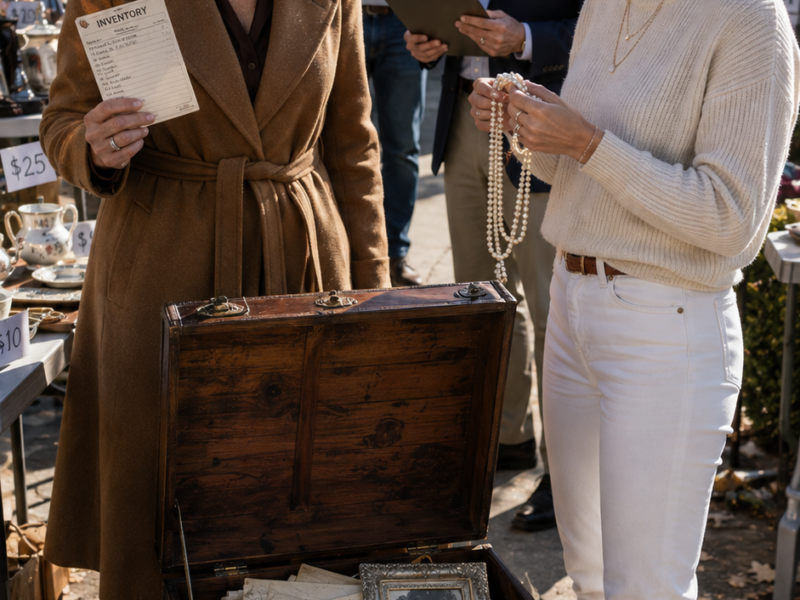
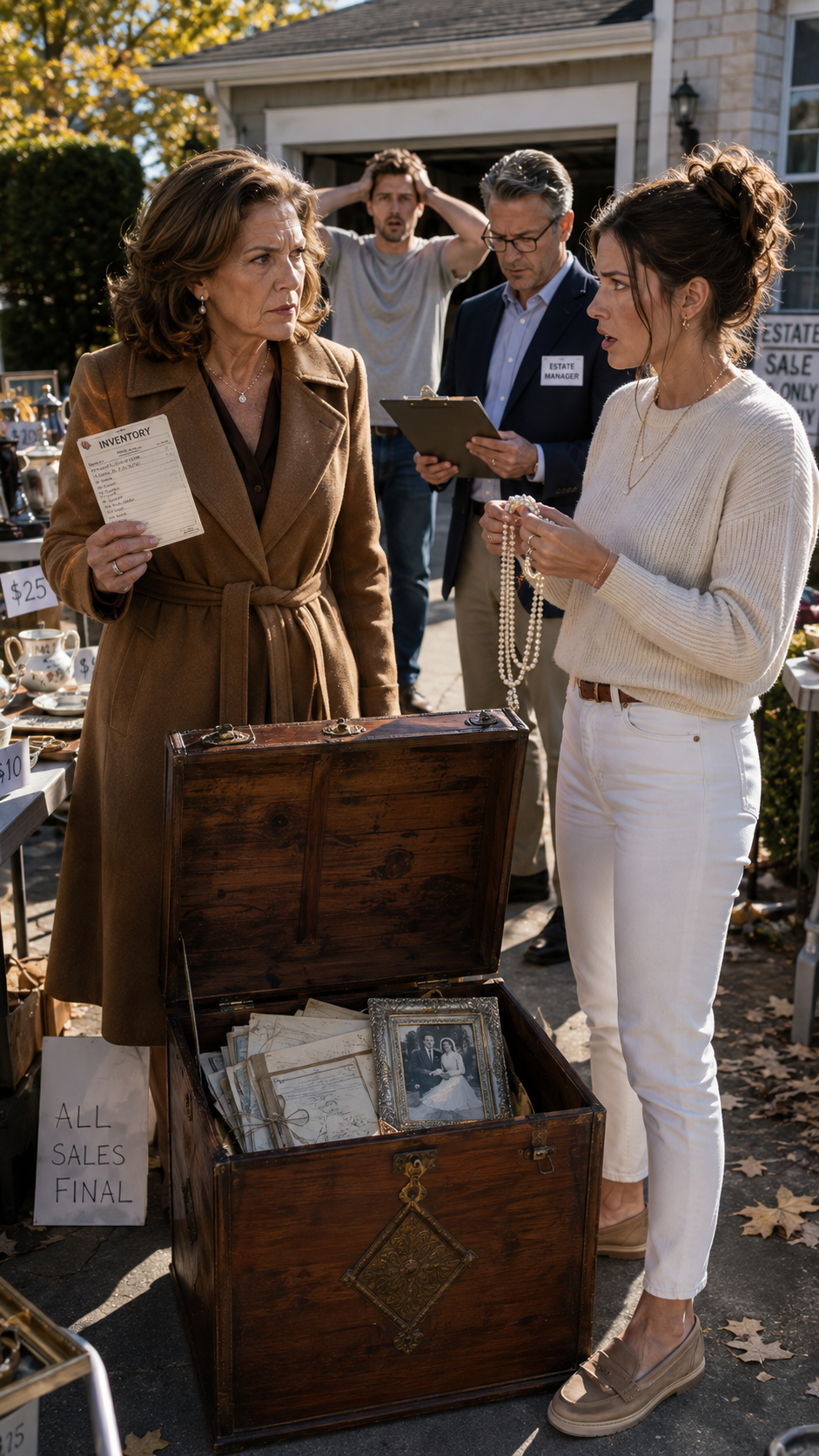
In the center of the pavement sat my cedar wedding chest, its heavy lid propped open. Daniel had sanded, stained, and sealed that chest himself the month before our wedding. It still carried that deep, earthy scent of cedar that used to fill our bedroom every winter. Inside lay the few things I cherished most: my wedding veil, Daniel’s handwritten letters, our silver-framed wedding photograph, and my mother’s pearl necklace—a gift she gave me a week before cancer took her life.
A woman I had never seen before was turning those pearls between her fingers.
“Excuse me,” I said, my voice quiet but sharp enough to slice through the morning chatter. “Those belong to me.”
The buyer looked up, startled. “Oh. I’m sorry. Your daughter-in-law told us everything on this table was part of the estate liquidation.”
Before I could reach for the necklace, Melissa stepped out from the open garage. She wore white designer jeans, a soft cashmere sweater, and a practiced, gentle smile—the kind she reserved for neighbors when she wanted to appear long-suffering.
“Ruth,” Melissa said, her tone dripping with patronizing sweetness, as if speaking to a lost child. “You’re home early.”
“I live here, Melissa,” I replied flatly.
Her smile flickered for a fraction of a second before recovering. “Of course you do, dear. But there’s so much activity out here. Why don’t you go inside, lie down, and let us handle this?”
“Handle what?” I asked, stepping closer to the cedar chest. “Why is my mother’s necklace priced at twenty dollars? Why is my wedding photo lying in a cardboard box while its frame is tagged for sale?”
Melissa glanced at two neighbors standing nearby, lowering her voice into a soft, sympathetic whisper. “Ruth, we discussed this. We told everyone you were transitioning. Making the house safer. Clearing out the clutter so you don’t have so much to worry about.”
“I agreed to no such thing.”
A man in a tan vest carrying a official clipboard stepped over from a box near the garage. He looked between Melissa, the pearls, and me. “Is there a problem here?”
“No,” Melissa said quickly.
“Yes,” I answered.
I reached into my handbag and pulled out a folded manila envelope. For months, ever since small heirlooms had begun vanishing from my dresser drawers, I had quietly documented everything—serial numbers, appraisals, photographs, and property deeds. I placed an inventory card on the table beside the pearls, showing a high-resolution photo of the exact necklace, down to its custom-repaired clasp.
“My mother’s,” I stated firmly. “Not estate property. Mine.”
The estate sale manager, a stern man named Mr. Henderson, looked at the card, then at the pearls, and finally at his clipboard. His professional demeanor instantly shifted.
“Mrs. Calder,” Mr. Henderson asked slowly, “did you authorize a full household liquidation?”
“No,” I said.
“Did you inform your family that you were permanently vacating this residence?”
“No.”
Melissa stepped in front of him, her smile finally dropping into an ugly, furious sneer. “This is a private family matter, sir! My husband and I are managing her care!”
Mr. Henderson held his clipboard away from her, scanning a signature page at the back of his file. He looked straight at Melissa and asked the question that made the entire driveway fall dead silent:
“Who signed this authorization form claiming Ruth Calder is legally incapacitated and no longer permitted to manage her own property?”
From the darkness of the garage, my son Tyler walked out, holding a thick folder. His face was flushed, his jaw tight with defensive rage.
“I signed it,” Tyler declared, stepping up beside his wife. “I have Power of Attorney, Mom. You’re getting old, you’re confused, and this house is too big for you. We’re liquidating the contents to pay for your assisted living facility down in Westlake. Now stop making a scene and go inside!”
He reached out, grabbing my wrist to force me toward the front door, while Melissa signaled two movers to pick up my cedar wedding chest.
I stood my ground, my wrist locked in my son’s grip, feeling the cold sting of his betrayal.
“Let go of my wrist, Tyler,” I said.
My voice was not loud, but it possessed a cold, vibrating authority that made my son’s fingers loosen. He took a step back, wiping sweat from his forehead, looking around at the gathered neighbors who were now staring in open shock.
“Mom, don’t do this,” Tyler muttered, his voice cracking with panicked desperation. “We did this for your own good! You can’t live here alone anymore! The paperwork is signed!”
“Show the manager the paperwork, Tyler,” I commanded.
Melissa snatched the folder from Tyler’s hands and thrust a stapled document into Mr. Henderson’s chest. “Here! It’s an Durable Financial Power of Attorney and Medical Guardianship, signed three weeks ago! My husband is her legal guardian! We have the right to sell these items!”
Mr. Henderson adjusted his glasses, scanning the notary stamp on the final page. “It appears to be a certified guardianship declaration, Mrs. Calder…”
“Look at the date of the notary, Mr. Henderson,” I instructed, stepping past Melissa to point at the page. “September 14th. On September 14th, I was in Johns Hopkins Hospital in Baltimore, attending a four-day architectural preservation conference. My flight tickets, hotel receipts, and conference badge are all attached to the affidavit in my purse.”
Melissa’s face turned the color of chalk. Tyler stumbled backward, his eyes widening in pure horror.
“A forged notary on a power of attorney is a Class 3 felony in the State of Illinois,” I continued, my tone completely devoid of fear or confusion.
I reached back into my handbag and pulled out a second, thick legal document bound in heavy blue cardstock, stamped with the official gold seal of the County Clerk’s Office.
“Tyler,” I said softly, looking at my son. “You thought your mother was just a quiet widow who spent her days gardening and baking pies. You forgot that before I retired, I spent thirty-four years as the Senior Chief Registrar for the Cook County Probate and Title Court.”
The silence on the driveway was suffocating. The estate sale buyers stopped picking through boxes; the neighbors stood frozen on the lawn.
“When you and Melissa moved into my home six months ago ‘to get back on your feet,’ I noticed my mail being redirected,” I revealed, holding up the blue document. “I noticed my bank statements disappearing. I knew exactly what you were planning. You didn’t want to help me. You wanted to declare me incompetent, sell my home out from under me, and pocket the proceeds of my estate.”
“Mom… please…” Tyler whimpered, dropping his hands to his sides, his arrogant posture completely collapsing.
“Two weeks ago,” I continued, turning the page of the blue document, “I met with the Chief Presiding Judge of the Probate Division—a woman I worked alongside for two decades. I didn’t just register a Judicial Affidavit of Absolute Competency; I transferred this entire property, the land, and every listed historical heirloom into the Ruth Calder Irrevocable Preservation Trust.”
Melissa gasped, her hands flying to her mouth. “An… an irrevocable trust?!”
“I am not the owner of this property, Melissa,” I declared, my voice ringing across the neighborhood with undeniable power. “The Trust is the owner. I am the Sole Executive Managing Trustee. Under Section 12 of the trust charter, any attempted unauthorized sale, theft, or liquidation of trust assets by non-trustees triggers an immediate, automatic eviction of all temporary residents and an instant criminal referral for elder financial fraud.”
Mr. Henderson closed his clipboard with a heavy, decisive SNAP.
He turned toward his two assistants standing near the garage. “Cancel the sale. Right now. Pack up our tables and put every single item back into the house exactly where you found it. We are shutting this down.”
“You can’t cancel!” Melissa shrieked, her sweet facade completely shattered into ugly, hysterical rage. “We hired you! We paid a deposit!”
“You handed me forged guardianship documents, lady!” Mr. Henderson barked back, pointing a stern finger in her face. “You committed fraud on my company! If Mrs. Calder doesn’t press charges against us, you’re lucky I don’t call the police myself!”
Buyers immediately began dropping items back into boxes, whispering in disgust as they hurried down the driveway toward their cars. The two neighbors who had been sipping coffee set their paper cups on a folding table and walked away without looking at Melissa.
I walked over to the table, picked up my mother’s pearl necklace, and wrapped it gently around my wrist. Then, I stepped over to my cedar wedding chest. I picked up Daniel’s silver-framed wedding photo from the cardboard box, wiped a speck of dust from the glass, and placed it safely inside the chest beside his letters.
“Tyler,” I said, turning to my son, who was weeping silently on the pavement.
“Mom… I’m sorry,” Tyler sobbed, taking a step toward me. “Melissa said it was the only way… she said we needed the money for our business investment… please, Mom, don’t throw us out!”
“I am not throwing you out, Tyler,” I said softly.
He looked up, a faint flicker of hope crossing his tear-stained face.
“The Sheriff’s Department is throwing you out,” I corrected him, pulling my phone from my pocket.
At that exact moment, two marked County Sheriff cruisers pulled up to the curb, their emergency lights flashing quietly against the autumn leaves. Two deputies stepped out, holding a manila folder containing the emergency Trespass and Possession Enforcement Warrant I had filed with the court three days ago.
The lead deputy, an officer I had known for years, walked up the driveway and nodded respectfully. “Good morning, Mrs. Calder. Is everything in order?”
“The illegal liquidation has been halted, Deputy,” I replied calmly. “These two individuals have breached their temporary residency agreement and committed felony forgery against the estate.”
The deputy turned to Tyler and Melissa. “Tyler Calder and Melissa Calder. You have thirty minutes to gather your personal clothing and step off this property. Any attempt to remove furniture, jewelry, or household items will result in immediate arrest for grand larceny.”
“Thirty minutes?!” Melissa screamed, her voice cracking as she looked at her packed designer luggage sitting near the front door. “Where are we supposed to go?! We sold our apartment lease! We have no money!”
“I hear there are lovely temporary rentals on the other side of town,” I said, my tone completely devoid of anger, carrying only the absolute finality of justice served. “You can use the twenty dollars you priced my mother’s pearls for to buy breakfast.”
Tyler collapsed onto his knees in the driveway, burying his face in his hands, weeping in complete, humiliating defeat as the deputies escorted Melissa toward the house to gather their clothes.
I reached down, took hold of the heavy brass handles of my cedar wedding chest, and pulled the lid down shut. The rich, clean scent of cedar filled the morning air—the scent of my home, my history, and my strength.
I turned my back on my ruined son and his hysterical wife, walked up the steps of my porch, and unlocked my front door—completely victorious, completely peaceful, and forever free in the house my husband and I built.