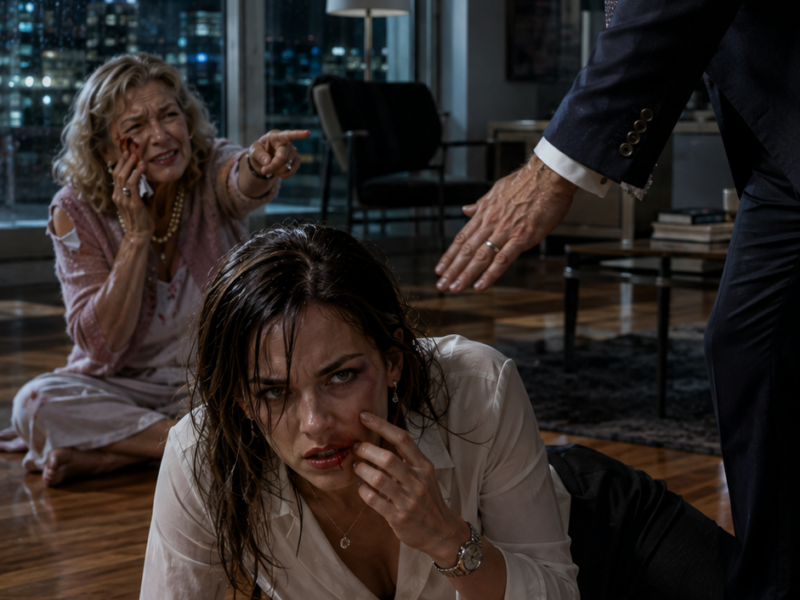
The relentless Seattle rain hammered against the floor-to-ceiling windows of our Mercer Island home, blurring the grey skyline into a watercolor wash of misery. Inside, the atmosphere was even colder
The relentless Seattle rain hammered against the floor-to-ceiling windows of our Mercer Island home, blurring the grey skyline into a watercolor wash of misery. Inside, the atmosphere was even colder. The house was a monument to modern, minimalist architecture—all glass, steel, and polished concrete. It was designed to be a sanctuary, but over the past six months, it had become a psychological war zone.
I stood in the kitchen, quietly pouring a cup of black coffee. I am Olivia. I hold a Ph.D. in Clinical Psychology, and I work as a Senior Forensic Psychologist for the state of Washington, profiling violent offenders and diagnosing severe personality disorders for the court system.
But my most dangerous subject wasn’t sitting in a maximum-security prison. She was sitting in my living room.
My mother-in-law, Mrs. Beatrice, was sixty-eight years old. She wore pastel cardigans, baked shortbread cookies, and possessed the public demeanor of a fragile, loving widow. Privately, she was a masterful, predatory manipulator. Ever since she moved in with us “temporarily” after a mild health scare, she had waged a covert, relentless campaign to destroy my marriage.
The sound of the heavy garage door opening echoed through the floorboards. My husband, Ethan, was home from his corporate law firm.
The moment the mechanical hum vibrated through the house, Beatrice’s entire demeanor shifted. She was sitting on the expensive leather sofa, watching a daytime talk show. As the lock on the front door clicked, Beatrice stood up.
I watched her from the kitchen island, my face entirely impassive, observing her like a specimen under a microscope.
Beatrice looked at me with a cold, malicious smirk. Then, in one swift, violent motion, she grabbed the collar of her own expensive cashmere cardigan and ripped it downward, popping the buttons off so they scattered across the hardwood floor.
Before I could even blink, she raised her right hand, curled her fingers into claws, and dragged her own acrylic nails violently down her left cheek. Four deep, bloody scratches instantly swelled on her fragile skin.
The front door swung open. Ethan stepped into the foyer, shaking the rain from his umbrella.
“Ethan! Help me!” Beatrice shrieked. It wasn’t a normal cry; it was a blood-curdling, Oscar-worthy scream of absolute terror. She threw herself onto the floor, hyperventilating, tears immediately streaming down her face.
Ethan dropped his briefcase. His eyes locked onto his mother, who was sobbing on the floor with torn clothes and a bleeding face.
“Mom?! What happened?!” Ethan yelled, rushing to her side and dropping to his knees.
Beatrice clung to his suit jacket, pointing a trembling, accusing finger directly at me. “She attacked me, Ethan! She went crazy! I just asked her to turn the television down, and she snapped! She hit me and scratched my face! She’s trying to kill me!”
Ethan’s head snapped toward me. He was thirty-five, a man trained to rely on facts in a courtroom, but completely blind to the pathological deceit of the mother who had groomed his emotions for decades.
“Olivia…” Ethan breathed, his face contorting into a mask of pure, unadulterated rage. He stood up, his fists clenched so tightly his knuckles turned white.
“Ethan, look at the pattern of the lacerations on her cheek,” I said calmly, keeping my voice in a perfectly modulated, clinical register. “They are self-inflicted. The angle of the striations indicates—”
“Shut up!” Ethan roared, his voice shaking the glass panes of the house.
He closed the distance between us in three massive strides. I didn’t even have time to raise my arms.
CRACK!
The back of Ethan’s hand struck my jaw with the force of a swinging bat.
The impact lifted me off my feet. I crashed hard into the marble kitchen island, my shoulder taking the brunt of the collision before I slid to the cold hardwood floor. A high-pitched ringing pierced my left ear. The metallic, hot taste of copper instantly flooded my mouth as my teeth cut deeply into my inner cheek.
“You psycho bitch!” Ethan screamed, towering over me, his chest heaving. “My mother is a defenseless old woman! You’ve been trying to push her out of this house for months, and now you assault her?!”
I lay on the floor, blood pooling in my mouth, looking up at the man I had married. Behind him, Beatrice peeked out from behind the sofa. The tears were still falling, but her lips were curved upward into a subtle, triumphant, demonic smile.
“I am calling the police,” Ethan spat, pulling his phone from his pocket, his eyes filled with absolute hatred. “And then I am having you committed! You are sick, Olivia! You belong in a mental asylum! Kneel down, beg her for forgiveness, and get out of my house!”
I did not kneel. I did not cry.
I slowly pushed myself up into a seated position. I wiped the blood from my chin with the back of my hand, smearing it across my skin. I looked at the blood on my fingers, then I looked at Ethan and Beatrice.
The loving wife was gone. The forensic psychologist had just taken the stand.
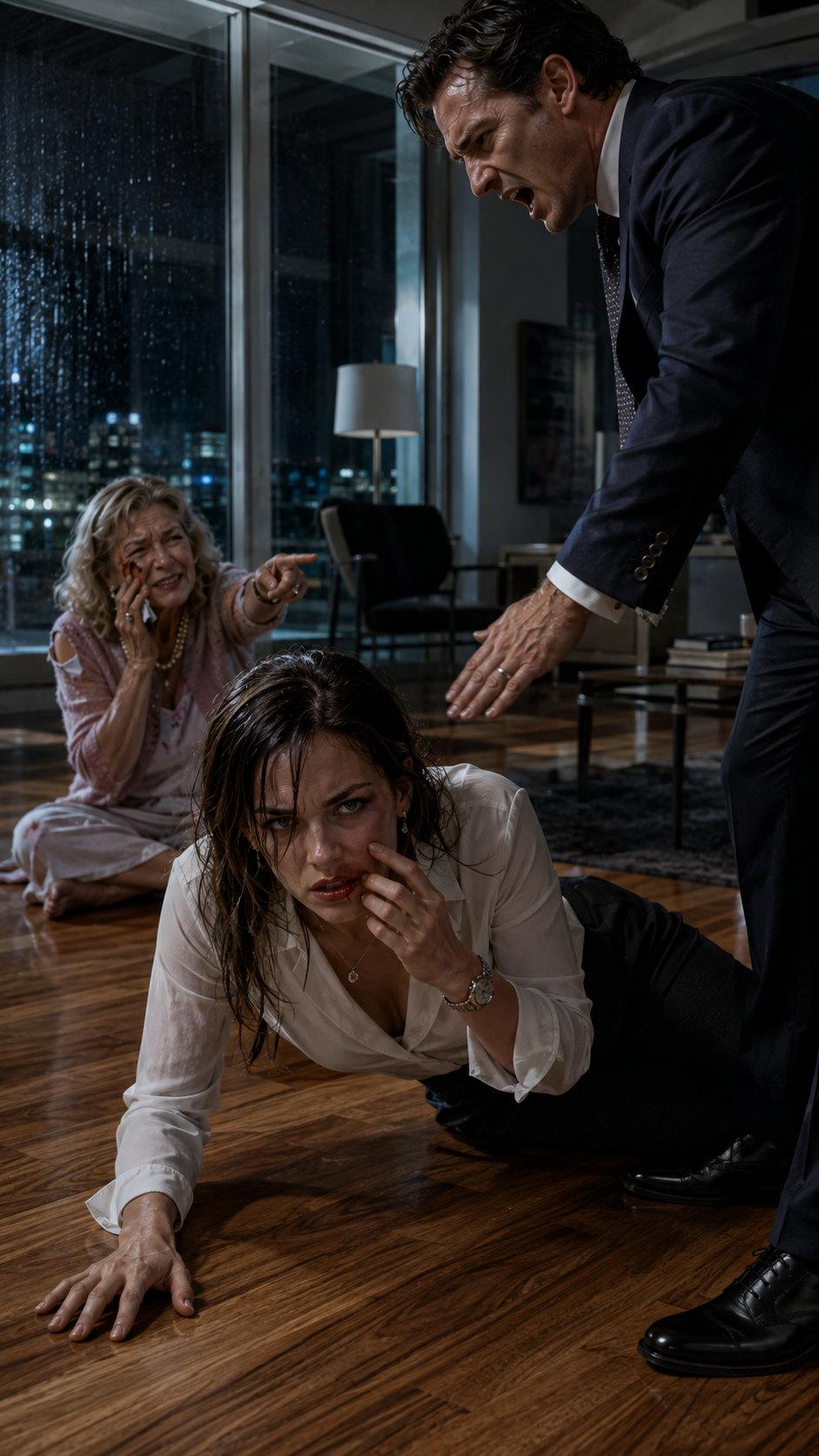
“Did you hear me?!” Ethan yelled, his finger hovering over the dial pad on his phone. “I am calling the cops, Olivia! You are going to a psych ward!”
“Put the phone on speaker, Ethan,” I said.
My voice wasn’t shaking. It was devoid of any emotion, cold and sharp as a scalpel. The sheer, unnatural calm in my tone made Ethan freeze. He expected hysteria. He expected me to beg, to cry, to desperately plead my innocence.
Instead, I calmly stood up, brushing the dust from my slacks. I walked past him—ignoring his aggressive posture—and stepped over to my leather work briefcase resting on the dining table.
“What is wrong with you?” Ethan demanded, taking a step back, unsettled by my absolute composure. “You just attacked my mother!”
“I am a Senior Forensic Psychologist for the State of Washington, Ethan,” I said, snapping the brass locks on my briefcase open. “My entire career is built on identifying the behavioral patterns of sociopaths, narcissists, and pathological liars.”
I pulled out a thick, red medical-grade dossier. I slapped it onto the dining table.
“What is that?” Ethan sneered, though his voice lacked its previous thunder.
“That,” I said, pointing at the file, “is a three-month longitudinal behavioral analysis of your mother. The subject: Mrs. Beatrice. The diagnosis: Factitious Disorder Imposed on Self, historically known as Munchausen syndrome, combined with severe Malignant Narcissism.”
Beatrice let out a loud, theatrical gasp. “Ethan! Don’t listen to her! She’s using her psych babble to confuse you! She’s trying to frame me!”
“She is intentionally feigning and producing physical and psychological symptoms of illness and trauma,” I continued, speaking directly to Ethan, ignoring her entirely. “Her goal is not financial gain. Her goal is coercive control. She manufactures crises to keep you in a perpetual state of emotional dependency, and she fabricates victimhood to systematically eliminate any perceived threats to her control over you. Namely, me.”
“You’re insane,” Ethan scoffed, though his eyes darted to the thick file. “I saw her face, Olivia! I saw her torn clothes! You did this to her!”
“You saw a performance,” I corrected, pulling a sleek, black remote control from the briefcase. “Ethan, you are a lawyer. You know that anecdotal testimony is unreliable. You require empirical, irrefutable evidence. So, I gathered it.”
I pointed the remote at the massive, eighty-inch smart television mounted on the living room wall.
“Six weeks ago, when your mother claimed I ‘pushed’ her down the bottom two stairs—a fall you also blamed me for—I realized I was living with a dangerous pathological manipulator,” I stated, my voice echoing clinically in the large house. “As the co-owner of this property, I legally contracted a private security firm to install hidden, medical-grade, high-definition surveillance cameras in the common areas of this house to monitor her ‘accidents’.”
Beatrice stopped crying instantly. Her tear-streaked face froze into a mask of pure, unadulterated horror.
“Cameras…?” Ethan whispered, the phone slowly lowering from his ear.
“Let’s review the footage of my violent assault, shall we?” I said.
I pressed play.
The massive television screen flickered to life. The high-definition, 4K footage was crystal clear, capturing the entire living room and kitchen area from the hidden vantage point of a modified smoke detector.
On the screen, a digital timestamp glowed in the corner: 4:12 PM. Today. Exactly four minutes ago.
The footage showed me standing quietly in the kitchen, pouring coffee. It showed Beatrice sitting on the couch, perfectly unharmed, watching television.
Then, the mechanical sound of the garage door could be heard on the audio feed.
Ethan watched the screen, his breath hitching in his throat as the reality of his life began to fracture.
On the video, Beatrice stood up. She looked toward the front door with a calculated, dead-eyed expression. Then, with violent, deliberate force, she ripped her own cardigan open, popping the buttons. She raised her own hand and dragged her acrylic nails down her face, drawing her own blood.
She threw herself to the floor, transforming instantly into a weeping, terrified victim, just a microsecond before Ethan walked through the front door on the screen.
The video ended. The television went black.
The silence in the house was absolute, save for the sound of the Seattle rain beating against the glass.
Ethan stood completely paralyzed, his eyes locked on the black screen. The phone slipped from his loose grip and hit the hardwood floor with a dull clatter. He turned his head slowly, looking at his mother.
Beatrice was pressed against the sofa, her face pale as a ghost, her jaw trembling. The bloody scratches she had inflicted upon herself suddenly looked grotesque, not tragic.
“Mom…?” Ethan whispered, his voice cracking, the tone of a deeply traumatized child realizing the monster was real. “You… you did that to yourself? You lied?”
“Ethan, sweetheart, no!” Beatrice scrambled, her voice shrill with desperate panic. “The video is doctored! She’s a computer expert! She faked it to turn you against me!”
“I don’t know how to edit a video, Beatrice,” I said, closing the red dossier. “But I do know how to submit one into legal evidence.”
Ethan looked at his hand—the hand he had just used to strike me down. He looked at the blood smeared across my chin. The horrific realization of what he had just done, and who had manipulated him into doing it, crashed over him like a tidal wave.
“Olivia…” Ethan choked, tears of profound horror and guilt welling in his eyes. He took a step toward me, reaching out. “Oh my god. Olivia, I’m so sorry. I didn’t know. I swear to god I didn’t know.”
I stepped back, out of his reach. The coldness in my eyes made him flinch.
“Don’t touch me, Ethan,” I said, my voice carrying the finality of a judge delivering a sentence. “Your ignorance is not a defense for domestic battery.”
I reached into my briefcase one last time and pulled out a manila envelope. I tossed it onto the kitchen island.
“Those are the divorce papers, drafted yesterday. I was waiting for the final piece of evidence to ensure I get absolute ownership of this house,” I explained smoothly. “I also emailed the security footage, the behavioral dossier, and photos of my bruised face to my divorce attorney, your law firm’s HR department, and the Seattle Police Department.”
Ethan fell to his knees, burying his face in his hands, sobbing uncontrollably. The formidable lawyer had been entirely broken by the truth.
I turned my gaze to Beatrice, who was now shivering on the sofa, realizing she had completely lost her puppet.
“You threatened to lock me in an asylum, Ethan,” I said, zipping up my briefcase. “But I’ve already forwarded Beatrice’s behavioral file to Adult Protective Services and a state psychiatric board. A woman who violently mutilates herself to frame others is a danger to herself and society.”
I walked toward the front door, slipping on my trench coat.
“They will be here within the hour to place her on a mandatory 72-hour psychiatric hold,” I stated, pulling the door open to the cold, rainy Seattle afternoon. “Enjoy the psych ward, Beatrice. I hear the food is terrible.”
I stepped out into the rain, the heavy oak door slamming shut behind me, leaving the mother and son trapped in the clinical, undeniable ruins of their own deceit.