The August heat in Charleston, South Carolina, is not merely a temperature; it is a physical weight.
The August heat in Charleston, South Carolina, is not merely a temperature; it is a physical weight. It presses against the Spanish moss dripping from the ancient live oaks, and it suffocates anyone foolish enough to step outside the air-conditioned sanctuaries of the city’s historic elite. But inside the Vance family’s two-hundred-year-old antebellum mansion in the French Quarter, the atmosphere was far more oppressive than the weather.
I sat near the center of the dining room, my hands folded perfectly in the lap of my tailored linen dress. The room was anchored by a massive, eighteen-foot Chippendale mahogany table—a sacred heirloom that had supposedly seated generals, governors, and six generations of the Vance bloodline.
At the head of this altar sat my mother-in-law, Mrs. Abigail Vance. She was sixty-five, draped in a lavender silk blouse and a triple-strand pearl necklace, possessing the kind of terrifying, fragile elegance that masked a deeply venomous soul. To my right sat Carter, my husband of three years. He was thirty-two, handsome in a soft, unstructured way, wearing a three-hundred-dollar linen shirt. But underneath the expensive fabric, he was a man entirely devoid of a spine.
I am Amanda. I am an architectural historian and the President of the State Architectural Conservation Trust. I build, I restore, and I preserve. But to Abigail Vance, I was nothing more than an unpedigreed parasite who had infiltrated her sacred bloodline.
“Carter, darling,” Abigail drawled, her voice cutting through the quiet clinking of crystal glasses. “Do remind the landscapers that the azaleas near the iron gates are looking decidedly pedestrian. We cannot have the tourists thinking we’ve let our standards slip to the level of the suburbs.”
She didn’t look at me when she said the word suburbs, but the target was clear.
“Of course, Mother. I’ll make the call tomorrow,” Carter murmured, keeping his eyes glued to his plate of roasted duck. He never defended me. It was a silent agreement he had made with himself long ago: his mother’s comfort always superseded my dignity.
The heavy mahogany doors swung open, and the house staff began bringing in the side dishes for our traditional Sunday lunch. Among the silver platters of asparagus and fondant potatoes was a stark anomaly—a heavy, rustic ceramic bowl filled to the brim with bubbling, golden, baked macaroni and cheese. I had requested it specifically. It was a Southern staple, a recipe from my own family, meant to bring a touch of genuine warmth to this sterile, judgmental room.
Abigail’s fork stopped in mid-air. Her gray eyes locked onto the ceramic dish as if a live grenade had just been placed on her precious table.
“What,” she breathed, the temperature in the room plummeting, “is that?”
“It’s baked macaroni and cheese, Abigail,” I said calmly, meeting her icy stare. “I thought a traditional comfort dish would be a nice addition to the menu today.”
Abigail’s face contorted, her manicured fingers gripping the edge of the table. “Comfort? This is a formal Sunday lunch at the Vance Estate. We do not serve slop meant for a county fair. This is coarse, Amanda. It is vulgar, heavy, and undeniably low-class. Much like the environment you were raised in.”
“Mother, please,” Carter whispered, shrinking into his chair. “Let’s just eat.”
“No, Carter, I will not just eat,” Abigail snapped, standing up from her chair. Her lavender silk trembled with her rage. “I have watched this uneducated, provincial girl try to drag our family name through the mud for three years! She does not respect our lineage. She does not belong in this house!”
“I respect history, Abigail,” I said, my voice steady, refusing to break eye contact. “But I don’t worship arrogance.”
That was the spark that ignited the powder keg.
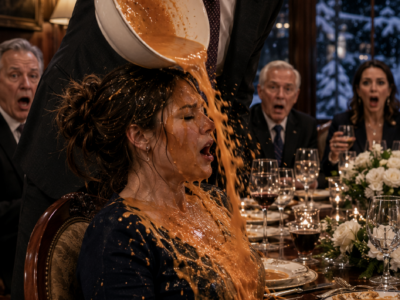
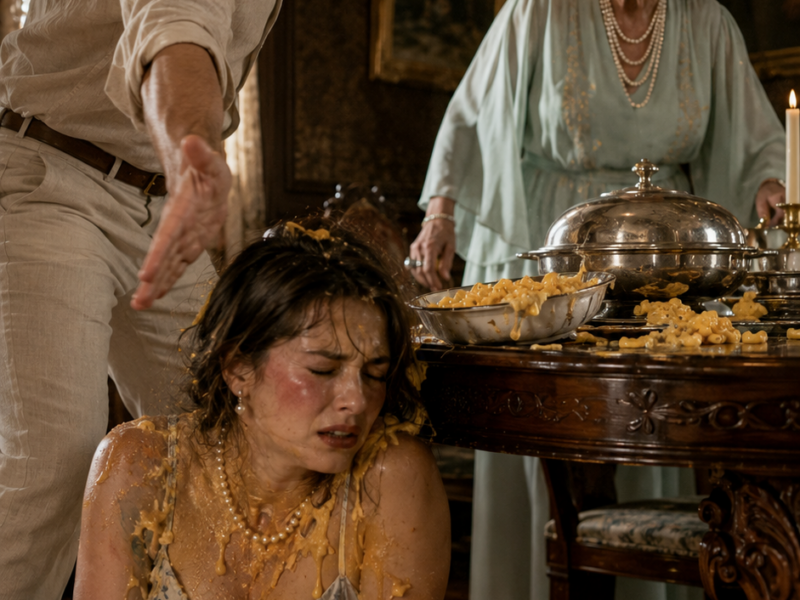
Abigail let out a sound that was half-gasp, half-snarl. She lunged forward, her hands wrapping around the heavy ceramic bowl of steaming macaroni and cheese. Before I could even register the movement, she hoisted the boiling hot dish and hurled it directly across the table at me.
SPLASH!
The searing heat hit me like a physical blow. The scalding, oily cheese and boiling pasta slammed into my face, my chest, and my shoulders. The sheer force of the throw knocked the breath out of my lungs. Thick, burning yellow grease dripped down my forehead, blinding my left eye, soaking into the fabric of my linen dress, and splattering violently across the pristine, two-hundred-year-old mahogany table.
I gasped in agony, my hands flying up to wipe the burning cheese away from my eyes. The dining room fell into a horrifying, dead silence, broken only by the wet plop of pasta hitting the Persian rug.
“You low-class provincial trash!” Abigail shrieked, her face a mask of triumphant malice as she pointed at the mess. “Look what you’ve done! You dirtied my family’s two-hundred-year-old historic table!”
Through my burning, tearing eyes, I saw Carter spring up from his chair. For a fraction of a second, I thought he was coming to help me. I thought he was finally going to stand between me and his monster of a mother.
Instead, he stepped toward me, his face twisted in a panicked, cowardly rage. He raised his right hand high into the air.
CRACK!
The impact of his open palm against my cheek sounded like a gunshot in the grand room. The slap was so hard it snapped my head to the side, sending a fresh wave of burning cheese flying from my hair. The iron taste of blood instantly pooled in my mouth from where my teeth cut into my inner lip.
“You arrogant bitch!” Carter roared, his voice cracking with the desperate need to appease his mother. “How dare you talk back to her?! Kneel down and apologize to Mother right now! Get out of this house!”
I sat frozen in the antique chair, my skin blistering from the heat of the food, my cheek throbbing violently from my husband’s hand. The cheese was cooling, congealing on my skin like a grotesque mask.
I didn’t scream. I didn’t cry.
I lowered my hands to my lap, spat a mouthful of blood onto the pristine floor, and looked up at the two people who thought they had just broken me.
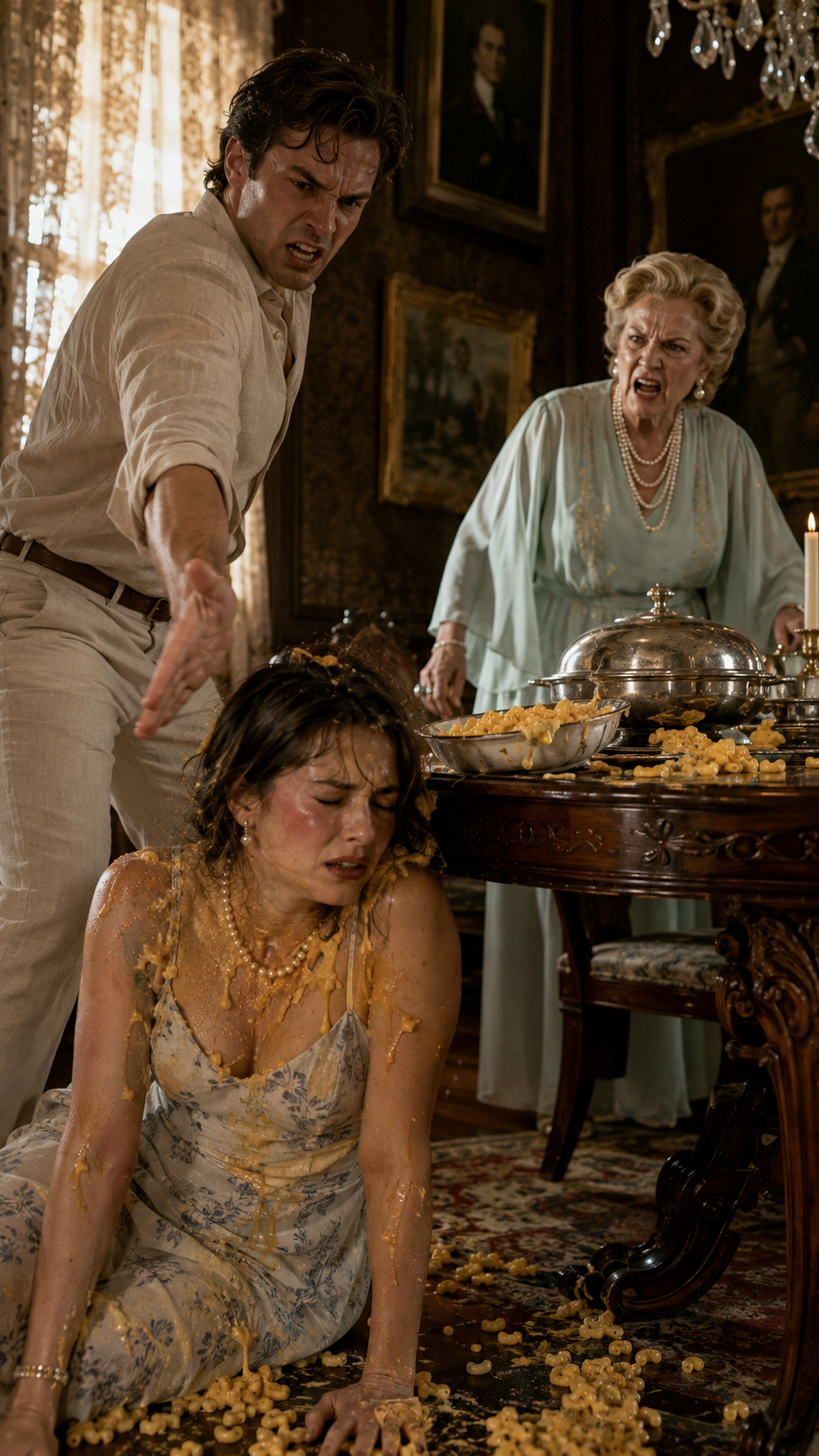
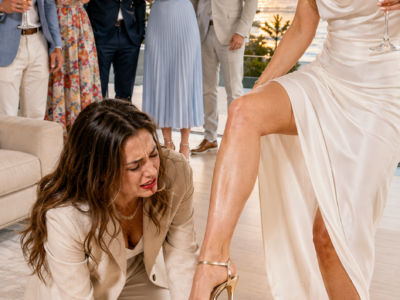
“Did you not hear my son?” Abigail sneered, adjusting her pearl necklace, her chest heaving with the thrill of the violence. “Get on your knees, wipe this table clean with your dress, and pack your bags.”
I reached for the linen napkin beside my plate. With slow, deliberate movements, I wiped the thick layers of cheese from my eyes and cheeks. The skin underneath was bright red and burning, but the physical pain was entirely eclipsed by a sudden, icy clarity.
“I won’t be packing anything, Abigail,” I said. My voice was eerily quiet, lacking a single tremor of fear.
Carter let out a frantic, high-pitched scoff. “Are you deaf, Amanda? You crossed the line! You are leaving!”
I reached down to the floor beside my chair, where my waterproof leather work briefcase rested. My hands, still slick with butter and cheese, unclasped the brass lock. I pulled out a thick, legal dossier bound in forest-green leather, stamped with the gold seal of the State of South Carolina.
I stood up and slammed the heavy document directly onto the center of the table, right on top of the grease stain that the casserole had left on the precious mahogany.
“You are right about one thing, Abigail,” I said, staring into her cold, gray eyes. “Someone is leaving this house today. But it isn’t me.”
Abigail glared at the leather binder. “What is this nonsense? If this is a divorce demand, hand it to Carter’s lawyers. You won’t get a dime of Vance money.”
“There is no Vance money, Abigail. There hasn’t been for years,” I replied, my voice echoing off the plaster walls.
Abigail’s haughty expression faltered. She shot a look at Carter, whose face had suddenly drained of all color. He stared at the green binder as if it were a venomous snake.
“Carter… what is she talking about?” Abigail demanded.
“Tell her, Carter,” I challenged, stepping away from the table. “Tell your mother what happened five years ago, right before you proposed to me.”
Carter’s mouth opened, but no sound came out. He took a stumbling step backward, wiping sweat from his forehead. “Amanda… please. Don’t do this. Not in front of her.”
“Five years ago,” I took over, my voice ringing with absolute authority, “this glorious, two-hundred-year-old estate was exactly thirty days away from being seized by the county. Your late husband left you with a mountain of hidden debts, Abigail, culminating in four hundred and fifty thousand dollars in unpaid property taxes and state liens.”
Abigail gripped the back of her chair, her knuckles turning white. “Lies. The Vance estate has never been in default.”
“It was scheduled for the Sheriff’s public auction block,” I said, tapping the green binder. “Carter came to my office at the Preservation Trust. He was weeping. He begged me to find a loophole to save your precious social standing before the local papers published the foreclosure notices.”
I opened the binder, flipping to the third page, heavily heavily stamped and notarized.
“Carter didn’t have the cash. But I did. Through my private family inheritance, combined with my executive authority at the State Architectural Conservation Trust, I structured a bailout. But I didn’t just pay your debts, Abigail. I executed a Perpetual Historic Conservation Easement.”
Abigail’s breathing became shallow. “An… an easement? What does that mean?”
“Read the title deed, Carter!” I barked, pointing at the page. “Read it to her!”
Carter leaned forward, his voice trembling so violently he could barely form the words.
“Grantor… Vance Family Estate LLC,” Carter choked out, tears welling in his cowardly eyes. “Grantee… The South Carolina Heritage and Architectural Preservation Trust. Property Status… Non-Profit Public Historical Monument.”
Abigail stumbled backward as if she had been physically struck. “Non-profit? Public? Carter, what did you sign?!”
“He signed over the title of this house,” I said, delivering the death blow. “The Vance family does not own this mansion, Abigail. The State Historic Trust owns it. You and Carter were merely granted a conditional, revocable tenancy. You are not the lady of the manor. You are a tenant living in a museum. And I am the Chief Managing Trustee.”
The dining room plunged into an absolute, suffocating silence, broken only by the low hum of the air conditioner.
Abigail stared at the state seal on the document, her mind desperately trying to reject the reality crashing down upon her. The untouchable Vance matriarch was entirely powerless, stripped of her kingdom by the very woman she had just assaulted.
“Conditional tenancy…?” Abigail whispered, the aristocratic venom completely gone, replaced by a pathetic, reedy panic. “No… no, I am a Vance. I have lived here for forty years! My social clubs, my galas… this is my home!”
“This is a state-protected historical asset,” I corrected her, turning the page of the binder to a section highlighted in yellow. “And as a conditional tenant, your residency is legally bound by the Heritage Cultural Code and Asset Preservation Standards.”
I pointed a finger at the bubbling grease and cheese burning into the finish of the two-hundred-year-old Chippendale table. Then, I pointed to the red, swollen handprint on my own cheek.
“Under Section 8, Subsection C of your tenancy agreement,” I read aloud, my voice sharp and clinical, “any intentional, malicious physical damage to protected historic artifacts—such as this 18th-century mahogany table—or any violent criminal misconduct committed on the premises by a tenant, results in the immediate, non-negotiable, and permanent revocation of all residency privileges.”
Abigail’s eyes widened in sheer, unadulterated horror. She looked at the cheese she had thrown, finally understanding the catastrophic trap she had just walked into.
“You assaulted a senior officer of the Trust, and you intentionally defiled a protected artifact,” I stated, closing the binder with a heavy thud. “You have violated your lease, Abigail. You are being evicted.”
“You can’t!” Abigail shrieked, her pristine facade shattering completely. She dropped to her knees on the Persian rug, clutching at the edge of the mahogany table, her pearls swinging wildly. “Carter! Do something! She’s stealing my home! Defend your mother!”
Carter stood frozen. He looked at his mother sobbing on the floor, then at the irrefutable legal documents, and finally at me. He had zero money, zero legal standing, and absolutely no power. The realization washed over him, turning him into a hollow shell of a man.
“I… I can’t do anything, Mother,” Carter wept, covering his face with his hands in absolute, humiliating defeat. “She holds the Trust. It’s her house.”
I didn’t feel a shred of pity as I looked down at the weeping, pathetic woman on the floor.
I reached into my pocket and pulled out my phone.
“I have just alerted the Foundation’s private security detail,” I announced. “They are waiting at the front gates. Abigail, you have exactly fifteen minutes to gather your personal clothing and exit the premises. Any attempt to take antique furniture, art, or crystal will be treated as felony theft of state property.”
“Where will I go?!” Abigail wailed, tears streaming down her face, destroying her makeup. “I have no cash! I have nothing!”
“I hear the suburbs are quite nice this time of year,” I replied, my voice completely devoid of mercy.
I turned my gaze to my husband, who was still crying into his hands.
“And Carter,” I said softly, causing him to flinch. “You are suspended as a tenant pending a conduct review for your assault. My attorneys will have the divorce papers and your formal eviction notice delivered to whatever cheap motel you two find tonight. Do not be here when I get back from the washroom.”
I turned my back on the ruined matriarch and the spineless son. With my head held high, the cheese still clinging to my dress like battle armor, I walked out of the grand dining room.
I didn’t need the police, and I didn’t need a billionaire to save me. I had the law, I had history, and I had finally reclaimed my dignity. The Vance legacy was dead, and I was the one who had written the obituary.