The cold November rain drizzled over Boston’s North Station, slicking the cobblestones and chilling the air to a bite.
The cold November rain drizzled over Boston’s North Station, slicking the cobblestones and chilling the air to a bite. I was standing behind a folding table outside the terminal, handing out bowls of hot beef stew to those seeking shelter, when I saw my ex-wife waiting in line.
Four years had passed since Maya walked out of my life. For every single one of those long, bitter years, I had believed the story my mother told me: that Maya had abandoned our marriage for a wealthy older man.
So when she finally reached my table, soaked by the freezing rain and wearing a denim jacket far too thin for a New England winter, I let four years of unvented venom rise straight to my throat.
“What happened, Maya?” I sneered, holding the ladle over her bowl. “Did the rich guy you cheated on me with finally throw you out onto the street?”
I expected anger. I expected a sharp retort or a defensive glare, because that was how I had replayed this reunion in my head a thousand times. Instead, Maya simply took the foam plate with both hands, whispered, “Thank you, Lucas,” and walked away without meeting my eyes. Her face was pale, her fingers were trembling from the cold, and she looked so utterly exhausted that my chest tightened with a sudden, unsettling realization.
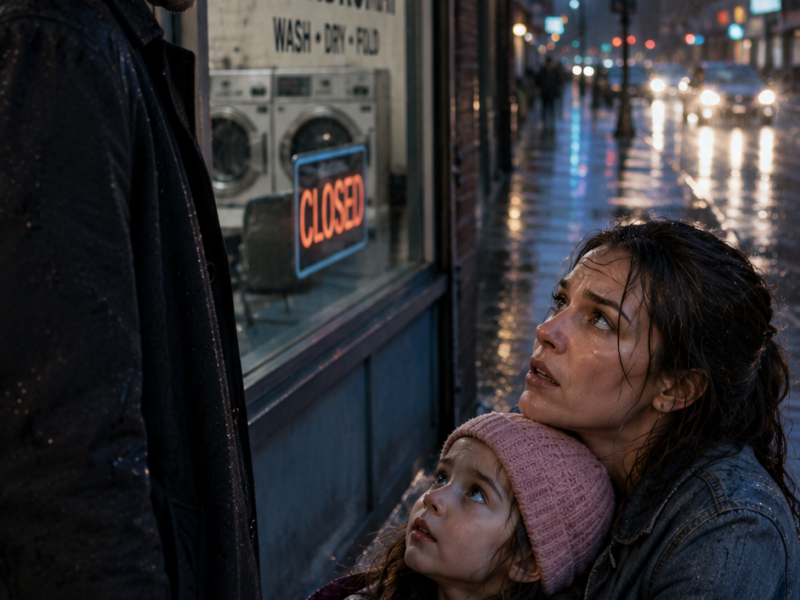
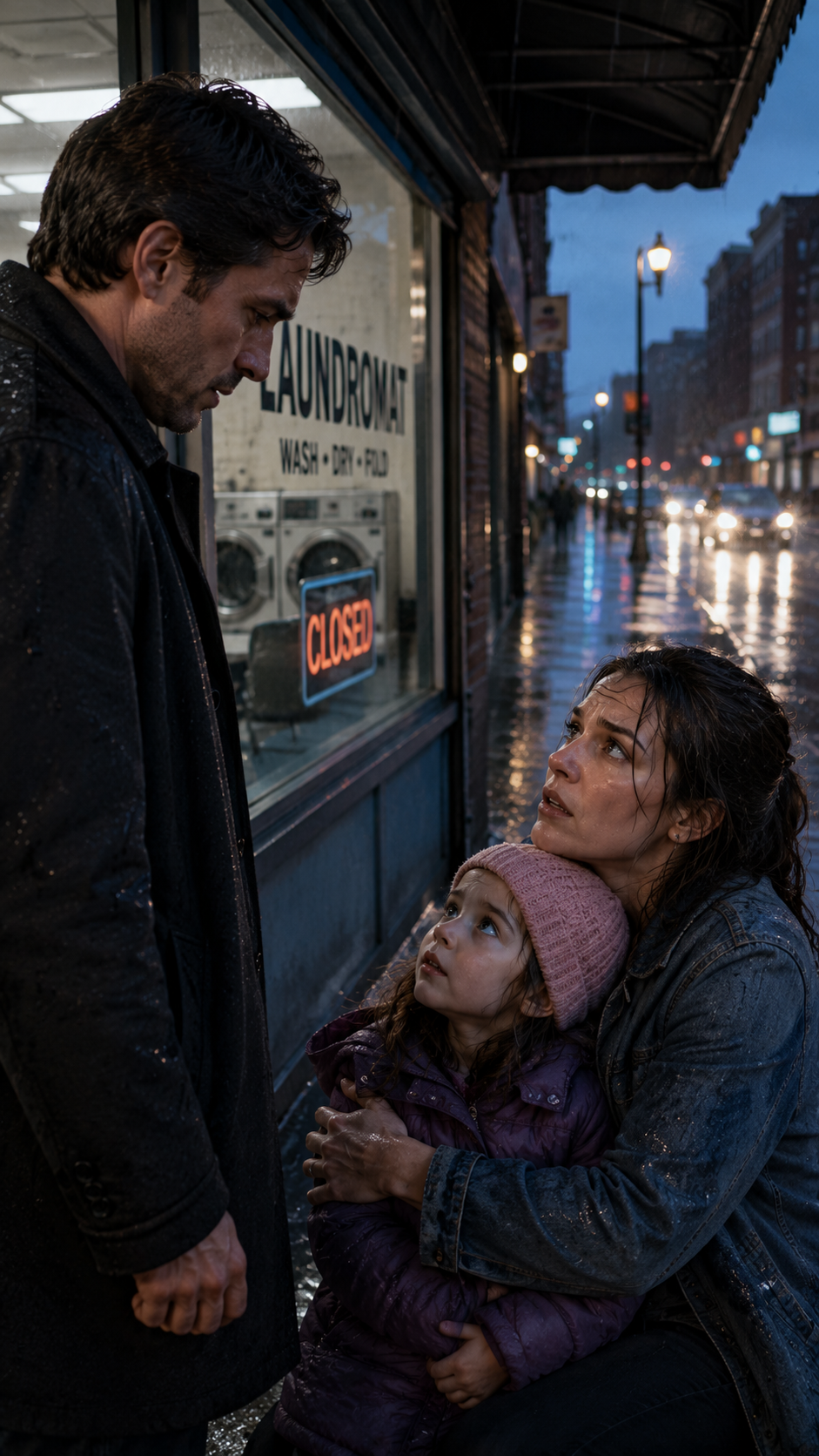
Something bothered me even more a few seconds later. Maya did not sit down on the station benches to eat, even though her gaunt cheeks suggested she hadn’t had a proper meal in days. She carried the steaming plate past the newsstand, past the pharmacy, and down a narrow side street toward a closed laundromat.
I handed my ladle to another volunteer and followed her.
Under the narrow, dripping awning of the laundromat, a little girl was waiting. She wore a pink knit hat, a worn purple coat, and scuffed white sneakers. The second she saw Maya, her face lit up and she ran forward, shouting, “Mommy!”
Maya crouched down on the cold concrete, handed the child the plate of stew, and gently lied that she had already eaten inside. Then, the little girl looked up—and locked her gaze straight onto mine.
Everything inside me stopped.
She had striking gray-green eyes—the exact, unusual shade my father had passed down to me, framed by the same small dimples that appeared beside her mouth whenever she frowned.
“Mommy,” the child whispered, leaning into Maya’s coat. “That man is staring at me.”
Maya turned, saw me standing under the streetlamp, and her expression froze into pure terror.
“How old is she, Maya?” I asked, my voice cracking against the damp air.
“Go back to your food table, Lucas,” Maya pleaded, pulling the girl behind her.
“How old is she?!” I demanded, stepping under the awning as my mind counted backward through four dark years.
Maya swallowed hard, her eyes glistening with unshed tears. “She’s four.”
Four. The single number pulled me violently back to the night our marriage died—to the screaming match in our apartment, and Maya’s trembling voice saying: “I’m pregnant. That man is my lawyer. Let me explain!”
Four years earlier, Maya and I had been married for five years, living in a townhouse owned by my mother, Mrs. Beatrice Vance. Maya worked long hours in logistics software development, while I worked in corporate purchasing. My mother, Beatrice—a retired private school headmistress who treated control as her divine right—despised Maya’s independence. Beatrice criticized her cooking, managed my bank accounts under the guise of “helping with bills,” and constantly fed my deepest insecurities.
When Maya became pregnant, she suffered severe morning sickness and sought assistance at the Boston Women’s Health & Legal Clinic. There, she met Arthur Croft, a volunteer attorney helping women facing financial abuse. When Maya nearly fainted one afternoon, Arthur drove her home. My mother followed them, took a photograph, and had the image digitally altered—erasing the clinic’s banner and replacing it with the entrance of a boutique hotel.
That night, Beatrice placed the edited photo in front of me. When Maya tried to tell me she was pregnant and that Arthur was her legal advisor, I refused to hear a word. Driven by blind, arrogant jealousy, I threw her out at dawn on February 10th. Before she left, Maya placed a sealed white envelope on the entryway table beneath my key ring and whispered, “Just read it, Lucas.”
I never read it. By the afternoon, the envelope had vanished.
Now, standing under the laundromat awning four years later, staring at my daughter Lily’s eyes, the horror of my blind stupidity hit me like a physical blow.
“Maya… is she mine?” I choked out.
“Yes,” Maya said quietly. “She’s yours.”
Over the next forty-eight hours, the lies I had built my life upon completely unraveled. Maya revealed that she had tried to call me twenty times from the hospital after Lily was born, but my mother had blocked her number on my phone and deleted every voicemail.
Driven by a burning need for the truth, I used my spare key to enter my mother’s estate in Chestnut Hill while she was attending her weekly charity board meeting. I bypassed the lock on Beatrice’s private study safe—a safe where she kept old family documents.
Deep inside the velvet-lined drawer, I found it: the original, unedited photograph showing the Boston Women’s Health & Legal Clinic banner behind Maya and Arthur Croft. Beside it lay the unopened white envelope from four years ago, containing Maya’s official ultrasound photos and a personal letter pleading for us to seek counseling.
But beneath the envelope lay a second, far more sinister secret.
Inside a leather accordion folder stamped with my mother’s personal seal were certified bank ledgers revealing a shocking truth: Maya held an independent pre-marital patent on a logistics tracking algorithm. For four years, while Maya and my daughter lived in near-poverty, Beatrice had forged Maya’s signature on corporate licensing checks, illegally diverting over $250,000 in patent royalties directly into Beatrice’s private foundation account!
My mother hadn’t just framed Maya to keep control over me—she had systematically financially ruined my wife to prevent Maya from ever having the resources to fight back.
The grand ballroom of the Ritz-Carlton Boston was brilliant with crystal chandeliers, gold leaf trim, and two hundred of New England’s prominent high-society figures. It was the annual gala for the Vance Heritage Foundation, where my mother, Mrs. Beatrice Vance, was being honored with the Lifetime Philanthropy Award.
Beatrice stood on the raised marble stage wearing a midnight-blue velvet gown and three strands of South Sea pearls, holding a crystal trophy.
“Family values, integrity, and stewardship have been the bedrock of my life’s work,” Beatrice announced into the microphone, her voice booming across the silent, glittering crowd.
“Then let’s talk about your stewardship, Mother,” my voice echoed from the central aisle.
Two hundred heads whirled around.
I walked down the velvet carpet toward the stage, wearing a dark suit, holding a sleek black tablet connected directly to the gala’s master AV projection system. Beside me walked Maya, elegant and calm in a simple charcoal dress, holding four-year-old Lily in her arms.
Beatrice’s face drained of color, her fingers clutching the crystal trophy so tightly her knuckles turned white. “Lucas?! What is the meaning of this interruption?! Security—”
“Stay right there, Beatrice,” I commanded, my voice cold as iron as I tapped the tablet screen.
The massive 20-foot projection screen behind the stage flickered, replacing the foundation logo with a high-definition side-by-side display:
On the left was the edited photo Beatrice had shown me four years ago. On the right was the original RAW camera file, clearly displaying the Boston Women’s Health & Legal Clinic sign and the legal intake folder in Arthur Croft’s hands.
Gasps of utter shock rippled through the high-society audience.
“Four years ago, my mother fabricated a disgraceful lie to destroy my marriage,” I announced into the wireless microphone, my voice vibrating across the ballroom. “She erased a health clinic banner to frame my pregnant wife for infidelity, drove her into homelessness, and stole my daughter’s father away from her.”
Beatrice stammered, her regal composure shattering into frantic panic. “He… he is confused! My son is unwell! Turn that screen off!”
“And why did she do it?” I continued, tapping the screen again.
The display shifted to a certified forensic financial audit from the Massachusetts Attorney General’s Fraud Division, accompanied by high-resolution scans of Beatrice’s forged signatures on twenty-four quarterly royalty checks totaling $250,000.
“Because my mother was secretly stealing my wife’s patent royalties to fund this very foundation!” I revealed, my voice echoing like a thunderclap. “She kept Maya destitute so her crime would never be uncovered!”
Pandemonium erupted in the ballroom. Board members stood up in outrage, local reporters pulled out cameras, and Beatrice dropped her crystal trophy onto the stage floor, where it shattered into a hundred jagged pieces.
“Lucas… please!” Beatrice wept, dropping her arrogant posture, taking a pathetic, stumbling step toward the stage edge, her hands trembling. “I did it for the Vance family name! I did it to keep you close to me!”
“You didn’t do it for family, Beatrice,” I said, looking down at her with pure, absolute indifference. “You did it out of pure, unadulterated malice.”
Richard Sterling, the Senior Partner of the legal firm managing the foundation, stepped onto the stage, took the microphone from Beatrice’s hand, and addressed the crowd: “The board of trustees will immediately suspend Mrs. Vance, freeze all foundation accounts, and cooperate fully with the District Attorney’s office.”
Beatrice collapsed back into her chair on stage, weeping hysterically, completely ruined in front of the elite society she had spent thirty years trying to impress.
I turned my back on the broken matriarch, walked over to Maya, and took my daughter Lily into my arms for the first time in four years.
Lily looked into my eyes, her small hand reaching up to touch my cheek. “Daddy?” she whispered softly.
“Yes, sweetheart,” I said, tears finally spilling down my face as I looked at Maya, seeing forgiveness and hope in her eyes. “I’m here. And I’m never letting you go again.”
We walked out of the Ritz-Carlton ballroom together, leaving the shattered lies behind us, stepping forward into a bright, clean future that was entirely ours.