Three Hours Before the Wedding, His Phone Exposed Everything — So I Married the Man He Feared Most.
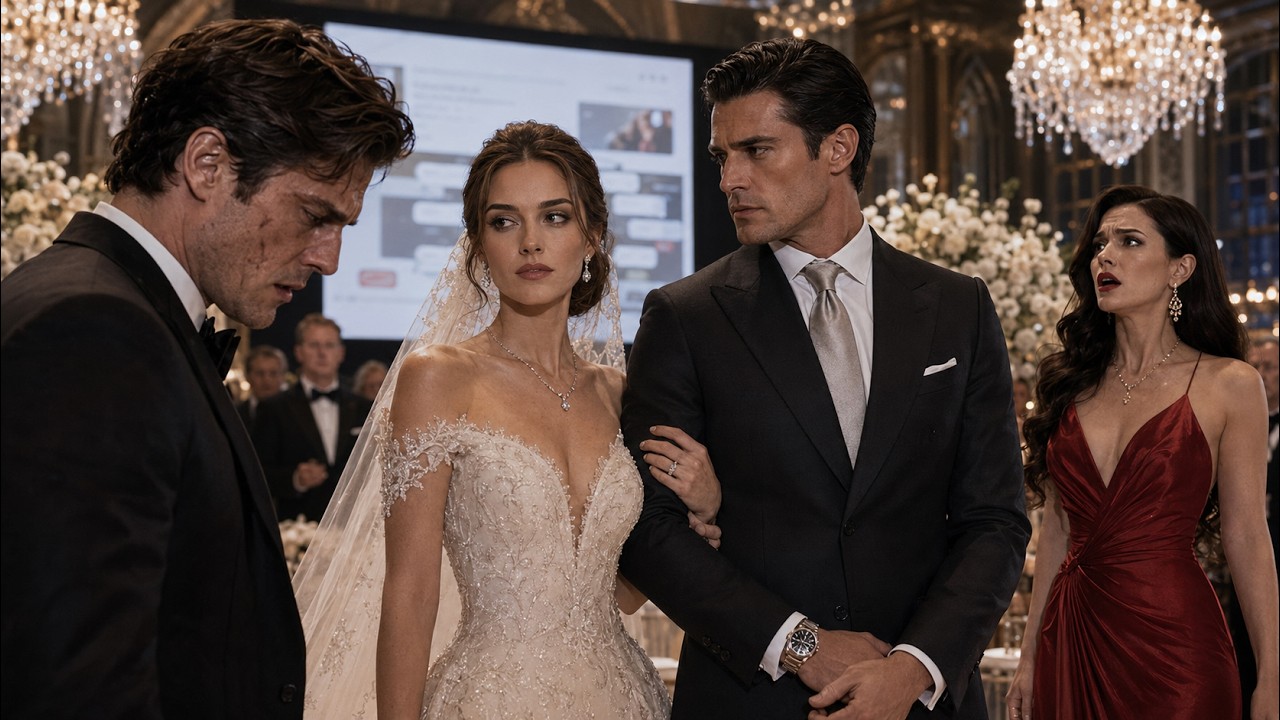
Three hours before my wedding rehearsal dinner, my fiancé’s phone lit up with a flight alert he was never supposed to receive in front of me.
Adrian was in the shower, humming like a man without a secret. On the marble counter beside his cufflinks the screen flashed once, then again.
Your flight to Lisbon departs tomorrow at 9:40 p.m. Check-in opens now.
For a moment I only stared. Tomorrow at 9:40 p.m. was not free time. Tomorrow at 9:40 p.m. Adrian and I were supposed to be standing beneath the crystal ceiling of the Aurelia Hotel while four hundred guests lifted champagne glasses to the new alliance. Tomorrow at 9:40 p.m. my father was supposed to announce that our family group would acquire a strategic stake in Adrian’s failing company. Tomorrow at 9:40 p.m. Adrian was supposed to kiss me for the cameras and tell New York that our marriage was more than a contract.
Instead he had booked a one-way first-class ticket to Portugal.
My hands went cold before my face changed. That was something my mother had taught me when I was sixteen and a board member twice my age tried to explain my own financial model back to me. Feel whatever you need to feel later. Never let the room watch you bleed.
There was no room now. Only the bathroom steam, the sound of running water, the ivory wedding gown hanging from the closet door, and the phone that had just turned my future into evidence.
Adrian had given me his passcode two months earlier because he hated dealing with vendors. The florist, the hotel, the security consultant, the minister, the photographer, the caterer—all of them called him first because he had insisted on being seen as an equal partner in the wedding. Then he handed every problem to me.
“Handle it,” he had said, kissing my temple while sliding the phone across the kitchen island. “You are better at making people obey.”
I had thought that was admiration. Now I understood it was convenience.
I entered the passcode. His home screen opened. The airline notification sat at the top like a warning label. Beneath it another message waited from a contact saved as S.C.
I knew before I opened it. No woman reaches twenty-nine inside a family business without learning the shape of a lie.
S.C. was Sophia Clark. Adrian’s first love. The woman he had described as a sad college memory, a broken girl from before he became serious, a person he felt sorry for but did not want. The woman he had sworn he stopped seeing when our engagement became public.
The message read: Tomorrow night belongs to us. Let her stand there in that ugly crown of a hotel while everyone realizes money cannot make a man stay.
My throat closed. Not because Adrian had betrayed me. Betrayal has a taste, and I had tasted small hints of it for months—canceled dinners, sudden business trips, the way he turned his screen away when he smiled. No. What froze me was the precision.
They had not planned to run away before the wedding. They had planned to let me walk down the aisle. They had planned to let me sign the ceremonial merger documents in front of investors. They had planned to let my father announce the capital package that would stabilize Adrian’s company. Then, during the evening reception, when the orchestra paused and the live cameras turned toward the stage for our first public toast as husband and wife, Adrian would vanish.
The groom would disappear. The bride would stand alone. The city would laugh. And Sophia would post proof from the airport.
I scrolled. Their messages were not hidden well. Arrogant people rarely hide things well once they decide you are too trusting to look. There were weeks of planning. Sophia wanted the timing exact.
“Not before the vows,” she wrote. “If you leave before, she becomes tragic. If you leave after the papers and before the toast, she becomes ridiculous.”
Adrian answered with laughing emojis.
She continued. “I want her father watching. I want the hotel full. I want every woman who smiled at me like I was trash to see Miss Calder abandoned in couture.”
Then another message. “After tomorrow she will be too humiliated to fight the clause. Your board will panic. Mine will confirm the Clark partnership. We take the Lisbon meetings, announce the waterfront fund, and let people decide whether they trust a deserted bride or a man brave enough to choose true love.”
I sat down slowly on the edge of the bed. The clause. There it was. The part that turned adultery into business.
Six months earlier, when Adrian and I agreed to marry, it had not been a fairy tale. We were honest about that. My family’s group needed his waterfront parcels for a hotel and residential project my father had wanted for years. Adrian needed our capital, our lender relationships, and our political discipline. His company looked bold from the outside, but inside it was thin as wet paper. He had charm. I had structure. He had land. I had money. Our marriage would quiet suspicious investors and turn a fragile joint venture into a family alliance.
That was the arrangement. Not cold. Not cruel. Just practical.
Then he became attentive. He learned my coffee order. He waited after late meetings. He told me the first honest thing anyone in his life had offered him was my trust. I knew love did not always begin as lightning. Sometimes it began as two people choosing the same future and then building warmth inside it. So I let myself believe we had become real.
That was my mistake.
The shower shut off. I locked the phone, placed it exactly where it had been, and stood. In the mirror I looked like a bride on the night before her wedding. Hair pinned loosely. Silk robe tied at the waist. Engagement ring flashing under soft lights. Calm face. Expensive calm. The kind men like Adrian mistook for blindness.
He came out wrapped in a towel, water darkening his hair.
“You look pale,” he said.
I smiled. “Long day.”
He crossed the room and kissed my cheek. His mouth was warm. His hand was steady. No guilt showed anywhere.
“After tomorrow it will all be worth it,” he said.
“Will it?”
He laughed softly. “Of course. You and me. The city will finally understand.”
I looked at him then. Really looked. Adrian had built an entire personality out of hunger. He hated being dismissed. He hated old money until old money opened its doors. He hated powerful men unless they wanted to invest. He hated my calm because it reminded him that I did not need to raise my voice to matter.
And above all, he hated Julian Voss.
Julian was the only man in New York real estate who could make Adrian sound small without speaking. Voss Holdings had beaten Adrian’s company on two waterfront bids, one hotel conversion, and a private equity raise Adrian still pretended he never wanted. Adrian called Julian cold, spoiled, predatory. But everyone knew the truth. Julian had inherited a tired family office and turned it into a surgical investment firm before thirty-five. He did not chase rooms. Rooms adjusted around him. Adrian feared him because Julian saw numbers before charm.
I had invited Julian to the wedding because Voss Holdings was one of our largest independent creditors on a separate project. Courtesy mattered in our world. So did optics.
I wondered what Adrian would do if the one man he most resented stood beside me while his plan collapsed.
The thought did not heal me. It steadied me.
Adrian touched the ring on my finger. “Tomorrow, no matter how tense it gets, just trust me.”
I almost laughed. “I will trust what I can prove.”
His smile flickered. “What does that mean?”
“It means I am tired, Adrian. Go sleep. We have a wedding to survive.”
He kissed me again and went to the adjoining suite reserved for the groom. He liked old traditions when they made him look important.
The moment the door clicked shut, I moved.
I did not cry. I called my father first. He listened without interrupting while I explained every message, every flight detail, every line about the clause and the planned humiliation. When I finished he was silent for five full seconds.
“What do you want to do?” he asked.
“I want the capital announcement to happen exactly as planned. I want the papers signed. And I want Julian Voss standing where Adrian is supposed to stand when the cameras turn.”
My father exhaled slowly. “That will start a war.”
“Adrian already started it. I am simply choosing the weapons.”
Next I called Julian. He answered on the third ring, voice calm even at that hour.
“Elena. This is unexpected.”
“I need a favor that will also be an opportunity,” I said. “Tomorrow you will be at the Aurelia. If I ask you to step forward at a specific moment, will you do it?”
A pause. “Does this involve Brooks?”
“It involves the fact that he planned to leave me standing alone after my family saved his company. I intend to make certain the story ends differently.”
Julian was quiet for a longer moment. Then: “I have disliked the man for years. Tell me the timing.”
I did.
The next twenty-four hours moved like a carefully staged operation. I smiled through the rehearsal dinner. I accepted toasts. I let Adrian kiss my cheek in front of photographers. I did not sleep. At dawn I met briefly with my father’s attorneys and with Julian in a private conference room two floors above the ballroom. The contingency documents were already prepared. The capital injection would still happen—but the controlling interest would shift. The waterfront parcels would come under a new structure. And if Adrian disappeared as planned, the marriage itself would never be completed.
At 4:00 p.m. I walked down the aisle in the ivory gown. Four hundred guests rose. Adrian waited at the altar looking every inch the devoted groom. The minister began. We exchanged the ceremonial vows that would not be legally binding until the civil documents were signed later. We signed the preliminary alliance papers in front of the cameras. My father announced the capital package. Applause rolled through the room like thunder.
The reception began. The orchestra played. Guests drank. Adrian moved through the crowd accepting congratulations, already checking his watch.
At 9:10 p.m. he slipped away, claiming a private call. I watched him go. At 9:25 p.m. I received the confirmation I had been waiting for: his car had left for the airport. Sophia’s flight was already boarding.
At 9:35 p.m. the orchestra paused. The live cameras turned toward the stage for the first public toast. The master of ceremonies looked for the groom. A murmur began.
I stepped onto the stage alone, microphone in hand.
“Ladies and gentlemen,” I said, voice clear and carrying. “My fiancé appears to have a prior engagement in Lisbon. He and an old acquaintance planned this evening with care. They intended for me to stand here alone after my family announced the capital that would save his company. They believed humiliation would silence me.”
Silence crashed over the ballroom.
“They miscalculated.”
I turned slightly. Julian Voss walked onto the stage and stopped beside me. Gasps rose. Adrian’s board members looked as if the floor had tilted.
“The capital package proceeds,” I continued. “The structure has been adjusted. The waterfront parcels will move forward under a partnership between my family’s group and Voss Holdings. The man who tried to use a wedding as an escape route will find that the clause he counted on no longer protects him. And the woman he left standing here will not be standing alone.”
I looked directly into the nearest camera.
“Some alliances are built on paper. Others are built on the moment someone shows you exactly who they are. Tonight I choose the second kind.”
Julian offered his arm. I took it. The room erupted—shock, whispers, the first scattered applause from people who understood power when they saw it.
Adrian’s flight left without him. Sophia’s posts never gained the traction she expected. Within forty-eight hours the financial press had rewritten the story: the Calder capital had moved, the parcels had new ownership, and the man who planned a public abandonment had become a cautionary headline.
Two months later, in a quiet ceremony attended only by family and a handful of trusted partners, I married Julian Voss. It was not a fairy tale. It was a decision made with open eyes. He never asked me to explain the night at the Aurelia. He simply stood where it mattered and never looked away.
Adrian tried once to reach me. I did not answer. Some debts are paid in public. Some are left unpaid on purpose.
I still keep the ivory gown. Not as a reminder of what almost happened, but as proof of what I refused to become: a woman left alone on a stage while someone else wrote the ending.
I wrote it myself.