The Maid Stole the Bride’s Veil — The Billionaire Froze When He Saw What Was Hidden Inside.
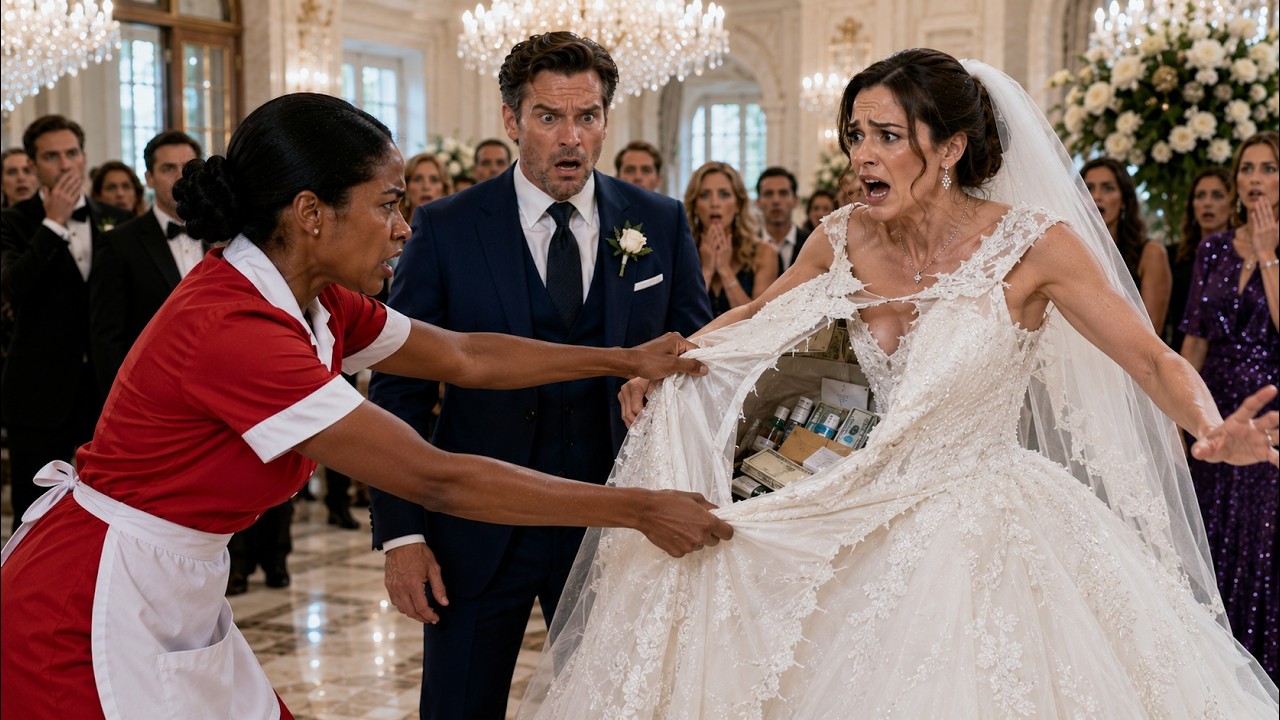
I had exactly four minutes. Four minutes before the wedding planner came looking for me, and I used every second of them. My name is Elena Ruiz, and for two years I had dusted the same banisters, folded the same linens, and walked the same halls my mother once walked in the Whitfield estate. I never told anyone why I took the job. I never said out loud that I was hunting for the truth that had destroyed her.
My mother, Marisol, had been the family seamstress sixteen years earlier. One night she came home without a job, without a reference, accused of something the Whitfields never fully explained. She packed her sewing kit and never spoke of them again—until the hospital, when the morphine loosened the words she had swallowed for thirteen years. “I didn’t take it,” she whispered. “Tell them I didn’t take it if you ever get the chance.” Then she drifted away and never woke up enough to say what “it” was.
So when I saw the open box on the vanity in the East Wing, and noticed the ridge along the inner hem of the bridal veil—stitched in a color that didn’t quite match—I stopped breathing. I knew the difference between a flaw and a deliberate seam. I lifted the veil. Behind a fold no camera would ever catch was a hand-stitched slit, old and careful. Something had been sewn inside for a very long time.
I took it.
In my small room off the kitchen I cut the stitching with shaking hands. Inside, wrapped in oilcloth, was a single photograph and a folded jeweler’s receipt dated seventeen years ago. The photograph showed two young women laughing outside that same jeweler. One was my mother, younger, hair longer, wearing a scarf I still kept in a shoebox at home. The other woman I didn’t recognize at first—until I saw the shape of the jaw, the tilt of the chin. It was the same face I had watched that morning arguing about seating charts. Not Vanessa Cole, the bride. Her mother. Carol.
The receipt was for a diamond-and-sapphire necklace. The buyer’s name, written in careful cursive, was Marisol Ruiz. My mother had never owned a diamond in her life. She died with three dresses and a sewing kit. Someone had bought that necklace and put her name on the paper.
Tucked beneath the tissue in the original box was a card in Eleanor Whitfield’s handwriting—the late mother of the groom. “For my son’s wife, whoever she is. Ask her about the necklace before you let her wear this.”
I could have put everything back. Kept my job. Let my mother’s name stay attached to a theft that was never hers. Or I could walk into the chaos already beginning in the hallway and hand a stranger’s family a truth that might blow the wedding apart three hours before it started.
I walked out still holding the veil.
Carol saw me first. Her face went through something I would remember for years—not surprise that the veil had been found, but terror about what else had been found with it. “Where did you get that?” she hissed. I held up the photograph. Her hand moved toward it instinctively, then stopped halfway. Daniel Whitfield arrived in time to see that half-motion. Years of reading people across boardroom tables told him more than any explanation could have.
“Somebody,” he said quietly, “is going to tell me what is happening in the next thirty seconds.”
I told him everything. The seam. The note. The photograph. The receipt with my mother’s name for a necklace she never owned. I told him about the job I had taken to find out why Marisol Ruiz had been fired without explanation and had spent the rest of her life ashamed of something she swore she hadn’t done.
Daniel stared at the receipt. “That’s not my mother’s handwriting. Someone is imitating it badly.” He looked at Carol. “You were friends with my mother. Before any of this.”
Carol sat down hard on the hallway bench. The story came out in pieces, the way true things usually do when someone has spent seventeen years arranging them into a lie. She had borrowed money from Eleanor during a hard stretch—more than she could repay. Rather than face the debt, she took a family necklace meant for alterations, sold it, and arranged for the blame to fall on the young seamstress handling the household’s jewelry repairs that season. Marisol Ruiz. Eleanor had suspected the truth even then, but had no proof. When she finally found the receipt Carol had carelessly left behind, the friendship was already fracturing. Instead of confronting her, Eleanor did something quietly devastating. She kept the evidence and sewed it into the one heirloom she knew would eventually be handled with enough care that the truth might surface on its own—the veil she intended for her son’s future wife. A message across time. She died three years before Daniel ever met Vanessa. She had no way of knowing her old friend’s daughter would be the one wearing it.
“I didn’t know,” Carol said, voice cracking. “I thought it had disappeared with her.”
Vanessa appeared around the corner in her robe, hair half-done, and stopped when she saw her mother’s face. Genuine confusion. Whatever this was, she hadn’t known. That detail mattered more than anyone realized in the moment.
Daniel turned to me. Really looked at me for the first time in two years. “Your mother lost her job over this. Her name. Her reference. Everything. Because of a debt that was never hers.”
“She never stopped saying she didn’t take it,” I answered. “She died still saying it.”
He asked for my mother’s full name and wrote it down carefully, the way you write something you intend to keep. “She’s owed an apology she’s not here to receive. I can’t fix that. But I can make sure her name stops being a lie in this family’s history.”
The wedding did not happen that afternoon. It happened six weeks later—smaller, quieter, without Carol present, in a garden instead of a ballroom. The veil had been carefully restored by a professional seamstress Daniel specifically requested because her name was Elena Ruiz. He thought it was fitting that the daughter of the woman his mother had tried to protect should be the one to make the veil whole again.
Carol was never charged. The debt was old, the money long spent. Daniel chose the truth as the punishment rather than a courtroom. She lost something she valued more than she expected: her daughter’s easy trust, and the standing she had built in a social world that does not forgive quietly. She left the city within the year.
Daniel tracked down Marisol’s old employment file, added a formal signed correction, and had it sent. Pointless in the practical sense—she would never read it. Not pointless at all in the sense that mattered. I keep that letter in the same kitchen drawer where my mother once kept her unopened one. Except mine is one I read on purpose, every year on the day she died.
I kept my job. Eventually I was offered something better—a role managing the household’s more delicate work. The kind of trust that isn’t handed out, only earned. I took it because for the first time in years I wasn’t working in that house to solve a mystery. I was simply working somewhere I had decided to stay.
On the day of the smaller wedding I stood near the back of the garden—not exactly as staff, more as a guest who happened to know how to fix a hem if anyone needed it. I watched Vanessa walk down the aisle in Eleanor’s veil, whole again, the old stitching invisible beneath the new. And I thought about a woman in a hospital bed who never got to hear the four words she had spent her final months waiting for.
You didn’t take it.
Somebody finally knew.