I Married a Stranger… But the Bullets at Our Wedding Revealed He Was the Heir to a Mafia Empire.
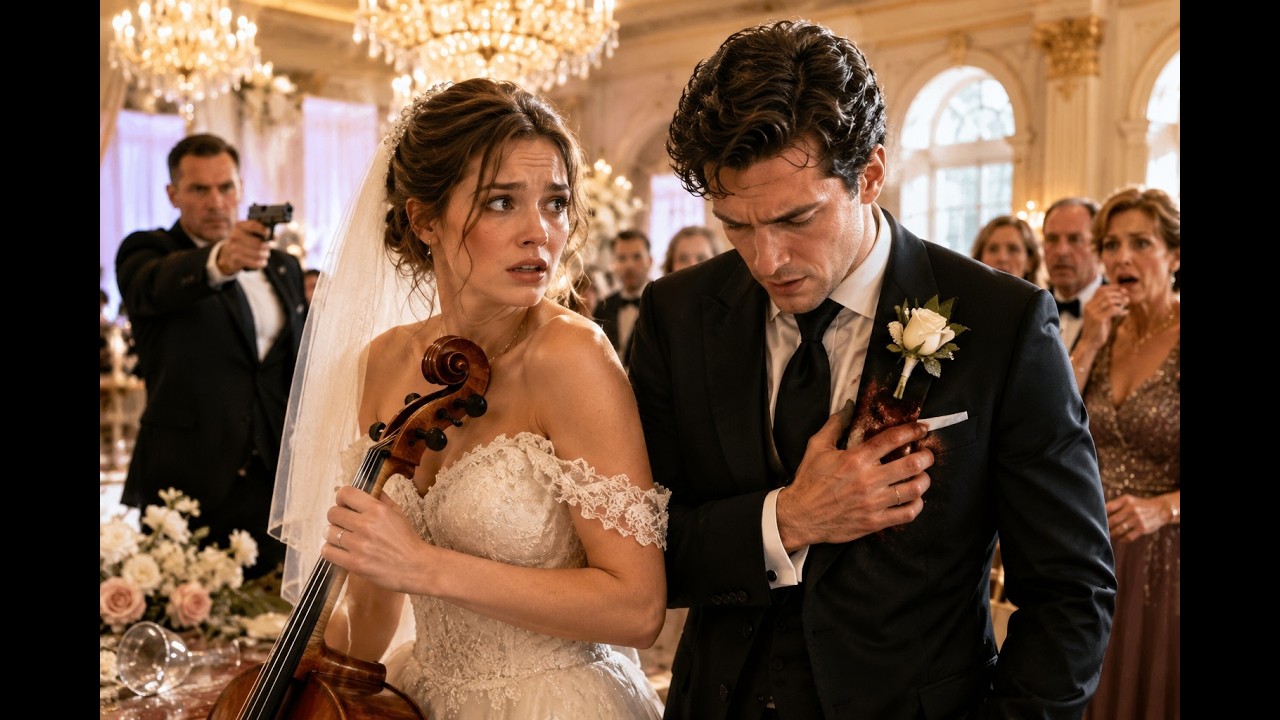
I never thought my hands, trained for Brahms and Bach, would one day grip a pistol. But standing in the blood-soaked ballroom of the Petton Hotel, watching crimson bloom across Damon’s crisp white shirt, I realized everything I’d believed about my quiet life was a lie. And the man I’d just vowed to love forever? He was the spark that ignited the war.
My name is Sienna Marlo—at least, that’s who I thought I was. Twenty-three, scraping by in Boston’s gray February slush, playing cello in the New England Conservatory’s practice rooms to drown out the echo of my mother’s funeral eight months earlier. Lung cancer had taken her fast, leaving me with nothing but rosin-scented memories and a stack of bills. Room 412 was my sanctuary. The cello didn’t judge my exhaustion from diner shifts or my lonely nights. It just demanded steady hands.
The door creaked open that Tuesday evening without a knock. He slipped in like a shadow—tall, mid-twenties, charcoal sweater hugging a frame that screamed controlled power, not the soft academic types who usually haunted these halls. Dark hair tousled, eyes like wet slate. He sat in the back row, pulling out a leather notebook as if he belonged.
“This room’s booked,” I snapped, bow hovering.
“I know,” he said, voice low and steady. “I’m not here for the room.” He glanced up. “The Brahms. You rushed the second movement. Bow arm tensed.”
Heat flushed my neck. Who was this guy? “I didn’t rush it.”
He smiled faintly. “You did. About four bars in. What were you thinking about?”
Nobody asked me that anymore. Not professors, not coworkers, not the friends who’d faded after Mom’s death. “My mother,” I admitted, surprising myself. “She used to watch my hands.”
Something flickered in his eyes—not pity, but recognition. “Damon Whitlock,” he said, extending a hand. His grip was firm yet careful, like a man who knew his strength could break things.
He returned every Tuesday and Thursday. “Logistics,” he claimed vaguely. Overseas childhood, complicated family. I noticed the patterns musicians catch: always facing the door, stairs over elevators, the way he tensed at sudden noises. But in a city of tired eyes, his attention felt like music—rare and intoxicating. For the first time since the funeral, I wasn’t just surviving. I was seen.
By April, the black SUV across from the conservatory felt off. I joked about it. Damon’s face drained of color for a split second before he brushed it off. That night, he showed up at the diner unannounced, jaw tight. “Leave with me. Now. No bag, no goodbyes.”
“Damon, I’m working—”
“Please.” Fear edged his voice, the controlled kind forged in fire.
In the borrowed car, truths spilled like shattered glass. His real name: Damon Callaway. Son of Russell Callaway, boss of the Callaway organization out of Boston’s South End. The SUV belonged to Anton Drago, a ruthless rival hunting weaknesses. Me. I’d become leverage without knowing it.
“You’re saying I’m a target?” My voice stayed eerily calm, the same calm before a brutal cello passage.
“I should have stayed away,” he whispered, knuckles white on the wheel. “But I didn’t. I’ll fix this.”
Fear should have swallowed me. Instead, a cold clarity surged—the same resolve that kept my bow steady through grief. I’d lost everything once. No one would take what little I had left. “Then teach me,” I said. “How not to be a liability.”
He stared like I’d spoken another language. But he didn’t argue. That was the first twist: the grieving musician wasn’t fragile. I was steel waiting to be forged.
Training with Priya in a shuttered Dorchester gym was brutal. Mornings before diner shifts, I learned exits, wrist breaks, how to fall protecting my hands—the only things that had ever mattered. “You move like you’ve been waiting your whole life for permission,” Priya muttered once. She was right. For 23 years, I’d shrunk to avoid burdening anyone. Now, I claimed space.
Damon watched me change, his guarded eyes softening into something deeper. Love bloomed amid the violence—stolen kisses in safe houses, nights where his arms chased away the shadows. Russell Callaway, broad-shouldered with silver hair and eyes like held breath, approved quietly. “Normalcy is armor,” he said. I kept the diner job, the cello practice. But I was no longer ordinary.
June brought the wedding—his cousin’s at the Petton Hotel, neutral ground for a fragile truce. I wore borrowed green, feeling like an imposter beside Damon in his tailored suit. For one golden hour, candlelight on champagne, I believed in futures. Laughter, vows, his hand steady in mine as we promised forever.
Then chaos erupted.
Glass shattered across marble as the first gunshot cracked. “Here comes the bride,” a voice snarled from the shadows. Drago’s men had infiltrated, turning the reception into a battlefield. Bullets whined. Guests screamed. Damon’s shirt bloomed red as he shoved me behind a pillar.
“Sienna! Stay down!”
But I didn’t. Training kicked in like muscle memory. I scanned exits, grabbed a fallen waiter’s knife—improvised weapon. A gunman lunged at Damon, who was bleeding but fighting like the heir he was. I moved without thinking: disarmed the attacker with a wrist lock Priya drilled into me, drove my elbow into his throat. He dropped.
“Behind you!” Damon roared.
Another twist—Drago himself emerged, smirking, flanked by shooters. “The Callaway princess. Easy target.”
But I wasn’t. As Damon traded fire, covering Russell’s flank, I slipped through the panicked crowd. My heart hammered a deadly rhythm. I reached the stage, where my cello case had been stashed for a surprise performance. No time for music. Inside was more than the instrument—Damon had hidden a backup piece there weeks ago, a precaution I now thanked the stars for.
I fired. The shot grazed Drago’s arm, buying seconds. Damon tackled him, fists flying in a blur of blood and fury. But Drago had one final card: a hidden detonator wired to the hotel’s support columns. “If I go, we all do!”
The room froze. Guests cowered. Russell barked orders, but chaos reigned. In that heartbeat, the biggest twist hit me. As I grappled with a fleeing guard for the detonator, my mother’s old locket— the one she’d clutched at every recital—slipped from my neck. It wasn’t just sentimental. Inside, a micro-drive. Mom had worked in the bakery above which I’d played, but whispers from her past surfaced in flashes: connections to the old families, secrets she’d buried to protect me.
“You’re not just a Marlo,” Drago laughed through pain as I pinned him. “Your blood ties the families. That’s why I wanted you—leverage on both sides!”
The revelation stunned me. Mom’s “complicated” history explained the isolation, the quiet strength. I wasn’t ordinary. I was the bridge.
With Damon’s help, we disarmed the bomb. Sirens wailed in the distance. Drago’s men fell or fled. In the smoking ruins, Damon pulled me close, his wound superficial but his eyes fierce with pride and love. “You saved us all.”
Russell nodded approval, a new respect in his gaze. “Welcome to the family, Sienna Callaway.”
We escaped into the night, but the war was far from over. Drago survived, vowing revenge. My cello now sat beside concealed weapons in our new safe house. I played it still—Brahms with bloodstained hands—but now it fueled a different fire. Love in the mafia underworld wasn’t soft. It was forged in gunfire, twists of fate, and unbreakable loyalty.
As I watched Damon sleep, bandage fresh, I smiled into the dark. The quiet student had become the storm. And together, we’d face whatever came next—not as victims, but as legends in the making.