I Caught My Groom and Sister Cheating Ten Minutes Before the Altar—Then Played Their Audio to 200 Guests and Walked Away.
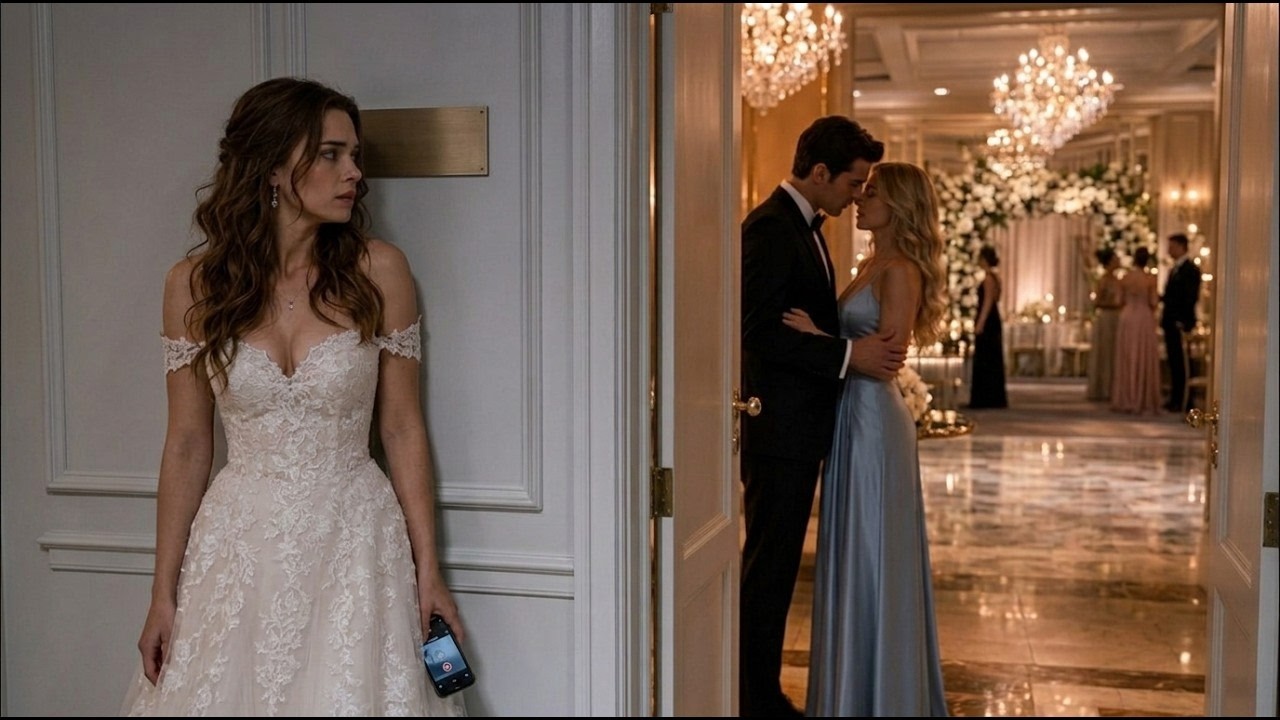
Ten minutes before I was due to walk down the aisle, I discovered that the man I had loved for three years had never truly seen me.
He only saw the wealth behind me.
And the woman beside him, whispering plans to steal it all, was none other than my own sister.
Two hundred guests were waiting outside. The wedding dress weighed heavily on my shoulders. In my hand was a recording that could shatter everything.
My name is Isabella Voss.
The morning light came through the tall windows of the Voss estate’s east wing in long pale sheets, the kind of light that made everything look cleaner than it was. I stood in front of the mirror in the bridal suite and did not recognize myself. The dress was my grandmother’s, altered three times to fit a body that had changed over the years—wider at the hips, sharper at the collarbone. The seamstress had done her work well. From a distance it looked perfect. Up close I could see the places where the seam strained, where old silk had been carefully hidden beneath new panels.
I understood the metaphor only later.
My maid of honor, Clare, was fussing with the veil behind me, talking about the florist, a missing centerpiece, a groomsman who had shown up already half-drunk. I was only half listening. I was watching my own eyes in the mirror. They looked very still.
“You ready?” Clare asked.
“Almost,” I said. “Give me ten minutes.”
Clare hesitated. She had known me since we were both fourteen. She had seen me through two broken engagements, a company acquisition that nearly killed me, and the death of my father four years ago. She knew what I looked like when something was wrong.
“You okay?”
“I just need a minute to breathe,” I said. “Go check on the guests. Make sure the Harmon table isn’t seated next to the Brennan table. Last time they were in the same room, someone threw a shrimp fork.”
Clare almost smiled. She left.
I listened to the door close. I counted to five. Then I picked up the small digital recorder I had placed inside my cosmetics bag beside the lipstick I hadn’t used, and I pressed play.
Julian’s voice came out of the tiny speaker—low, familiar, slightly impatient. The voice I had fallen asleep listening to for three years.
“Doesn’t matter. Once it’s legal, we move on the trusts. The family attorney is old and slow, and he trusts her instincts. So we need her to feel secure for at least another six months.”
Then Sophia’s voice—lighter, a little breathless. The voice of someone enjoying herself.
“She will. She always does. Isabella trusts people too much. It’s her whole thing.”
“That’s why this works,” Julian said.
A pause. A sound I had spent two days trying not to think about—the specific silence of two people standing very close together.
“After the honeymoon, you start pushing for a seat on the Meridian board. I’ll back you from the outside. She won’t fight you on it. Not if she thinks it’s coming from a place of family.”
Sophia laughed, low and genuine.
“God, she’s going to be so easy.”
I stopped the recording.
I set the device down on the vanity with the same precise care I used when handling documents that could not be reprinted. My hands were not shaking. I noticed that. I had expected them to shake. Instead there was something else—a cold, deep stillness moving through my chest like a door being shut very quietly in a very large house.
I looked at myself in the mirror again. The dress still looked perfect from a distance.
I opened the cosmetics bag again and took out my phone. I pulled up the name of my attorney, Marcus Webb, and typed four words.
Recording secured. Be ready.
Sent it.
Then I reapplied my lipstick, picked up my bouquet—white peonies, my choice over Julian’s suggestion of calla lilies—and walked out of the bridal suite.
The corridor outside was thick with the controlled chaos of a large wedding running ten minutes behind schedule. A photographer moved past me backward, shooting something. Two of my cousins from my father’s side were arguing quietly near the staircase. The harpist, posted at the corner of the landing, had started playing something I didn’t recognize—unhurried and slightly melancholy.
I found Julian in the small anteroom off the main hall where the wedding coordinator had set up the groom’s staging area. A cart with champagne no one was supposed to touch yet. A mirror for last-minute checks. A folding table with a seating chart the coordinator kept adjusting.
He was alone.
He looked, as he always did, like he had been assembled from a catalog of what a certain type of woman wanted—tall, broad through the shoulders, a jaw that photographed well. He had the kind of easy confidence that came from never having been told no by anyone who mattered to him.
He saw me and his face did what it always did—the smile, the warmth behind the eyes that I had believed for three years was real.
“You look incredible,” he said.
“Thank you,” I said.
He crossed the room and took my hands. His were warm and dry. He smelled like the cologne I had given him last Christmas.
“A little nervous?” he asked.
“No,” I said.
Something in my voice made him look at me more carefully, just for a second. A flicker of recalibration behind his eyes. Then it was gone.
“Ten minutes,” he said. “Then it’s done.”
“Yes,” I said. “Then it’s done.”
I left him there and walked toward the main hall.
The Voss estate had been built in 1887 by my great-great-grandfather, a man who had started with a single freight company and turned it into a logistics empire that eventually branched into real estate, finance, and then, under my father’s hand, investment banking. The house had been renovated six times and preserved twice and had survived two fires, one of which had taken the original east wing entirely. What stood now was a reconstruction, careful and exact, built to match photographs of what had been lost.
My father had always thought that was practical.
“You preserve what you can,” he used to say. “You rebuild what you lose. But you don’t pretend the two things are the same.”
The main hall could seat two hundred fifty. Today it held just over two hundred—the precise number my mother had insisted on after three separate conversations about the guest list that had each ended with someone raising their voice. The chairs were arranged in long rows facing the elevated platform at the far end, dressed in white fabric and pale greenery. The flowers were real. The lighting was soft and deliberate.
I stood at the edge of the entrance corridor and looked at it all. Two hundred people who had come to watch me get married—business associates and family friends and cousins I saw once a year and a handful of people I genuinely loved. My mother, seated in the front row in a pale blue dress, was talking to someone beside her, composed and upright, the way she had been composed and upright at every significant moment of my life.
In the second row on the groom’s side I could see the faint outline of Sophia’s profile. My sister had been asked to sit in the audience rather than stand as a bridesmaid—my decision, made six months ago for reasons I had given as logistical and which were actually instinctive. I had felt something wrong then and had no name for it.
I had a name for it now.
I took out my phone one more time, opened the audio file I had transferred there that morning—the full recording, eleven minutes and forty-three seconds of conversation captured through a small device placed in the library adjoining Julian’s study, where I had found him on the phone two nights ago and stepped back before he heard me. I had set the recorder on the shelf and walked away and spent two days trying to make myself believe I had misunderstood.
I had not misunderstood.
I sent the file to Marcus Webb with the message: Stand by. You’ll know when.
Then I put my phone in the small pocket hidden in the skirt of the dress. The seamstress had added it without being asked because the seamstress had known me for twelve years and understood that I always needed somewhere to put my hands when they weren’t occupied.
The wedding coordinator appeared at my elbow, flushed and efficient.
“We’re ready when you are, Miss Voss.”
“One moment,” I said.
I looked at the hall again—at the flowers and the light and the two hundred people who had come to watch something they believed was true.
My father had told me once near the end, when the medication was making him slow and honest in ways he hadn’t been before: “The worst thing you can do in business is let someone mistake your patience for weakness. They’ll keep taking until there’s nothing left, and then they’ll act surprised.”
I had thought he was talking about business.
“Okay,” I said to the coordinator. “Let’s go.”
The music shifted when I appeared at the entrance. The harpist transitioned into something brighter, more formal, and the two hundred heads turned in a single slow wave, the way crowds do when they feel the moment beginning.
I walked without hurrying. I kept my eyes forward and my chin level and my hands steady around the stems of the white peonies.
Julian was standing at the platform, watching me come. The smile was there, wide and warm, and directed at me like a light.
The officiant, a man named Fletcher who had performed three other Voss family ceremonies, stood ready with his papers. He was a careful man, particular about timing and phrasing, and he had spent two weeks preparing remarks about commitment and partnership and the specific courage it took to choose another person.
He would not get to deliver them.
I reached the platform. I took the two steps up and stood across from Julian and looked at him. His eyes were warm. His hands reached for mine. I gave him my left hand. In my right I was holding my phone.
“Before we begin,” I said.
My voice carried. The acoustics in the hall were excellent. I had always known that. I had given presentations here. I had spoken at my father’s memorial here, standing in almost exactly this spot.
Fletcher looked at me, a small frown of confusion.
“Isabella,” Julian said, low and gentle, a note of private humor. “We’re about to—”
“I know,” I said. “This will only take a moment.”
I pressed play.
The recording came out of the phone speaker at full volume, and the hall went from murmuring to silent in the span of a breath.
Julian’s voice, clear and unmistakable:
“Doesn’t matter. Once it’s legal, we move on the trusts. The family attorney is old and slow, and he trusts her instincts. So we need her to feel secure for at least another six months.”
I watched his face. Watched the warmth drain out of it in real time, replaced by something I had never seen there before. Not panic exactly. Something colder. The face of someone running calculations.
Sophia’s voice:
“She will. She always does. Isabella trusts people too much. It’s her whole thing. That’s why this works.”
The pause. The silence of proximity.
“After the honeymoon, you start pushing for a seat on the Meridian board. I’ll back you from the outside. Family.”
Sophia again:
“God, she’s going to be so easy.”
I stopped the recording.
Two hundred people. Not one sound.
I could hear the ventilation system in the ceiling. I could hear, distantly, a car passing on the road outside the estate’s main gate.
Julian’s hand was still holding mine. He hadn’t let go. I could feel the pressure of it—not the gentle pressure of before, but something tighter, reflexive.
I pulled my hand free.
“Isabella,” he said. The warmth was gone. What was left was careful, measured—a man deciding very quickly how to manage something. “This is— You need to let me explain what you think—”
“I don’t think anything,” I said. “I know.”
I turned to face the room.
My mother in the front row, the blue dress, the composed face. Except it wasn’t composed anymore. It had cracked somewhere in the last forty seconds, and what was underneath was something I had never seen on my mother’s face before—a kind of naked, unprepared horror.
In the second row, Sophia had her hand over her mouth.
I looked at her for a moment. My little sister, seven years younger, who had grown up in the same house and shared the same last name and been handed fewer advantages and understood that on some level—and had decided, apparently at some point in the past three years, that the right response to that was this.
I felt something that wasn’t quite anger and wasn’t quite grief, something without a clean name.
I looked back at the room.
“I’m sorry you came here today for this,” I said. “I’m not sorry you heard it.”
I handed my bouquet to the stunned officiant, stepped down from the platform, and walked up the center aisle through two hundred people who parted for me without knowing they were doing it.
I did not look back at Julian.
I did not look at Sophia.
I walked through the entrance corridor and out the main doors of the estate into the pale morning light and took out my phone and called Marcus Webb.
He answered on the first ring.
“Tell me you have everything,” I said.
“Everything and more,” Marcus said. “You want to talk now?”
“Now,” I said. “Where are you?”
“Twenty minutes out.”
“The East Garden,” I said. “Side gate.”
I hung up.
I stood on the front steps of the house where I had grown up and breathed in the morning air, which smelled like cut grass and someone’s cigarette from somewhere behind the catering van. Behind me, through the closed doors, I could hear it starting—the specific noise of two hundred people processing something they hadn’t expected. Not quite chaos. Not quite silence. The sound of a story breaking open in real time.
Inside that hall, Julian Hale was still standing on the platform. I knew him well enough to know he hadn’t moved yet, that he was still in the first phase, still assembling his version of events, still calculating which story to tell and to whom. He was very good at that. Three years had taught me exactly how good.
What he didn’t know yet—what he had never thought to look for because he had looked at Isabella Voss and seen a woman who trusted people too much—was that the investment firm that had been quietly financing his expansion for the past two years, the one he knew only as Meridian Capital Partners, the one whose backing had allowed him to triple his portfolio and take on debt at terms no bank would have offered him cold, was not run by the distant institutional entity he believed it to be.
It was mine.
I had spent four months preparing the documents Marcus was about to bring me.
But right now, in the East Garden, the morning was quiet, and the grass was still wet from the night before, and I stood at the side gate and waited, and felt, underneath the cold and the grief and the thing without a name, something that surprised me.
I felt very, very clear.
My phone buzzed. A message from a number I didn’t recognize at first. Then I looked more carefully and realized I did recognize it—an old number, one I had deleted eight months ago when something had felt wrong and I hadn’t let myself examine why.
The message was from Sophia.
He told me you already knew. He said you were planning to sell Meridian and cut us both out. I believed him. Isabella, I am so—
I locked my phone without reading the rest.
The gate clicked.
Marcus Webb came through it carrying a leather briefcase and the specific expression of a man who had been waiting for a call like this for some time and was not surprised to have received it.
“Okay,” he said, looking at me with something careful and professional that almost covered the concern underneath. “How are you doing?”
“Fine,” I said. “What do we have?”
He opened the briefcase and spread three documents on the flat surface of the garden stone bench, anchoring them against the morning breeze with his briefcase and his palm.
“Annulment on grounds of fraud is clean,” he said. “You were induced to enter the marriage contract under false pretenses. The recording establishes intent. We have text message records going back nineteen months that I’ll walk you through. My paralegal pulled them from the backup you gave us in February.”
“February?” I said.
“You gave us the phone backup in February,” Marcus said without inflection. “You said you wanted the records preserved in case you needed them.”
I knew what I had said.
I had given him the backup after a night when Julian had been on the phone in the kitchen at two in the morning and had ended the call the moment he heard me on the stairs. I had told myself it was nothing. I had given Marcus the backup the next morning before I had time to talk myself out of it.
Marcus continued.
“Meridian Capital Partners is already in the process of calling every note. Julian’s expansion debt comes due in sixty days. He won’t be able to refinance. Not with this recording circulating. And the board seat Sophia wanted? The one she was going to push for after the honeymoon? That seat doesn’t exist anymore. I dissolved the relevant entity this morning.”
I looked at the documents. Clean. Precise. Final.
Behind us, from the main hall, the sound of raised voices was just beginning to reach the garden. Julian’s voice, I thought, though I couldn’t make out the words. Managing. Explaining. Building something out of the wreckage.
What he hadn’t yet discovered was that the wreckage was not the worst of it.
What he hadn’t yet discovered was what I had built underneath him, patient and invisible for two years, and what I was about to do with it.
Marcus closed the briefcase.
“You want me to handle the guests?”
“No,” I said. “They already heard everything they needed to hear.”
I looked back at the house where I had grown up—the reconstructed east wing, the carefully preserved facade, the long driveway where two hundred people were now trying to decide what story they would tell when they got home.
I thought of my father’s voice.
They’ll keep taking until there’s nothing left, and then they’ll act surprised.
I was not surprised anymore.
I turned to Marcus.
“Let’s go,” I said.
And for the first time in three years, I walked away from something that had never been real without looking back once.