He Gave My Seat at the Gala to His Mistress in Front of 200 Guests… So I Built an Empire Without Him.
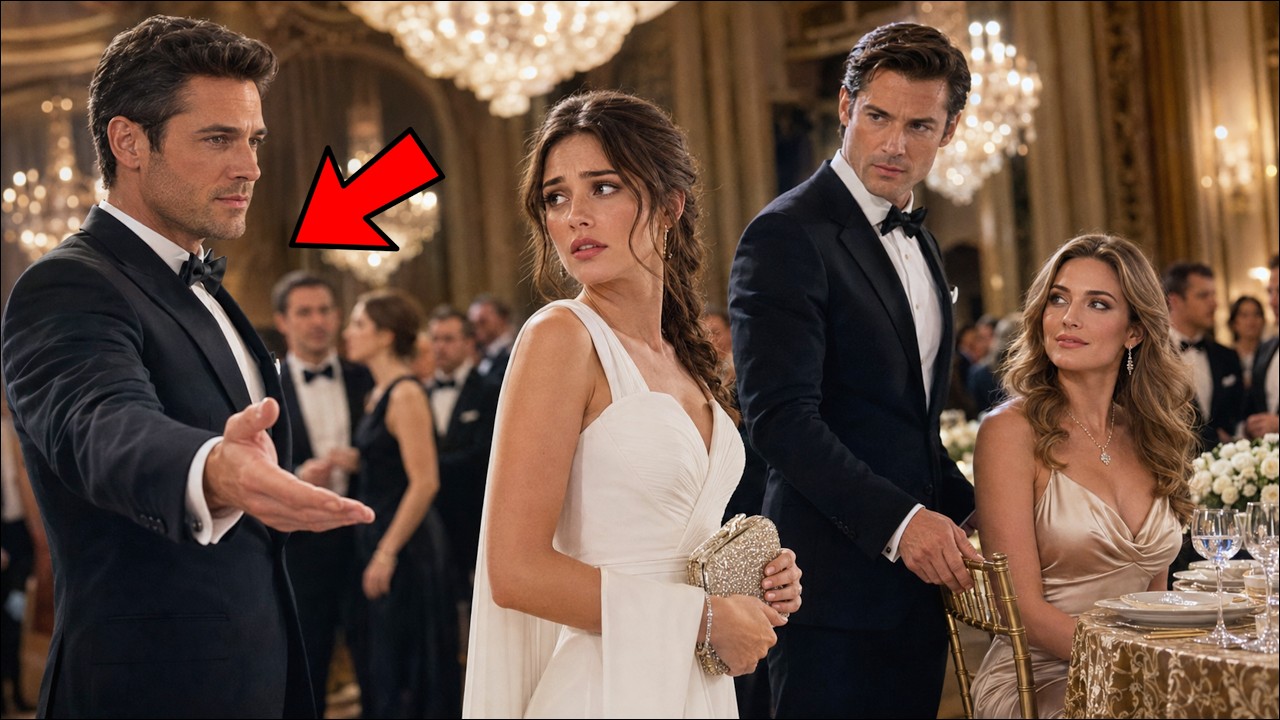
My husband lifted my place card from the seat beside him and laid it in front of his mistress.
“Nicolette needs to be seen tonight,” he murmured as he pulled out my chair for her. Then he looked at me, still standing before two hundred guests, and asked me not to make a scene.
For one foolish second I thought I had misunderstood him.
Crystal chandeliers scattered warm light across the ballroom. A string quartet played near the windows. Waiters moved between the tables with silver trays of champagne. Everything looked too polished for something so ugly to be happening.
Nicolette lowered herself into my chair. Ivory silk slid over her knees. She placed one hand beside my name card, displaying the thin gold bracelet Declan had once told me was a gift for an investor. It was engraved with the date of his company’s founding.
Declan adjusted his cufflinks. He would not look directly at me.
“There’s a place for you near the event staff,” he added. “It’s only for dinner. The investors need to understand that Nicolette is leading the new launch.”
The chair scraped softly as she moved closer to him. That sound hurt more than shouting would have.
I had spent the afternoon helping him choose his speech. I had fixed the loose button on his tuxedo in the car. Ten minutes earlier he had kissed my cheek for the photographers and called me his steady hand. Now his hand rested on the back of Nicolette’s chair.
“You knew before we arrived,” I told him.
Declan’s jaw tightened. “This is not the time.”
Nicolette tilted her face toward me. Her expression was composed, almost sympathetic, but triumph brightened her eyes. “I offered to sit somewhere else,” she said. “Declan insisted. Tonight matters to the company.”
She had not offered. I could hear it in the softness of her voice. She wanted me to understand that she could lie while sitting in my place and my husband would support her version.
Guests at the neighboring table had stopped pretending not to watch. A woman in emerald satin studied her menu without turning a page. Somewhere behind me a camera shutter clicked.
I could have thrown the champagne. I could have demanded an explanation loud enough to silence the quartet. Instead I picked up my evening bag.
“Enjoy the seat,” I said. “You may learn what it costs.”
Declan caught my wrist before I could turn. His fingers pressed against my pulse.
“Nadia, don’t punish me for making a business decision.”
I looked down at his hand until he released me. “A business decision doesn’t usually wear perfume you bring home on your shirts.”
Color rose along his collar. Nicolette’s practiced smile disappeared.
I walked away before either of them recovered. The ballroom seemed twice as long as it had when we entered. My heels sank into the carpet. The air smelled of gardenias and roasted meat. Every step carried me past someone who knew Declan Roark—founder, controlling owner, the man who had expanded one aging hotel into an eight-property group. I could feel the question following me: What had his wife done to deserve being removed from his table?
I was ten feet from the exit when a man stepped into my path.
Everett Lang was taller than Declan and quieter than everyone around him. He owned Northline Hospitality, the only regional group that had beaten Declan for three major properties. My husband spoke Everett’s name the way other people spoke about mold behind a wall.
Everett glanced past me at the head table. His expression did not change, but he had seen enough. Then he held out his hand.
“Dance with me, Nadia.”
I almost laughed. “You hate my husband.”
“Tonight that isn’t the reason.”
The quartet had shifted into a slow arrangement. Several couples were already moving toward the floor. If I refused I would still have to cross the lobby alone while people watched. If I accepted, Declan would call it a betrayal. He had just given my chair to the woman wearing his gift.
I placed my hand in Everett’s.
He guided me onto the floor without looking back at Declan. His palm rested lightly below my shoulder blade, leaving enough space between us to make his intention clear. He was not claiming me. He was helping me remain upright.
“You don’t have to talk,” he said.
That may have been the kindest thing anyone had offered me all evening.
For the first few measures we moved in silence. I concentrated on the polished floor and the measured pressure of his hand. When I finally looked up, Everett asked whether I remembered the lodging conference in Denver six years earlier. At the time I had managed operations for a struggling convention hotel. I had presented a case study about employee turnover and service failures. Declan had attended my session, though we were not yet married. Everett had challenged every number on my final slide.
I reminded him that he had been irritating.
The corner of his mouth lifted. “You were right.”
That surprised a breath of laughter out of me.
Across the room Declan sat rigidly beside Nicolette. His eyes followed us. She leaned toward him, speaking close to his ear.
Everett noticed. “Northline bought the Bellwether in Milwaukee last month,” he said. “Beautiful building. Disastrous operation. I need an independent assessment before I decide whether to renovate or sell.”
I pointed out that I had left the industry two years earlier.
“Those two years do not erase the previous twelve,” he answered. “Proposals are due Monday at noon. My assistant will send the scope if you want it.”
There was no rescue hidden in his offer. That made it more tempting.
The song ended. Everett released my hand immediately and offered a plain white business card. I tucked it into my bag without promising anything.
When I looked toward the head table again, my former place had vanished beneath Nicolette’s handbag.
I left the gala alone. Outside, Chicago wind swept between the buildings and lifted the hem of my dress. The river carried broken reflections of office lights. I stood beneath the hotel awning, breathing air that smelled of rain and traffic. Declan’s driver hurried toward me. I shook my head, ordered a car on my phone, and waited beside a planter filled with white roses.
My hands began shaking only after the ballroom doors closed behind me.
During the ride home three photographs from the gala appeared online. In the first, Declan and I smiled at the entrance. In the second, Nicolette sat beside him at dinner. In the third, I was dancing with Everett. The caption called it an unexpected realignment among Chicago’s hotel leaders. There was no photograph of my husband moving my name card. That was how humiliation worked. People often saw your reaction before they saw what had been done to you.
Declan arrived at our Gold Coast townhouse shortly after midnight. I was in the dressing room changing into jeans and a sweater. An open suitcase lay across the bench.
He stopped in the doorway. “Are you leaving?”
“Yes.”
He reduced the entire night to a dispute over a chair.
I folded another shirt. The cedar-lined room smelled faintly of his cologne. It had once comforted me.
“You gave my place to the woman you’re sleeping with.”
His face hardened, but he did not deny it. That hurt in a clean, final way.
Declan loosened his bow tie and admitted that he and Nicolette had become close during the Santa Fe acquisition. He claimed he had planned to tell me after the gala. I pointed out the specially printed place card. Whatever he had intended, my public replacement had not been spontaneous.
“How long?” I asked.
“Five months.”
Five months took me back to a hotel terrace in Santa Fe. Declan had called from there and told me he missed me. I had been home reviewing his speech for an investor dinner.
I gripped the suitcase handle. “Would you have confessed if you hadn’t been caught?”
He repeated that he had planned to do it. It was not an answer.
Irritation replaced the discomfort on his face. He was used to ending difficult conversations by making everyone else feel unreasonable. He blamed our problems on my withdrawal from work and social events. I returned to our agreement that I needed time to recover from burnout. Afterward he had found a new reason every month for me to delay returning. He insisted he had never forbidden me. Yet he asked me to wait a little longer, and a little longer, until the waiting itself became the shape of our marriage.
I zipped the suitcase. The sound cut through the room.
“I’m done waiting,” I said.
I left that night. I did not take the car he had given me or the jewelry that carried his company’s logo. I took the clothes that still felt like mine and the quiet certainty that I would not ask for the seat back.
Monday morning I submitted a proposal to Northline. It was thorough, unsentimental, and better than the two competing submissions. Everett hired me on the terms he had outlined on the dance floor—no favors, no rescue, only the work.
The Bellwether assessment became the first of many. I rebuilt the operational systems that had once made me valuable in the industry. Clients who had known me before my marriage began calling again. Within eighteen months I formed my own consultancy. Within three years that consultancy had grown into a hospitality group focused on turning underperforming properties into destinations people actually wanted to stay in.
Declan’s company continued, but the narrative around it shifted. Investors noticed the woman who had once been called his steady hand was now competing for the same contracts—and winning more of them than expected. Nicolette’s public role grew quieter. The gold bracelet eventually disappeared from photographs.
I never returned to the Gold Coast townhouse. I never asked for an apology that would have cost him nothing and meant less. The night he moved my place card taught me the only lesson that mattered: some seats are not worth reclaiming.
The empire I built afterward carried no one’s name but my own.
And every time I walked into a ballroom now, the chair at the head of the table was already mine.