Forced to Marry a Poor Single Dad — Unaware He Was Actually the Richest Man in the Country!
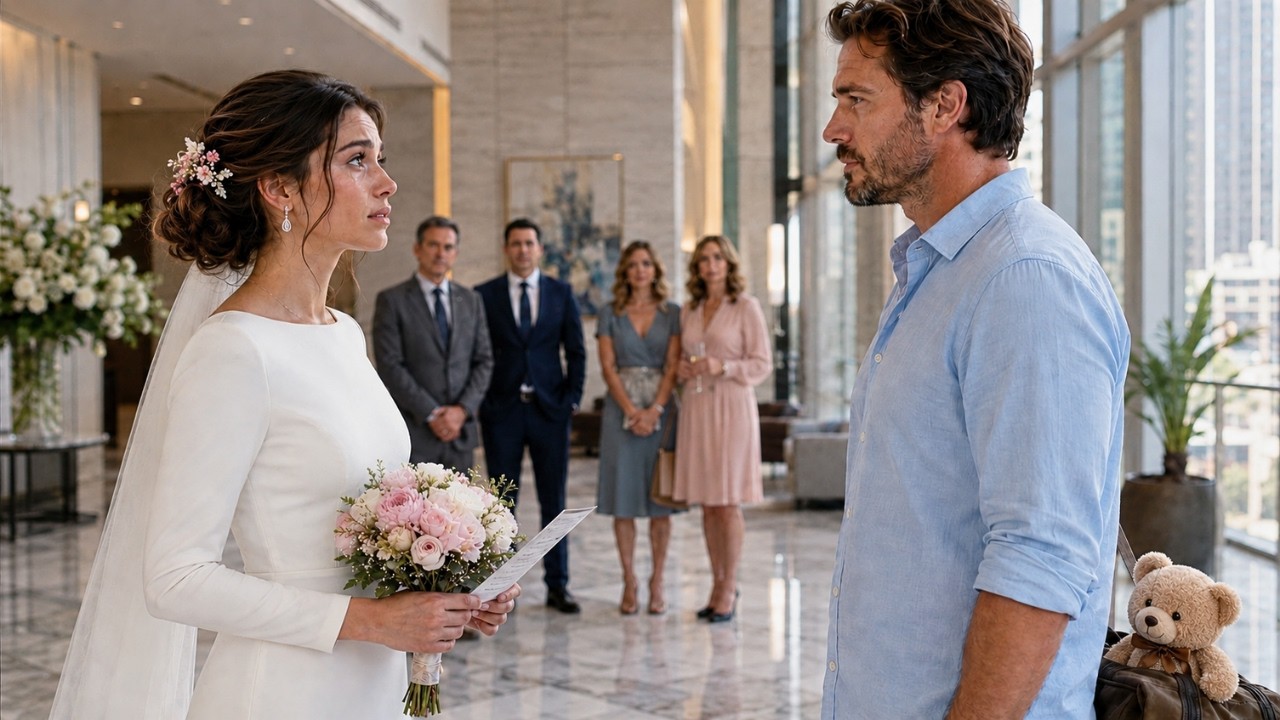
The Wedding of Whispers
The wedding lasted less than fifteen minutes, yet it carved a permanent line through the center of my life.
I stood in the vestry of a small, drafty chapel on the edge of the city, my hands trembling inside the lace sleeves of a plain, unadorned white dress that had belonged to my mother. The mirror reflected a young woman whose eyes carried the hollow, exhausted weight of a dozen different catastrophes.
Outside in the wooden pews, the guests whispered—a low, venomous buzzing of judgment that carried straight through the thin walls. They mocked the man waiting for me at the altar. They called him a washed-up, impoverished widower struggling to raise a toddler alone in a leaky farmhouse, a man so thoroughly drenched in bad luck that even his own shadow seemed to abandon him.
They looked at me with pity, whispering that my future had ended before it had even begun.
None of them knew the truth. None of them knew that the man everyone pitied was hiding the most heavily guarded secret in the nation, and that I was simply a sacrifice offered up on the altar of corporate debt.
My name is Emily Carter. For as long as I could remember, I believed that relentless hard work and absolute honesty were the keys to a stable life. I grew up in a valley town where opportunities were as scarce as winter rain and dreams were routinely sacrificed to pay the grocery bill. My father passed away when I was twelve, leaving my mother buried under mountains of medical debt and crushing anxiety.
I became the kind of daughter who bled herself dry without uttering a single complaint. I skipped college so I could work two grueling shifts—dawn at a local bakery, evenings at a dry cleaner’s—while caring for my mother’s failing lungs. I ignored my own ambitions because survival was a full-time job.
Despite every hardship, I never lost my gentleness. People in town often smiled at my steady heart, but kindness is a fragile shield against the cruel machinery of poverty.
When my mother’s condition deteriorated into acute respiratory failure, the hospital bills skyrocketed beyond anything my accounts could fathom. Every traditional bank rejected my loan applications with cold indifference. Every distant relative suddenly discovered they had their own financial emergencies.
Just when hope evaporated entirely, an influential, silver-tongued businessman named Victor Lang materialized in our lives like a polished savior.
Victor swept in with promises that sounded too miraculous to be real. He swore he would clear every medical balance, erase every collection agency’s claim, and establish a protected trust to secure my mother’s long-term care.
There was, of course, a clause. A clause that shattered my chest into a thousand jagged pieces.
I had to marry a man named Daniel Brooks—a supposed struggling single father living on the ragged outskirts of the city. Victor spoke of Daniel with casual, biting contempt, painting him as a broken handyman who barely earned enough to keep his daughter fed. Victor made it sound as though Daniel should weep with gratitude that someone like me was willing to lower herself to marry him.
With no other viable way to keep my mother breathing, I signed the papers. I walked into the chapel believing I was walking into a life sentence of quiet despair.
The Farmhouse Sanctuary
Daniel Brooks did not look like a corporate pawn at the altar.
He wore a dark suit that had clearly seen years of careful maintenance—the fabric was old and slightly threadbare, but brushed and pressed with meticulous care. His leather shoes were scuffed at the toes from years of manual labor, but polished to a dull shine.
Standing beside him was a tiny, bright-eyed six-year-old girl named Lily, clutching a bouquet of wild daisies almost as large as herself. When I stepped up beside him, Lily looked up at me with an unvarnished, innocent smile, completely unaware that the adults surrounding us viewed our union as a tragedy.
Throughout the brief, perfunctory ceremony, I noticed something deeply unsettling: Daniel never flinched. When Victor’s associates shot him looks of open, arrogant disdain, Daniel met their gaze with a calm, impenetrable dignity. His eyes carried a heavy, ancient sadness, but they also flashed with an eerie, quiet self-assurance—as though he possessed an entire deck of hidden cards while everyone else was playing checkers.
There was no lavish honeymoon. No celebratory reception. After the papers were signed, Daniel drove us out past the industrial rail yards to an old, whitewashed farmhouse nestled among acres of overgrown orchards and vegetable patches.
I braced myself for squalor and misery. Instead, I found an unexpected sanctuary.
The farmhouse was undeniably old, but it was spotless. Freshly cut wildflowers sat on the windowsills. The kitchen smelled faintly of vanilla and baking bread. The surrounding acreage was a masterclass in patient cultivation—neat rows of heirloom tomatoes, budding apple trees, and thick patches of summer roses.
Daniel did not treat me like a captive or a reluctant acquisition. He treated me like an honored guest in his home.
“You don’t have to lock your bedroom door, Emily,” he said softly on our first night, handing me a steaming mug of chamomile tea. “You didn’t choose this life, and I won’t pretend you owe me anything because a piece of paper says so. Take all the time you need.”
His words disarmed me completely. Over the following weeks, the rhythm of our strange household settled into a peaceful, almost magical routine.
Every morning before the first grey streak of dawn painted the horizon, Daniel rose quietly to prepare breakfast for Lily and me before leaving for his mysterious “odd jobs” in the city. Every evening, he returned with groceries, helped Lily with her reading homework, repaired a loose floorboard in the pantry, and spent an hour reading fairy tales by the hearth.
I had never witnessed a man so utterly, selflessly devoted to a child.
Lily slowly wrapped her small, warm hands around my heart. Having missed the steady presence of a mother since she was an infant, she attached herself to me like a morning glory vine. She followed me into the garden, helped me knead bread dough, picked wild snapdragons for my hair, and laughed with pure, ringing joy whenever I braided her dark curls.
Those simple, golden moments began to soften the frozen walls I had built around my chest. Even though I still believed our marriage was an engineered trap, I began to realize that genuine kindness and human warmth could sprout in the most neglected soil.
The Fractured Illusion
As the weeks melted away, however, the cracks in Daniel’s carefully maintained facade began to multiply.
I noticed subtle contradictions that didn’t fit the profile of a struggling handyman. His cell phone—an old, cracked model he kept in his work jacket—buzzed incessantly late into the night. Whenever it rang, he invariably stepped outside into the cold orchard air, speaking in a low, authoritative murmur that vanished the moment he stepped back inside.
On two separate occasions, sleek, tinted black luxury sedans crawled silently down our gravel lane past midnight, their headlights off, before turning around and melting back into the highway.
Then came the afternoon I stumbled upon his locked workshop in the converted barn.
Daniel had rushed out to fetch a leaking pipe fitting, leaving his heavy leather briefcase sitting on the porch bench. When a sudden gust of wind flipped the top open, several crisp, heavy documents slid onto the grass.
I bent down to scoop them up. My eyes snagged on the corporate headers: international acquisitions, multi-billion-dollar infrastructure investments, and banking syndicates spanning Zurich, Singapore, and New York. The figures printed on the pages weren’t mortgage notes or repair estimates; they were staggering, astronomical valuations involving corporate entities I only ever read about in financial newspapers.
When Daniel returned and found me holding the papers, his breath hitched. But instead of panicking, he walked over, gently retrieved the files from my numb fingers, and offered a weary, melancholic smile.
“I do freelance diagnostic consulting and office hardware repairs for major corporate conglomerates in the city, Emily,” he explained smoothly, his voice entirely steady. “Sometimes… my clients send me high-level paperwork to review for security compliance. It looks impressive, but it’s just logistics.”
It sounded plausible. It fit the narrative of a clever, hard-working technician. Yet, my instincts screamed that something profound and terrifying was being hidden just beneath the surface of his words.
Meanwhile, Victor Lang’s presence grew increasingly intrusive.
Victor visited my recovering mother at her care facility twice a week, always making sure to remind her that her medical bills were being settled by his generosity. Whenever he dropped by our farmhouse to deliver “audit documents” for my signature, his smiles felt rehearsed, oily, and predatory. He seemed less interested in our well-being and more obsessed with confirming that I was thoroughly trapped, regularly dropping loaded hints that if I ever tried to challenge the marriage, my mother’s hospital account would instantly be frozen.
The Hospital Corridor
The illusion finally shattered on a sweltering, torrential Tuesday afternoon.
Lily had been complaining of a dull ache in her side all morning. By noon, her skin burned with a terrifying, spiking fever, and she curled into a tight, shivering ball on the living room sofa, gasping for shallow breaths.
Panic seized my throat. Daniel was away in the city, unreachable by phone. Without a second thought, I scooped Lily into my arms, wrapped her in a wool blanket, and drove my sputtering old sedan straight to St. Jude’s Children’s Hospital—the most exclusive, state-of-the-art medical center in the downtown district.
The moment I pushed through the emergency glass doors, carrying a delirious Lily, the chaotic atmosphere of the triage desk shifted instantly.
A senior intake nurse glanced at Lily’s flushed face, checked her chart, and instantly froze. Her eyes darted to my face, scanning my features with a look of sudden, profound terror mixed with absolute deference.
“Get Dr. Sterling immediately,” the nurse barked into her desk intercom, her voice cracking. “Code Blue-Alpha status. Notify the executive suite right now.”
Before I could demand an explanation, a team of four attending physicians materialized out of nowhere, gently lifting Lily onto a specialized pediatric gurney.
“Wait—please, I don’t have private insurance,” I stammered, tears streaming down my cheeks. “We need to go to the community county hospital, I can’t afford—”
A tall, silver-haired chief of medicine placed a steady, reassuring hand on my shoulder. “Mrs. Brooks, please calm down. Your medical expenses at this facility—and every other specialty center in this network—are fully maintained under the primary Brooks Foundation endowment. You will never receive a bill here.”
My brain stalled. Brooks Foundation?
Before I could process the words, hospital executives and security personnel swarmed the corridor, clearing a wide path as double doors at the end of the hall swung open.
A man walked through.
He wore a bespoke charcoal suit that radiated quiet, devastating luxury. His hair was slightly disheveled from rushing, his sleeves pushed up to his forearms, but his presence commanded the entire architectural space of the sterile hospital wing.
It was Daniel.
But he wasn’t the humble, threadbare handyman who lived in our farmhouse. The slouch in his shoulders was completely gone. His posture was that of an absolute apex predator—a man used to moving mountains with a single flick of a pen.
Behind him trailed three executive vice presidents from major international banks, a row of legal counsels, and the hospital’s chief executive officer, all of them bowing their heads slightly as they spoke to him in breathless, reverent tones.
“Chairman Brooks,” the hospital director whispered, his hands clasped nervously in front of him. “We have the surgical team prepped. The appendectomy protocol is locked in. We are entirely at your disposal.”
Daniel didn’t answer the director immediately. His dark eyes scanned the crowded corridor until they locked onto mine, standing frozen beside Lily’s gurney.
The silence in the hallway was absolute. The powerful corporate titans, the elite physicians, and the administrative staff all stood in rigid, hushed deference, waiting for the man they called Chairman to issue his command.
Daniel walked slowly toward me, his boots clicking rhythmically against the polished terrazzo floor. When he reached me, he ignored the frantic murmurs of the hospital staff, reached out, and gently wiped a stray tear from my cheek with a thumb that smelled faintly of garden earth and old paper.
“I am so sorry I wasn’t there when she got sick, Emily,” he murmured, his voice rich, deep, and steady. “I tried to keep the storm away from our door for as long as I possibly could.”
I stared up at him, my voice completely lost in the hollow of my throat. “Who… who are you, Daniel?”
He offered a soft, rueful smile that didn’t quite reach his tired eyes. “I am Daniel Brooks. But my grandfather built the largest private shipping and industrial conglomerate in the western hemisphere. And the men who forced you into this marriage… are about to find out what happens when you mistake a quiet man for a broken one.”
The Corporate Execution
The operation on Lily was a complete, textbook success. Within forty-eight hours, she was sitting up in a private VIP recovery suite that resembled a luxury penthouse hotel room, happily coloring in a massive sketchbook while a private pediatric nurse hovered nearby with fresh fruit smoothies.
While Lily slept, Daniel led me down to a private conference room on the hospital’s executive floor.
Waiting for us inside were two high-powered corporate attorneys carrying heavy leather briefcases, along with a man I recognized instantly from the evening news: Victor Lang.
Victor sat at the far end of the long mahogany table. His face, usually so smug and unyielding, was completely drained of color. His hands shook visibly as he gripped the edge of the table, his expensive silk tie slightly crooked.
When Daniel pulled out a chair for me and took his seat at the head of the table, Victor let out a ragged, pathetic breath.
“Chairman Brooks,” Victor choked out, his voice trembling violently. “I… I had no idea Mrs. Brooks was your legal spouse. The acquisition files we processed through our regional bureau simply listed a standard marital arrangement—we had no intention of—”
“You had every intention, Victor,” Daniel interrupted, his voice dropping into a register so cold and devoid of mercy that the air in the room seemed to drop ten degrees. “You specifically targeted a vulnerable young woman, manufactured a fictitious financial crisis through your predatory lending fronts, and forced her into a coerced marriage as a debt-slave to satisfy your speculative real estate syndicate.”
Victor swallowed hard, looking desperately around the room for an escape route that didn’t exist. “The hospital debts… her mother’s care… we absorbed millions in liabilities—”
“And you have already been fully reimbursed,” Daniel stated, sliding a thick document across the polished wood. “Every cent you spent on Emily’s mother has been deposited back into your firm’s primary account, down to the last decimal. Along with a formal notice of criminal indictment for human trafficking, financial coercion, and corporate extortion.”
My jaw dropped. I turned my head to look at Daniel. “You… you knew?”
“I knew who was buying up the distressed mortgages in your valley town three months before our paths ever crossed, Emily,” Daniel said gently, turning his gaze toward me. “My investigators flagged Victor’s syndicate months ago for running illegal debt-trapping operations targeting impoverished families. When I discovered he was planning to use you as collateral to secure a fraudulent zoning permit for a luxury resort… I simply stepped into the path he had laid out.”
“You… you set this up?” I whispered, my mind spinning.
“I bought the debt legally, Emily,” Daniel corrected softly. “I didn’t force you into anything you weren’t already willing to do to save your mother. But I wanted to see if the woman everyone in that valley whispered about was truly as pure and selfless as my scouts reported.”
He looked back at Victor, his eyes narrowing into slits of pure steel. “And you, Victor… you didn’t just cross paths with a random baker’s daughter. You picked a fight with the majority shareholder of the bank holding your corporate overdraft notes.”
Victor slumped forward in his chair, his head dropping into his hands as the terrifying reality of his total financial annihilation crashed down upon him. Within forty-eight hours, Victor Lang’s real estate empire was systematically dismantled, his assets frozen, and federal marshals escorted him from his corner office in handcuffs.
The True Wealth
Two weeks after Lily was discharged from the hospital, we returned to the whitewashed farmhouse.
Nothing had physically changed about the house. The apple trees were still heavy with ripening fruit, the vegetable patch still required weeding, and the evening breeze still rustled the old oak trees along the lane.
Yet, everything was different.
The local town had somehow caught wind of who Daniel truly was. Overnight, luxury cars began lining our gravel lane—mayors, corporate directors, and foreign ambassadors pulling up to the farmhouse gate, hoping for a five-minute audience with the reclusive billionaire who controlled a vast global empire from a wooden desk in his barn.
Daniel turned every single one of them away. He delegated his daily corporate operations to his trusted executive board, choosing instead to spend his afternoons sitting on our wooden porch, peeling apples for Lily while I kneaded bread dough in the kitchen.
One evening, as the sun dipped below the horizon, painting the sky in strokes of bruised purple and gold, Daniel walked into the kitchen. He stood quietly behind me, wrapping his warm arms around my waist and resting his chin gently on my shoulder.
“You never asked for any of this wealth, Emily,” he murmured against my neck. “You thought you were marrying a poor, broken widower with nothing to offer.”
I turned around in his arms, looking up into his dark, steady eyes—eyes that no longer carried sadness, only a profound, unshakable peace.
“I didn’t marry you for your money, Daniel,” I said softly, resting my hands against his chest. “I married a man who loved his daughter with his whole heart, who treated me with kindness when he owed me nothing, and who fixed the floorboards without ever asking for praise.”
Daniel smiled—a wide, bright, unguarded smile that made him look ten years younger. He reached into his jacket pocket and pulled out a small, velvet-covered box. He didn’t drop to one knee; he simply held it out between us.
“The first wedding was a legal transaction engineered by monsters,” he whispered. “Will you marry me a second time, Emily? Not because a contract demands it, but because we choose each other?”
I looked down at the simple, elegant silver band resting inside the velvet box, and then up at the man who owned half the world yet chose to spend his life tending a garden in an old farmhouse.
“Yes,” I whispered, throwing my arms around his neck. “Yes, Daniel. A thousand times yes.”
True wealth, I finally understood, was never measured by the digits in a bank account, the title on a corporate tower, or the scale of an empire. It was measured in the quiet moments of unshakeable loyalty, the warmth of a child’s laughter, and the steady, unbreakable rhythm of two hearts building a home together from the ground up.