He Changed the Locks on Our Marriage — Then the Quiet Woman He Underestimated Locked Him Out of Everything He Built.
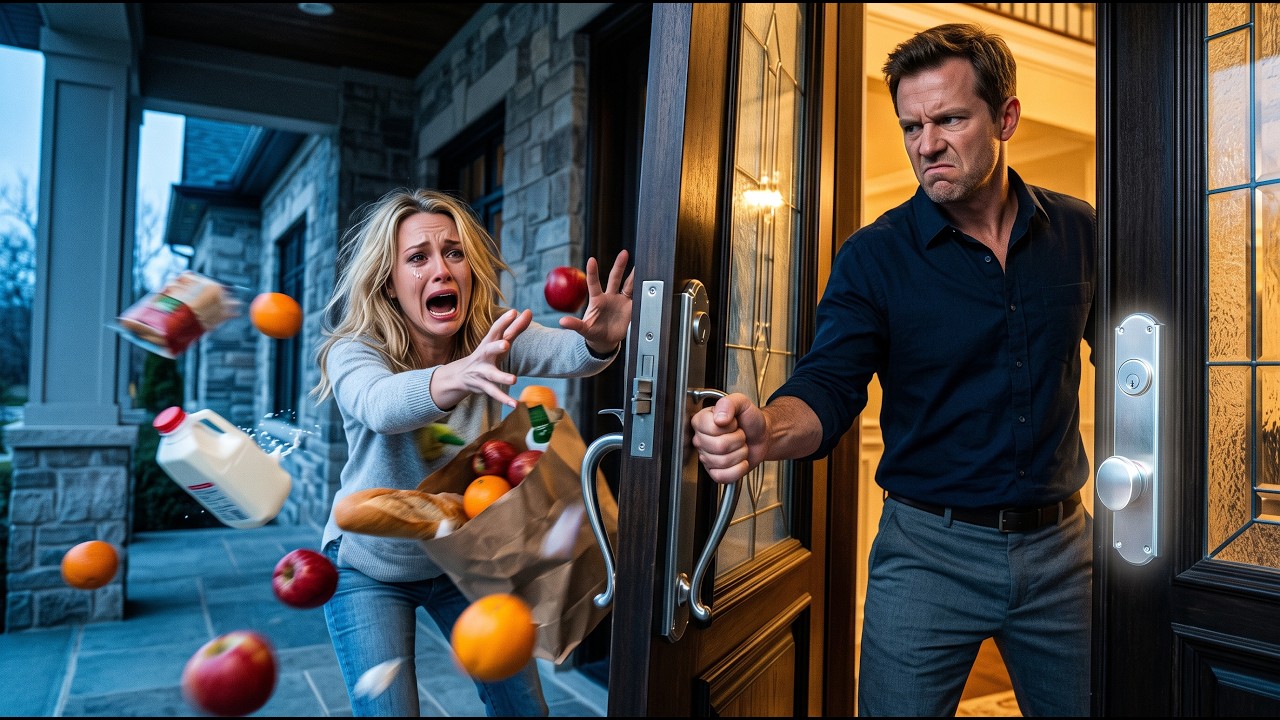
I stood on the porch of the house I had lived in for nine years with two paper bags of groceries cutting into my fingers, and the key card failed for the third time. Through the frosted glass I could see the kitchen light on. I could hear the television. I rang the doorbell.
It took almost a full minute for him to open it. When he did, he didn’t step back. He stood in the doorway with one hand braced against the frame, blocking it without quite looking like he was blocking it — the practiced posture of a man who had rehearsed this moment.
“My key isn’t working,” I said.
“I know,” he answered. “I changed the locks this morning.”
I waited for the joke, the explanation, anything that would make the world right itself. Nothing came.
“You changed the locks on our house.”
“On my house,” he said, and the flatness in his voice told me this was not the start of a fight. It was the end of one I had never been invited to. “You’re not my wife anymore. Not really. I think you stopped being that a long time before either of us said it out loud.”
I stood there in the cooling evening air while the bottom of one grocery bag began to tear, and understood that somewhere in the last several months — while I had been paying bills, going to work, asking him if he wanted chicken or pasta — my husband had built an entire case against our marriage and delivered the verdict without ever calling me to the stand.
I did not scream. I did not cry on that porch. I turned around, put the bags in the car, and drove to my sister’s apartment.
For the first eleven days I did the only thing I had ever been truly good at: I stayed calm and I stayed close. I met him for coffee. We divided furniture in clipped, businesslike tones. He was unnervingly calm the entire time. No raised voice. No messy guilt. Just variations of the same line: “This has been coming for a long time. I think you know that.”
I didn’t know that. That was the detail that kept me awake on the pull-out couch, staring at a ceiling that was not mine. There had been no fight before the locks changed. No slow fade I could point to. Just an ordinary Tuesday and a door that no longer opened for me.
On the ninth day, during one of those careful coffee meetings, he mentioned almost offhand that he had already talked to “a friend who knows about this stuff” about how to handle the house. I let it go. Pressing felt petty next to the larger devastation. Later I would understand that everything sounds like nothing until you look at it twice.
My sister refused to let it stay nothing.
“Men don’t talk to a friend about divorces unless the friend is a lawyer,” she said, wine glass in hand, eyes sharp. “And they don’t casually mention lawyers unless they’ve already been talking for a while. You’ve spent a week and a half letting him set the pace of every conversation. He tells you when to meet. He tells you what to divide. He tells you you’re not his wife anymore and you accept it like a weather report.”
I had no defense. It was true.
“So what do I do?”
“You stop reacting,” she said. “And you start finding out what actually happened. Because I don’t think this marriage quietly died. I think somebody killed it on purpose, and you’re the only one in the room who doesn’t know that yet.”
The first real thread came from my own name — or rather, the places it had quietly stopped appearing.
I logged into the joint account on a Thursday morning, something I hadn’t bothered to check in months. Four months earlier a second account had been opened. His name only. Into that account, over the following months, nearly thirty thousand dollars had been transferred out of the savings we had built together for a decade.
I sat at my desk at work for almost twenty minutes without moving, the number glowing on the screen like something radioactive. That evening I called him, voice as level as I could make it.
“There’s a second account with thirty thousand of our savings in it.”
A pause longer than it should have been. “I moved some money for expenses.”
“What expenses?”
“Legal fees. Moving costs. Things I needed to handle. I didn’t think I needed to run every dollar by you anymore, given where things are.”
“We are still married. That money is still half mine.”
“For now,” he said, and hung up.
“For now.” The phrase sat in my chest like a stone.
My sister and I spread the numbers across her kitchen table like a crime-scene diagram. “Thirty thousand doesn’t disappear into legal fees and moving costs,” she said. “That’s a down payment. That’s something with a shape. ‘Expenses’ is what men say when they don’t want you asking what the shape is.”
It took more quiet digging — public records, a careful conversation with a mutual acquaintance who still liked me more than she liked keeping secrets — before the picture resolved. The “friend” was a property developer. Three months before the locks changed, a small lakeside cabin two hours outside the city had been purchased under an LLC that traced, through two shell layers, back to my husband. Bought with money that was supposed to be half mine. Hidden behind paperwork designed so I would never think to look.
“He’s been planning an exit,” my sister said quietly, staring at the property records. “For months. Long before he ever said a word to you.”
The money was never the real betrayal. It was only the door that led to it.
I didn’t confront him again. Every direct question just handed him another chance to rehearse an answer. Instead I waited and watched, turning the same patient stillness he had used against me quietly back in his direction.
The crack came from an old joint subscription neither of us had bothered to cancel. A dinner reservation confirmation forwarded automatically to an email address I still technically shared. Two names on the booking. His. And a name I didn’t recognize at first — until the memory landed with a slow, sick lurch.
She was the architect his firm had brought on eight months earlier. I had met her once, briefly, at a company holiday party. Easy laugh. She had complimented my dress and asked, with what seemed like genuine interest, how we had met.
I sat with the receipt open on my laptop for a long time before I called my sister.
“There’s a woman,” I said, and heard my own voice come out steadier than I expected. “She works with him.”
“How long?”
“I don’t know yet. But the cabin… I don’t think that was ever going to be his alone.”
Once I knew what to look for, the rest of the picture arranged itself with the grim clicking precision of a lock finally turning the right way. A colleague from his office — someone I had stayed friendly with independently of the marriage — mentioned carefully, apologetically, that the two of them had been close for the better part of a year. Close enough that people in the office had started making quiet jokes long before I had any idea anything was wrong.
The final piece came from her own social media. An account set mostly to private except for a handful of photos visible to anyone. One posted four months earlier of a lake at golden hour, captioned only with a single word: “Ours.” I recognized the dock immediately. I had seen it in the property listing photos days before.
I sat with the phone in my lap that night looking at that photo, and something in my chest that had been braced and aching for two weeks finally, quietly, went still.
He hadn’t fallen out of love with me slowly. He had built an entire second life — a woman, a cabin, a private account funded by money that was half mine — and once it was fully constructed he had come home on an ordinary Tuesday and changed the locks, framing an affair as an ending I had somehow failed to see coming.
“You’re not my wife anymore.” He had said it like an observation. It had been a plan.
I didn’t cry when I finally understood the full shape of it. I sat very still in my sister’s living room for almost an hour, turning the pieces over — the account, the cabin, the woman, the locks — until something in me settled into a version of myself I didn’t fully recognize but trusted immediately.
“I’m not going to yell at him,” I told my sister. “I’m not going to show up at the house and make a scene. He’d like that. It would make me the unstable one and him the man who finally had a reason to leave.”
“So what do you want to do?”
“I want to make sure that when this is over he has nothing left to hide behind. I need a lawyer. A good one. Someone who understands hidden assets, not just who keeps the china.”
The lawyer my sister found was a sharp, unhurried woman who listened to the entire timeline without interrupting once — the way people do when they are already three steps ahead of the story and simply letting the client catch up.
“He used a joint asset to fund something he then transferred into a solo-owned LLC,” she said, tapping the printed documents. “That’s not just morally ugly. Depending on the laws here, that’s dissipation of marital assets. Potentially fraudulent conveyance if the transfer happened after he’d already begun planning the separation. Judges do not look kindly on spouses who quietly move money out of reach before filing.”
“So I have a case?”
“You have a very good case. But cases like this move faster and cleaner when the other side doesn’t know you’re building one. Has he filed anything yet?”
“Not that I know of.”
“Then here’s what we’re going to do.” For the first time something like a small, controlled smile crossed her face. “We’re going to let him think you’re exactly where he left you — sad, slow, reactive. And while he’s busy believing that, we’re going to file for an emergency asset freeze on every account he touched in the last six months, including the LLC. He won’t see it coming until it’s already signed.”
I felt something in my chest unclench for the first time in weeks.
“And the other woman?”
“She’s about to become a very inconvenient complication in her own career once her employer finds out she was conducting an affair with a married client while helping structure a real estate deal that hid marital assets from that client’s spouse. I don’t need to touch her directly. I just need to make sure the right information reaches the right desk.”
The trap, once she laid it out in full, was almost elegant in its restraint. No confrontation. No dramatic reveal across a dinner table. Just paperwork filed quietly, timed precisely, designed to close every door he thought he still had open before he even realized I had found the key.
For the next two weeks I played my part exactly as instructed. I met him for one more amicable coffee. I let him talk about furniture and moving dates. I nodded when he mentioned, almost gently, that he thought this arrangement was better for both of us in the long run. I watched him perform kindness toward a woman he believed had no idea what he’d done, and I said nothing, because I had learned that silence held correctly could be its own kind of weapon.
Then, on a Wednesday morning while he was in a client meeting he could not leave, the asset freeze was filed and approved.
That was only the beginning.
The complication came from a direction none of us had fully anticipated — the property developer. The filing hadn’t just frozen my husband’s accounts. By necessity it had named the LLC that held the cabin, which meant it had also dragged the developer’s business into a legal filing he wanted absolutely nothing to do with. It turned out he had his own reasons for panic, reasons that had nothing to do with me or my husband or the other woman, and everything to do with the fact that two of his other properties were already under a separate, unrelated investigation for zoning irregularities.
He called my husband in a panic I only heard about secondhand. He wanted his name off the LLC immediately. He wanted distance from anything with my husband’s name on it. And in his haste to protect himself, he did something that ended up mattering far more than he understood: he sent a string of frantic, poorly worded emails demanding to know how “the wife” found out about the cabin transfer, how much she knew, and whether the freeze could somehow be walked back before it damaged him further.
Those emails, once they surfaced in discovery, were pure gold.
My husband tried to call me that afternoon. I let it go to voicemail. He tried again. And again. By the third attempt the performance of calm was gone. The message he left was raw, furious, and — for the first time — frightened.
I listened to it once, then forwarded it to the lawyer without answering.
Two days later the other woman learned that her firm had received an anonymous but meticulously documented package outlining her involvement in the cabin purchase and the timeline of the relationship. She was placed on administrative leave pending internal review. The developer, desperate to extract himself, began cooperating with my lawyer in exchange for being removed from the filing as quickly as possible. In the process he handed over more documentation than we had even asked for — transfer timelines, communications, the whole quiet architecture of the exit plan.
My husband, who had spent months believing he was the only one building anything, suddenly found every door he thought he still controlled swinging shut at the same time.
When we finally sat across from each other in the lawyer’s conference room — not a coffee shop, not a porch, not a doorway he could block — he looked smaller than I remembered. The calm was gone. The rehearsed lines were gone. What remained was a man who had underestimated the quiet woman he locked out and was only now discovering how thoroughly she had been paying attention.
“You could have just asked for a divorce,” I said. My voice was steady. “You could have been honest. Instead you built a second life with money that was half mine, hid it behind paper, and then stood in our doorway and told me I wasn’t your wife anymore like it was something I should have already known.”
He opened his mouth. Closed it. There was nothing left to say that the documents hadn’t already said better.
I didn’t need a dramatic final speech. The freeze held. The cabin became a marital asset subject to division. The secret account was clawed back. The other woman’s career took the hit her choices had earned. And the man who had changed the locks on a Tuesday evening discovered that the door he thought he had closed on me had, in the end, locked him out of far more than a house.
I walked out of that conference room into afternoon light that felt different than the light on the porch the night everything began. Not triumphant. Not broken. Simply finished with a version of myself that had waited to be invited to her own life.
I had been locked out of a house. What I found next was the truth of who had been living inside it all along — and the quiet, precise power of stopping the performance and starting the case.
He never expected that the woman he underestimated would be the one holding the receipts when the door finally closed for good.