Billionaire Publicly Called His Son’s Wife a Nobody in Front of 120 Guests—He Collapsed When Her Father Walked Through the Door.
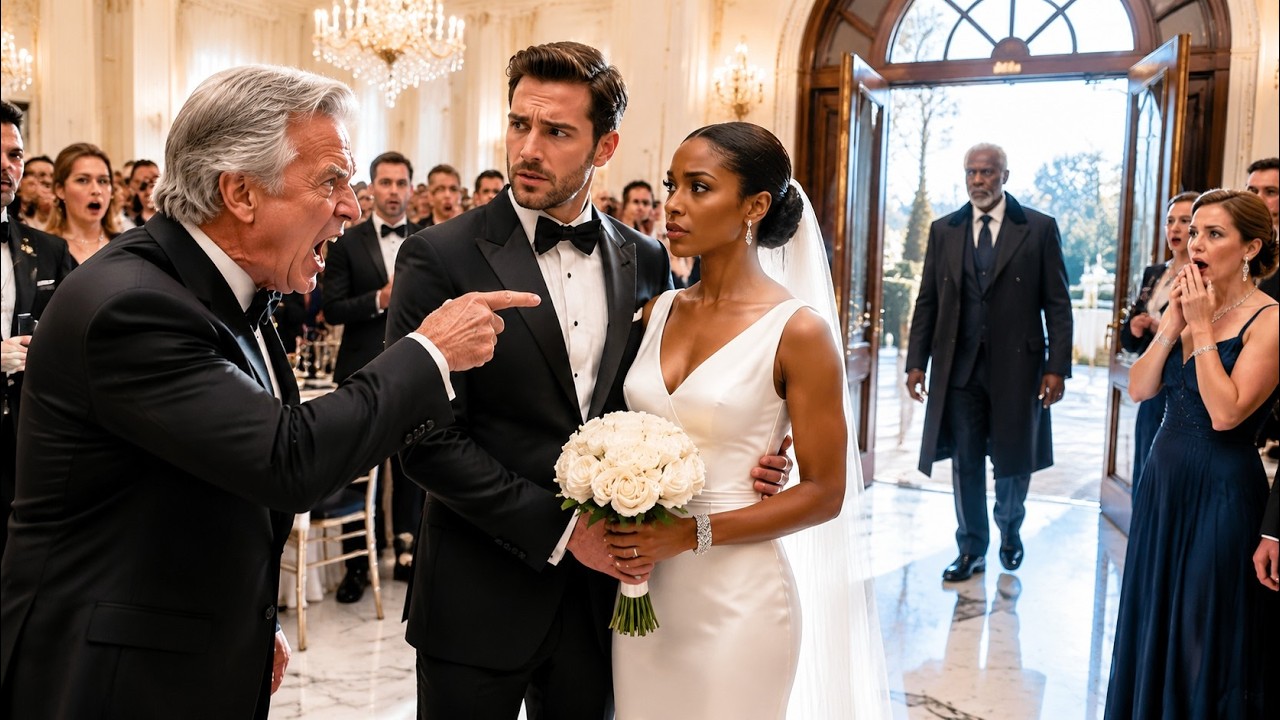
The first words I heard when I walked through the front door of the Ashford estate were not hello or welcome.
They were: “Get out of my son’s house.”
Flat. Cold. Final. The way you speak to a dog that has wandered onto your porch.
I did not flinch. I never did.
Three hours later the man who said those words would be sitting on the floor of his own dining room, unable to stand, unable to speak, unable to understand how the woman he had just tried to destroy had brought his entire world down without raising her voice once.
But we are getting ahead of ourselves.
The Ashford property sat at the end of a private road in Westchester County—twelve thousand square feet of restored colonial architecture, a hedge maze nobody used, and a view of the Hudson that cost more per square foot than most people earned in a year. The occasion was the Ashford Family Foundation’s annual black-tie dinner. One hundred twenty guests. White orchids everywhere. A string quartet that cost more per hour than the catering staff earned in a week. Waiters in pressed jackets carried trays of champagne that no one finished.
I arrived alone, driving myself in a ten-year-old Volvo that the valet took without expression but held at arm’s length like something that might contaminate the Bentleys. I wore a navy dress I had bought at a discount rack two winters ago. Sensible heels. No jewelry except a thin gold band on my left hand. My hair was pulled back simply, the way I wore it in court—neat, unobtrusive, precise. I carried a small handbag that had seen better decades.
At the front entrance a young man in a waiter’s uniform was struggling with a stuck service door, tray balanced in one arm, face tight with quiet panic. I stopped. Set down my bag. Used both hands to help him wedge the door open, then steadied the tray while he recovered.
“Thank you,” he breathed. “I’ve been fighting that thing for ten minutes.”
“Bottom hinge,” I said. “Lift as you push. You’ve got it now.”
He looked at me like I had handed him something he hadn’t expected to receive. I picked up my bag and went inside.
That was me. Lena Voss. I had spent my life noticing the things other people decided weren’t worth their time—the stuck doors, the tired waiters, the people standing in rooms like they didn’t belong there. I noticed because I had been all of those things once.
My husband, Caleb Ashford, was already inside somewhere near the bar, probably trying to talk his father off whatever ledge the old man had climbed onto this time. Caleb had married me three years ago in a small ceremony attended by fourteen people. He hadn’t told his family until it was done. He knew them well enough to know that was the only way it would happen at all.
His father, Victor Ashford, had never forgiven either of us for that.
Victor was seventy-one, silver-haired, and possessed of the specific certainty that belongs only to men who have never in their lives been told no by anyone they respected. He had built Ashford Capital over forty years. He gave to museums, to senators, to foundations that bore his name in marble. He sat on three hospital boards and one federal advisory committee. He believed in merit the way other people believe in God—loudly, selectively, and in ways that always seemed to confirm he already had it.
He had formed his opinion of me the day Caleb brought me to Sunday dinner eight months after the wedding. I had arrived in that same navy dress, or one very like it. I had shaken Victor’s hand without deference. I had answered his questions about my work in short sentences. I hadn’t laughed at his jokes. I hadn’t asked about the foundation. I hadn’t acted impressed by the house.
Victor had decided in the first twenty minutes that I was a fraud. A woman who had seen an opening and taken it. His son—kind to a fault, brilliant in the wrong ways—had been taken in by someone unremarkable, someone without a name worth knowing, someone who would cost them eventually.
He had been waiting three years for the cost.
Tonight, he decided, was close enough.
I was standing near the window with a glass of water—I didn’t drink at events like this, hadn’t in years—when Victor crossed the room toward me with the deliberate stride of a man who had rehearsed this.
“I want a word,” he said, loud enough. Just loud enough. A few heads turned.
I turned to face him. “Of course, Victor.”
“Mr. Ashford,” he corrected.
A pause. “Of course, Mr. Ashford.”
He let that land. Then continued. “You’ve been in this family three years. Three years, and I still don’t know a single thing about you that Caleb hasn’t told me himself. You have no background I can verify. No family here tonight. No one who will stand and vouch for you in a room like this.” He tilted his glass toward the crowd. “In forty years of these dinners, every person in this room has a story I know. Except you.”
“I’m a private person,” I said.
“Private?” He repeated it like I’d said something amusing. “That’s a polite word for it.”
People nearby had stopped pretending not to listen. Caleb appeared at my side, jaw tight.
“Dad. Not tonight.”
Victor raised one hand. “This has been three years coming, Caleb. You made a decision without this family and we have all been paying for it.” He turned back to me. “I had someone look into you.”
My expression didn’t change. “You hired an investigator.”
“I did. Thorough one. And what he found was interesting. Not because there was anything there, but because there was almost nothing. No family money. No property. A law degree from a state school. A modest practice in a city no one here has reason to visit. You married my son and I still cannot figure out what exactly you bring to this family.”
“She brings herself,” Caleb said. “That’s what she brings.”
“That’s not an answer.”
“It’s the only one that matters.”
Victor ignored him. He was looking at me the way he looked at grant proposals he was about to reject—with the patient contempt of a man who has already made up his mind and is simply going through the motions of due diligence.
“Let me say what I actually think,” Victor said, and the nearby conversations dropped to nothing. “I think you saw my son—good, trusting, too generous for his own interests—and you calculated. I think you decided this was a door worth opening, and you opened it. And I think you’ve been managing your image in this family ever since. Showing up in that dress”—a glance down at my clothes, flat and dismissive—“driving that car, playing modest, playing humble, because you understood that demanding things would show your hand.”
“She hasn’t asked us for a single thing,” Caleb said, his voice shaking now.
“Not yet.”
The word landed like something dropped from a height.
I was quiet for a moment. “Then you think I married your son for money?”
“I think,” Victor said, “that people without money usually have reasons for marrying people who have it.”
“That’s not an accusation,” I said. “That’s a prejudice dressed in a suit.”
Victor’s eyes narrowed.
“And your investigator,” I continued, “wasn’t very thorough.”
“He’s the best in this city.”
“Then he billed you for effort he didn’t put in.” I said it without heat, the way you’d correct a filing error. “But that’s a conversation for another evening.”
“There won’t be another evening.” Victor straightened. “I want to be very clear. I want this said in this room with these people present. You are not an Ashford. You will never be an Ashford. Whatever Caleb has put in your name, whatever access he’s given you, I will spend whatever I have to spend in whatever courtroom I have to enter to unwind it. You have been a project. And projects end.”
A waiter stood three feet away, completely still, staring at his tray.
Caleb’s voice came out stripped of everything but cold fury. “Say one more word to her. I dare you.”
“Or what?” Victor looked at his son with something close to sorrow. “You’ll choose her over your family? Over forty years of everything I built? Over your name?”
Caleb didn’t hesitate.
“Yes.”
The room went very still.
“Without a second thought,” Caleb said. “I have chosen her every day since I met her, and I will keep choosing her after you’ve run out of things to threaten me with.”
Victor looked at his son for a long moment. Then he turned and spoke to the room—the one hundred twenty guests in their black tie, all of whom were now watching openly.
“This is what happens,” he said, almost philosophical, “when you raise a son to be kind instead of smart. When you teach a boy that goodness is the same as strength. He ends up giving everything away to someone who knows how to ask for it quietly.” He shook his head. “I’m not angry at her. I’m almost impressed. I’m angry at the weakness that let this happen.”
Caleb started forward.
“Don’t,” I said quietly.
My voice was steady. My face was calm. But something had shifted behind my eyes. Not anger. Not hurt. Something older than both of those. The particular exhaustion of a person who has done this before. Not this room. Not this family. But this moment—the moment when someone decides you are the sum of where you came from and refuses to look any further.
I had been in rooms like this my whole adult life. I had been underestimated in all of them. I had learned a long time ago that you don’t correct people’s assumptions by arguing with them. You wait. You let them speak. You let them build the case against you in front of witnesses. And then you let the room see what they built.
“Victor,” I said.
He turned back, faintly surprised I was still speaking.
“There’s someone coming tonight who asked to meet with you about the Ashford Foundation’s infrastructure grant—the one you’ve been trying to close for eight months.” I paused. “I know because he told me. He called last week. His name is Nathaniel Voss.”
A few things happened at once.
The foundation’s executive director, a careful woman named Patricia who had been hovering near the bar for the last ten minutes with the expression of someone watching a car accident in slow motion, went absolutely still. Two of the men closest to Victor turned to look at each other. And Victor himself, just for a fraction of a second, looked uncertain.
“Nathaniel Voss,” he repeated.
“He said he’s been trying to reach you for three weeks. Something about the terms on the Caldwell infrastructure project.” My voice was even. “He mentioned he might stop by tonight. He had something he wanted to show you in person.”
“Why would Nathaniel Voss contact you?” Victor said, but his voice had lost some of its edge.
“He didn’t contact me,” I said. “He contacted my father.”
The sound of a car door. It was faint, barely audible through the tall windows, through the music and the conversation. But in the sudden near-silence of the room, it carried. Footsteps on the gravel drive.
Victor looked toward the windows, then back at me, then toward the door. He had no idea what he was about to see. He was still building the story, still deciding whether this was a bluff, whether I had somehow engineered something, whether there was still a way to reclaim the ground he’d given up.
The front doors opened.
A man stepped in from the night.
He was in his late sixties, unhurried, wearing a plain wool overcoat with no decoration, no cuff links visible, nothing to mark him. His hair was white, cut short. His face was the face of someone who had long ago stopped needing anyone’s approval and found the experience restful. He moved through the entrance the way water finds its level—without effort, without performance—finding the center of the room because that was simply where he was going.
His eyes swept the space once. They found me, and his face—until that moment entirely composed—went soft in the specific way that belongs only to fathers.
He crossed the room.
Victor was tracking him the whole time, trying to place him, running through forty years of faces and deals and handshakes. He had almost gotten there when Patricia appeared at his elbow and said in a voice stripped entirely of its professional composure:
“Victor. That’s Nathaniel Voss.”
The name hit the room like a change in air pressure.
Victor turned to Patricia. “What?”
“Nathaniel Voss. He founded Voss Infrastructure Group—the firm that designed the Caldwell project. The one that holds the primary contract on the infrastructure grant you’ve been negotiating.” She swallowed. “He’s been on the other side of that table for eight months. You’ve been trying to get his signature.”
Victor’s face did something complicated.
“That’s his daughter,” Patricia said.
Nathaniel reached me and put his hand on my shoulder—one hand, easy and familiar—and I let out a slow breath.
“Everything all right?” he said quietly.
“It’s fine, Dad.”
He turned to look at Victor Ashford for the first time.
Victor’s mouth opened. Nothing came out.
It was Patricia who filled the silence, unable to help herself. “Mr. Voss, I had no idea you’d be joining us tonight. If we’d known, we would have—”
“You weren’t meant to know,” Nathaniel said, not unkindly. “I had an interest in seeing this family on an ordinary evening.” He paused. “This has been informative.”
He didn’t say it with heat. That was the thing. He said it the way you’d observe that the weather had turned. Factual. Almost mild. Containing something enormous underneath the surface.
Victor found his voice. “There’s been a misunderstanding—”
“Has there?”
“What was said tonight—it was a family matter. Private between—”
“I heard most of it from the driveway.” Nathaniel’s voice was still measured. “The windows were open.” His eyes moved across the room, slowly taking in the people, the phones that had appeared, the one hundred twenty guests now arranged in a loose circle around all of them. “You told this room that my daughter had nothing. That she had calculated her way into your family. That she wasn’t worth knowing.” He paused. “In front of witnesses.”
Victor’s hand found the back of a chair.
“You’ve been trying to close the Caldwell contract for eight months,” Nathaniel continued. “Two hundred sixty million in foundation funding. That contract runs through my firm.” He reached into his coat pocket and produced his phone with the calm of a man who had thought this through long before he arrived. “I’ve been patient with the timeline because Lena asked me to be. She didn’t tell you who I was because she wanted to see what kind of people you were when you thought it didn’t matter.” He looked at Victor with something that was not quite pity but was adjacent to it. “You showed her.”
Victor’s knees went.
It wasn’t dramatic. It wasn’t a collapse. Not exactly. More like a slow withdrawal of something structural. He sat down into the chair behind him heavily—a man whose body had simply decided it was done holding the weight of the evening. His hand gripped the armrest. His face was the gray of old ash.
The room was completely silent.
One of the guests near the fireplace—a woman who had laughed quietly at something Victor had said forty minutes ago, the laughter of someone who wants to be on the right side—set down her glass and looked at her shoes.
Nathaniel dialed a number. He didn’t move away. He stood in the center of the room in plain sight and put the phone to his ear.
“It’s Nathaniel,” he said when someone answered. “The Ashford Foundation account. I need you to send them a formal notice of contract termination review first thing tomorrow.” A pause. “Yes. I’ll explain the full situation when I’m back. Tonight’s been clarifying.”
He hung up.
Victor made a sound that wasn’t quite a word.
“The contract,” he started.
“Is under review,” Nathaniel said. “Whether it moves forward will depend on a number of things. None of them,” he added, “involve how much money your family has.”
The moment that followed was the kind people would remember for years. Not because of what was said, but because of what wasn’t. Because of the image: Victor Ashford in his thousand-dollar jacket, sitting in his own chair in his own house, surrounded by his own guests, looking like a man who had just understood the dimensions of what he’d done.
He had spent the evening trying to reduce a woman to her most convenient version. He had performed that reduction in front of one hundred twenty people—not because he had evidence, but because he had always been allowed to. Because no one had ever cost him anything for it.
The cost had walked in through his front door in a wool overcoat.
Caleb was across the room in four steps. He pulled me into him, his forehead against my hair, and I let him hold me. My hand rested against his back.
“I’m sorry,” he said into my hair. “For all of it. For years of it.”
“You chose me,” I said. “Every time. That’s all.”
Nathaniel watched us. For a moment the hard, careful look he’d worn since he walked in softened entirely. He put a hand on Caleb’s shoulder.
“You told your father you’d choose her when you thought you’d lose everything for it,” Nathaniel said. He looked at Caleb steadily. “I don’t forget things like that.”
Victor watched the three of us from his chair. His wife, Constance, who had stood nearby through the entire exchange with the frozen expression of someone watching the walls come in, reached for his arm. He didn’t seem to feel it.
He had spent forty years building a name that meant something. He had handed that name to his son, and his son had used it to defend a woman Victor had decided wasn’t worthy of it.
He looked at me—at the navy dress, the sensible heels, the thin gold band, the woman who had helped a waiter with a stuck door and never once asked this family for a single thing—and for the first time in his life, Victor Ashford had nothing left to say.
I looked back at him without triumph. Without pity.
Only clarity.
The room was still watching. The phones were still out. The string quartet had long since stopped playing.
And somewhere in the quiet that followed, the cost of underestimating the wrong woman finally settled into the foundation of a house that would never feel quite as solid again.