Malaysia Extends Search For Missing Flight MH370 Until 2027 As Families Continue Seeking Answers
Malaysia has announced that the search for Malaysia Airlines Flight MH370 will continue for another year, extending one of the longest and most complex aviation recovery operations in history more than 12 years after the aircraft disappeared.
The decision offers renewed hope to the families of the 239 passengers and crew who have waited more than a decade for definitive answers about one of aviation’s greatest mysteries. Although multiple international search operations have failed to locate the aircraft, Malaysian authorities say they remain committed to continuing the effort.
Malaysia’s Ministry of Transport confirmed that the current search agreement has been extended until June 30, 2027.
The operation is being carried out by marine robotics company Ocean Infinity under a “no find, no fee” arrangement, meaning the company will receive payment only if the wreckage of Flight MH370 is successfully located.
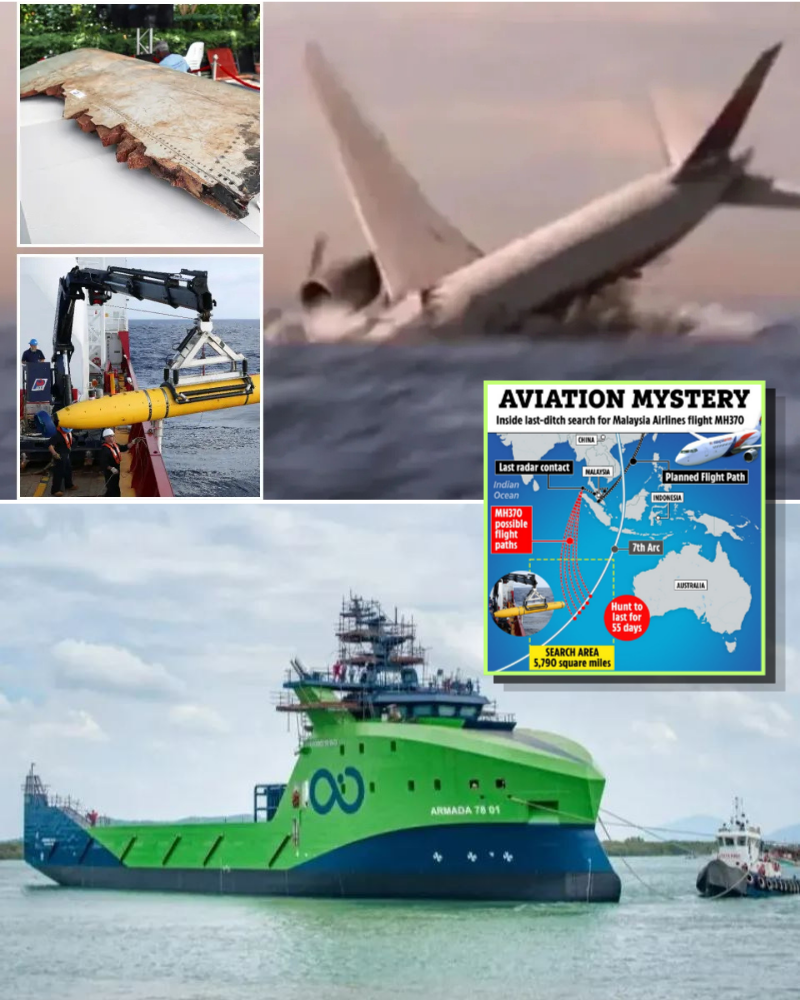
Under the terms of the agreement, Ocean Infinity could receive approximately £50 million if the aircraft is found.
Government officials said the extension demonstrates Malaysia’s continuing commitment to the families of those aboard the missing flight.
In a statement announcing the decision, authorities said extending the mission reflects the government’s determination to provide closure for the next of kin who have continued searching for answers since the aircraft disappeared in March 2014.
The additional year will allow Ocean Infinity to complete the remaining search area, estimated at approximately 7,500 square kilometers in the southern Indian Ocean.
The company resumed its latest search campaign in 2025, conducting operations in two separate phases using advanced autonomous underwater vehicles capable of mapping the seabed at extreme depths.
Despite months of searching, the mission concluded without locating the aircraft, prompting discussions between Malaysian officials and Ocean Infinity regarding whether further exploration should continue.
Following those discussions, the government approved the latest extension.
Flight MH370 disappeared on March 8, 2014, while traveling from Kuala Lumpur to Beijing with 239 people on board.
Less than an hour after takeoff, the Boeing 777 lost contact with air traffic controllers before deviating dramatically from its planned flight path.
Subsequent satellite analysis suggested the aircraft flew for several additional hours before ending its journey somewhere in the southern Indian Ocean.
Despite one of the largest multinational search operations ever undertaken, the main wreckage has never been found.
Only a limited number of aircraft fragments believed to be from MH370 have washed ashore along coastlines bordering the western Indian Ocean over the years.
Those discoveries confirmed the aircraft crashed into the ocean but did not reveal its precise resting place.
The passengers aboard MH370 represented several different countries.
Approximately two-thirds were Chinese nationals, while others included citizens of Malaysia, Indonesia, Australia, India, the United States, France, and the Netherlands.
The multinational nature of the tragedy has ensured continued international attention throughout the investigation.
Families of the victims have repeatedly urged authorities not to abandon the search.
On the twelfth anniversary of the disappearance, relatives of many Chinese passengers published an open letter expressing frustration over what they described as limited communication regarding the latest search efforts.
They called for greater transparency and regular updates while emphasizing that uncertainty has remained one of the most painful aspects of the tragedy.
For many relatives, the absence of confirmed answers has prolonged the grieving process.
Without the recovery of the aircraft or flight recorders, investigators have been unable to determine with certainty exactly what caused MH370 to disappear.
Over the years, numerous theories have emerged, ranging from mechanical failure to deliberate human intervention.
However, no explanation has been conclusively established through official evidence.
Aviation experts continue to regard MH370 as one of the most challenging unsolved cases in modern civil aviation.
Advances in underwater search technology have significantly improved investigators’ ability to explore remote areas of the ocean floor, giving search teams greater confidence that previously inaccessible locations can now be examined more thoroughly.
Ocean Infinity has indicated that improvements in mapping technology, autonomous underwater vehicles, and data analysis may increase the likelihood of locating the wreckage compared with earlier search attempts.
Malaysian officials have expressed cautious optimism while acknowledging that success cannot be guaranteed.
The government’s decision to authorize another year of searching reflects both the technical progress made in recent years and its commitment to exhausting every reasonable opportunity to locate the aircraft.
For the families of those aboard MH370, the extension represents more than another search mission.
It represents another opportunity to obtain answers that have remained elusive for more than a decade.
Many relatives have consistently stated that recovering the aircraft would provide long-awaited certainty, allowing investigators to better understand what happened during the flight and giving families a measure of closure after years of unanswered questions.
As Ocean Infinity prepares to continue operations through June 2027, the disappearance of Flight MH370 remains one of aviation’s greatest mysteries.
Whether the renewed effort will finally locate the aircraft remains uncertain, but Malaysian authorities say they remain committed to pursuing every credible lead until the search area has been fully examined.