“YOU’RE LISTED ON THE BIRTH CERTIFICATE” — THE CALL THAT BROUGHT A TORONTO CEO TO THE HOSPITAL 14 MONTHS AFTER THE DIVORCE.
Fourteen months since I signed the papers. Fourteen months since I walked out of that glass tower on Bay Street with nothing but a carry-on suitcase and the kind of silence that follows you home and sits at your kitchen table like it pays rent.
I told myself I was fine. I made tea. I started running again. I got a library card like I’d been meaning to do for three years of marriage. I called my mother on Sundays and said things were good—really, I was settling in—and she believed me because she wanted to, and I let her because it was easier than the truth.
The truth was that I still reached for the right side of the bed in the dark. The truth was that I had memorized the sound of his car in the parking garage and my body still listened for it some nights before my brain caught up. The truth was that leaving a man like Julian Voss—a man who could buy half of Bay Adelaide Centre and still come home for dinner like it meant nothing—doesn’t free you the way you think it will. It just replaces one kind of weight with another.
We had been married three years, together five before that. Eight years of my life. Of my twenties. Of the version of me who thought love was enough to smooth over the parts that weren’t working.
He never wanted children. He said it clearly, early, in that way he had of stating things like facts. Flat. Clean. No room for interpretation. I thought I could live with it. I thought I was the kind of woman who didn’t need that. I was wrong. By the time I understood how wrong, I had already built my whole life around his schedule, his apartment, his world. Dismantling it felt like tearing down a house with my bare hands.
So I did it anyway.
I moved into a ground-floor rental in Leslieville. Exposed brick. A radiator that clanged in February like it was angry about something. I got a job back in landscape architecture—the career I had quietly let slide while fitting myself into the shape of his life. I was rebuilding. I was fine.
What I did not tell anyone—not my mother, not my best friend who kept a bottle of prosecco in her fridge specifically for my divorce check-ins, not even my therapist for the first four months—was that I was pregnant when I left.
Seven weeks. I hadn’t even been sure yet. I took the test in a gas-station bathroom off the 401 because I couldn’t bear to do it in the apartment we shared. Couldn’t bear to have that news exist in that space. The second line appeared and I sat on the lid of that toilet for a long time and thought about nothing very clearly.
By the time the lawyers finished, I was almost eleven weeks. I made an appointment. Then I canceled it. Then I made it again. Then I sat in my car outside the clinic on a Tuesday morning in November with the heat running and the radio off and thought: I don’t want to do this. Not because of him. In spite of him.
I wanted this baby. That was the part that surprised me most—how certain I was, how immediate, how much that certainty had nothing to do with Julian at all. This was mine. This small impossible thing was mine, and I was going to keep it, and I was going to do it the way I did everything else in those months: alone, and fine, and not talking about it more than necessary.
I told my mother at Christmas when I was far enough along that hiding it was becoming a project. She cried. She asked about the father. I said we were not in contact. She understood, or she pretended to, which is its own kind of love.
My daughter was born in May. Six pounds, fourteen ounces, in a blizzard that broke every record Toronto Hydro had on file. Which felt appropriate. I named her Elara—after my grandmother’s middle name and a character in a novel I loved in university. She came out with her eyes already open and her fist already curled, and I looked at her and thought: There you are. I’ve been waiting for you.
For eight months it was just the two of us. Eight months of feeding schedules and sleep deprivation and learning how to do everything one-handed while she was on my hip. Eight months of my mother driving in from Barrie every other weekend. Of my best friend sending meal kits and voice messages at midnight. Eight months of Elara growing from a small red creature into a person with opinions about her stuffed elephant and a laugh that started in her whole body.
I did not contact Julian. I did not plan to.
The night everything changed was a Thursday in January. Elara had been fussy all afternoon—not her usual fussy, but the kind that has a different quality to it. Quieter. More deliberate. Like something hurts but she doesn’t have the words. I checked her temperature at seven. It was high enough that I called Telehealth Ontario. The nurse on the line asked a series of careful questions and then said, given her age and the number, I should probably take her in.
The SickKids ER on a Thursday night in January is its own kind of world. I sat in the waiting area with Elara against my chest, her body radiating heat through both our layers, and told myself it was probably just a virus. All babies get fevers. I believed about half of it.
They took her back within an hour. The doctor was young, quick, efficient in the way emergency pediatricians learn to be. She asked about symptoms, history, recent vaccinations. Then she looked at the chart and looked at me and said, very gently, that they needed to run a few more tests. Because of Elara’s age and the nature of what they were seeing, there were some questions about family medical history they wanted answered.
“Is the father available to contact?” she asked. “There are some hereditary conditions we’d want to rule out. It may not be necessary—but if there’s any way to reach him, it could help us rule out a few things faster.”
I looked at her. She looked at me.
I said I would try.
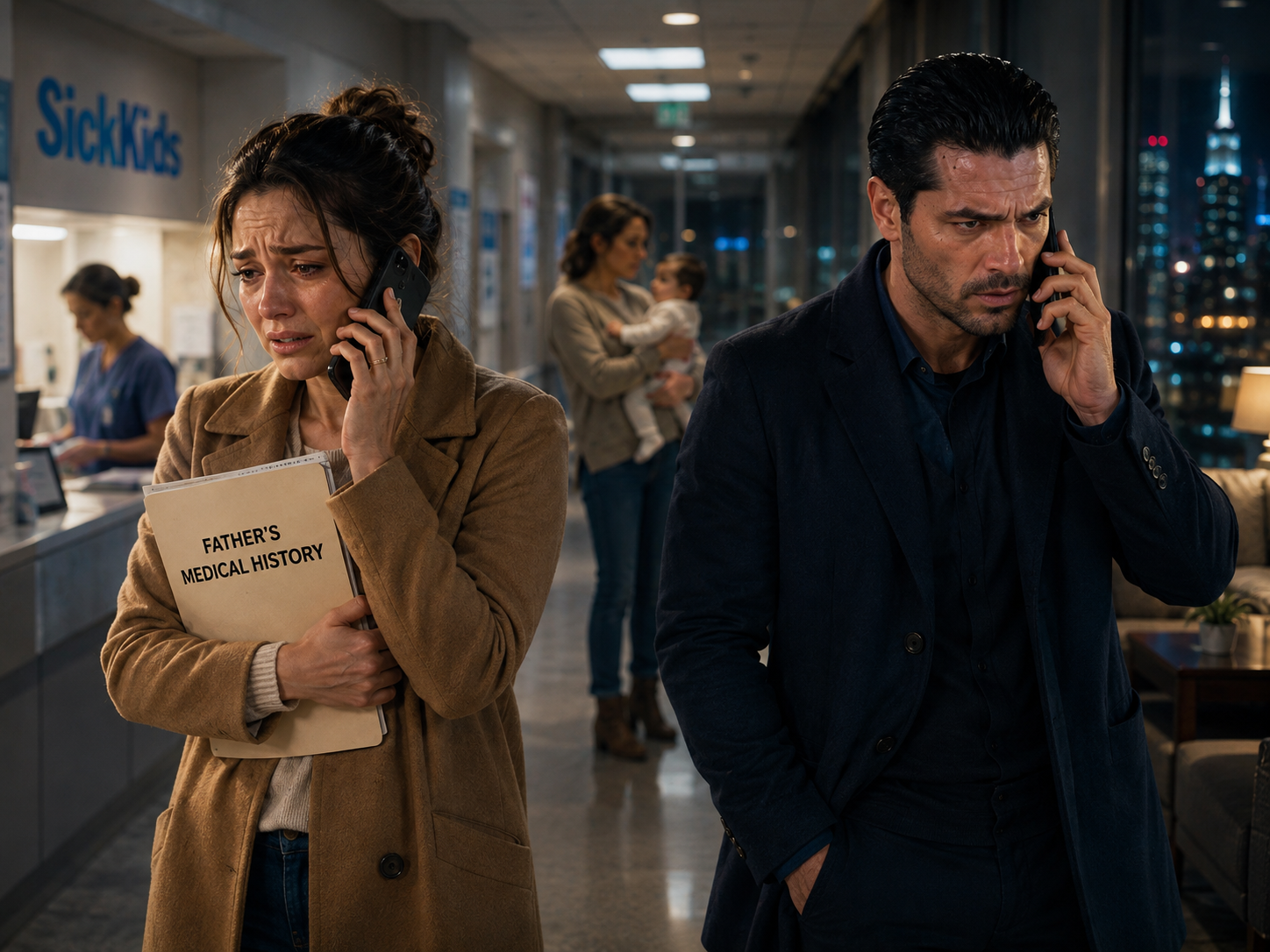
I had not deleted his number. I had not let myself examine why. I stepped into the hallway under the fluorescent lights and stared at his name on my screen for a long time. It was 9:14 p.m. I thought about all the nights I had sat across from him at dinner and tried to find the right moment to talk about the future, about children, about what we wanted our life to look like—and how he would listen with that particular stillness of his, the kind that looked like patience and felt like a door closing.
I pressed call.
It rang twice.
“Yes.” His voice. That was all. Just “yes,” like he’d been expecting a call—just not from me.
I said his name. Silence.
“Julian.” I said it again because I didn’t know how else to start. “I’m at SickKids. The doctors need some family history information. It’s for a patient.”
More silence. Then: “What patient?”
It wasn’t really a question. There was something in the way he said it—flat, careful, the way he said things when he already knew the shape of the answer and was waiting to see if you would give it to him honestly.
I closed my eyes.
“Her name is Elara. She’s eight months old. She has a fever and they’re running tests. The doctor asked if the father was reachable and I—” My voice stopped cooperating. “You’re listed on her birth certificate. I listed you.”
I had not planned to say it that way. I had not planned to say it at all.
The hallway felt very long suddenly.
“I’m on my way,” he said.
He hung up.
I stood there with the phone against my collarbone and thought: What have I done?
He arrived forty minutes later. I don’t know how he got there that fast from wherever he’d been. His condo was in Yorkville. Parking near the hospital at that hour was a particular kind of nightmare. But I looked up from the chair beside Elara’s bed and he was standing in the doorway in a dark wool coat, still half-buttoned, like he’d left in a hurry.
He looked at her first. Not at me. At Elara.
He stood in the doorway and looked at my daughter the way you look at something you are trying very hard to understand all at once—feature by feature, detail by detail. Something passed across his face that I had never seen on him before. Something quiet and undone.
Then he looked at me.
“You should have told me,” he said.
“I know.”
“Fourteen months.”
“I know.”
He came into the room and sat down in the chair on the other side of her bed. He didn’t say anything else for a while. The nurse came in and he answered her questions—family history, medical background, his father’s side, his mother’s side—in the same efficient way he handled everything. He remembered everything. He always did.
The test results came back closer to midnight. Viral. A common strain. Nothing hereditary. Nothing catastrophic. Elara would be fine with fluids and monitoring. They wanted to keep her overnight just to be safe.
When the doctor left, the room felt smaller.
Julian sat with his elbows on his knees, staring at the floor between his polished shoes. For a long time neither of us spoke. The machines made their small patient sounds. Elara slept with one fist curled near her mouth, the way she always did.
“I never wanted this,” he said finally. Quiet. Not cruel. Just factual, the way he had always been. “I told you that. From the beginning.”
“I know.”
“And you still listed me.”
“Yes.”
He looked up. “Why?”
I could have given him a dozen answers. Because the form asked. Because it felt dishonest not to. Because some small, stubborn part of me refused to erase him completely from the story of her life even when I had erased him from mine.
Instead I said the only true thing I had left.
“Because she’s yours too. Whether you wanted her or not. And someday she might need to know that.”
He was silent for a long time. Then he reached out—slowly, carefully—and touched the edge of the blanket near Elara’s foot. Not her skin. Just the blanket. As if even that much contact required permission he wasn’t sure he had the right to ask for.
“I don’t know how to do this,” he said.
“Neither did I,” I answered. “I learned.”
He stayed until morning. He didn’t try to hold her. He didn’t make promises. He simply sat in the chair and watched her breathe, and when the nurse came to check vitals he stood and gave her space and then sat back down again.
When they discharged us, he walked us to the parking garage in silence. Snow was falling in soft, heavy flakes. He opened the car door for me the way he always had—habit, not affection—and then hesitated.
“I’d like to see her again,” he said. “If that’s something you’re willing to allow.”
I looked at Elara sleeping in her car seat, cheeks still flushed from the fever that had brought us here. Then I looked at the man who had once been my entire world and was now something far more complicated.
“We’ll start small,” I said. “And we’ll see.”
He nodded once. Then he turned and walked back toward the hospital entrance without looking back.
I sat in the driver’s seat for a long time with the engine running and the heat on low, watching snow collect on the windshield. Elara made a small sound in her sleep. I reached back and touched her foot through the blanket.
Fourteen months of silence. One phone call. One fever. One name on a birth certificate that refused to stay hidden.
I didn’t know what came next. I only knew that the version of my life where Julian Voss no longer existed had just ended in a hospital hallway under fluorescent lights, and whatever came after would have to be built from the truth instead of the careful quiet I had been living in.
I put the car in drive.
And for the first time in fourteen months, I didn’t feel entirely alone.