CEO Spots His Ex-Wife at a Restaurant—The Twin Girls Beside Her Stop Him Cold.
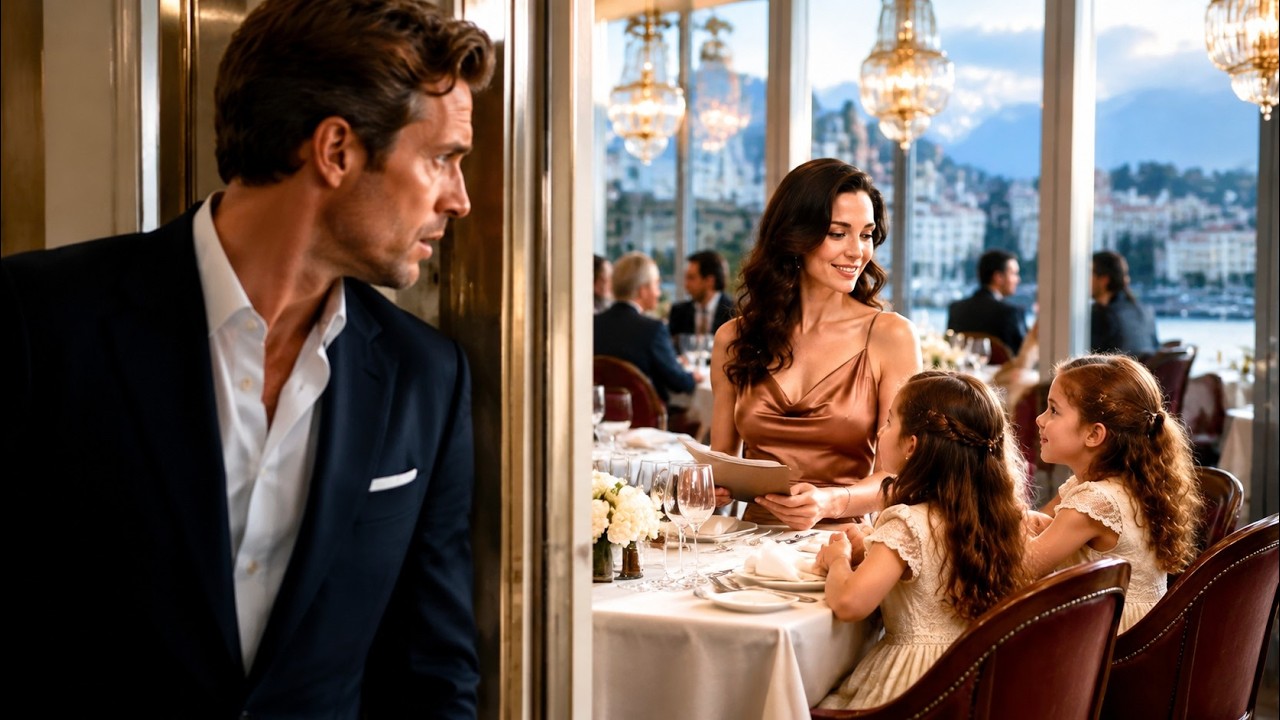
He noticed the twins first.
That was the thing that stayed with him afterward—in the elevator going up to his room, staring at the ceiling of the hotel while the city hummed outside. He had not noticed Elena first. He had noticed two small red-haired girls sitting on their knees in a restaurant booth, both of them leaning over a children’s menu with the focused intensity of people negotiating a contract.
And he had thought absently that they looked exactly like the photograph his mother kept on her mantle of him at that age.
And then he had looked up, and there was Elena.
My name is Elias Voss.
Four years. Four years, two months, eleven days—though I had stopped counting at the fourteen-month mark, or so I told myself.
She was sitting across from the girls, one elbow on the table, her chin resting in her palm, reading something on her phone with the ease of a woman who had nothing to prove to anyone. Her hair was shorter. She was wearing a dark green coat I didn’t recognize. She looked—and this was the part that did something strange to my chest—she looked completely fine.
I stood in the entrance of the restaurant for what was probably four seconds and felt like forty years.
My companion said something to me. I answered. I didn’t know what I said. I was seated on the other side of the room, and I picked up a menu, and I did not read a single word on it.
The girls had ordered. I could tell because one of them was now spinning a sugar packet on the table while the other one appeared to be lecturing her mother about something, one small finger pointed upward in the universal gesture of a person who is making an important point. Elena was nodding with the patience of someone who had heard this particular argument before and had made her peace with it.
The girls had red hair.
My hands were flat on the table. I pressed them down deliberately and looked at the menu again.
Lamb. Duck. A risotto with something seasonal. I read the words without absorbing them.
I had dark hair. Elena had dark hair. Her mother had dark hair. Her father—
I put the menu down.
I was thirty-eight years old. I had built a logistics company from a two-man operation out of a basement into something that now employed four hundred people across six provinces. I had negotiated contracts full of lawyers specifically designed to make me feel small. I did not rattle easily. I had been told more than once, usually by people who were not happy about it, that I had the unsettling quality of seeming calmer the worse things got.
I was not calm right now.
I was looking at two little girls in a restaurant booth and doing math in my head that I did not want to be doing.
Elena and I had met at a funding conference. She had been presenting a regional health initiative. I had been there because my company was being courted for a logistics partnership, and I had arrived an hour early and wandered into the wrong room. And she had been at the front testing her slide clicker. And she had looked up at me and said, “You’re very early or very lost.”
I had said, genuinely uncertain.
She had laughed.
It was the specific laugh of someone who hadn’t expected to laugh, which was, I would later think, the most dangerous kind.
We were married eighteen months later in a small ceremony. My mother, Beatrice, had expressed her enthusiasm for the event in the way she expressed enthusiasm for most things—quietly, precisely, and with a series of very specific concerns that she delivered one at a time over the following weeks, as though she were issuing memos. The venue was charming, but perhaps a little rustic. The guest list seemed weighted toward Elena’s side. Had I considered that a prenuptial arrangement might simply be good sense given my assets?
Elena had never said anything about my mother that was unkind. This, I would eventually come to understand, was not the same as saying there was no problem.
The marriage lasted two years and seven months.
On a Thursday in November I came home to an apartment that was half empty in a way that was so deliberate, so careful—her half, only her half, my things untouched—that it took me almost a full minute standing in the front hallway to understand what I was looking at.
There was a letter on the kitchen counter.
It said: I’m sorry. I can’t explain it right now in a way that would make sense to you. This isn’t what I wanted. Please don’t try to contact me for a while. I need time.
That was it. That was the whole letter.
I had stood in the kitchen for a long time. Then I had called her. It went to voicemail. I had sent a text and another. And on the fourth day, a longer message that I had written and deleted three times, and which had not been answered. Six weeks later, through a lawyer, she had filed for divorce.
She had not contested anything. She had asked for nothing. She had simply wanted to leave, and she had left, and she had taken nothing with her except the things that were hers. And whatever it was she knew that she wasn’t telling me, I had never found out.
The waiter came.
I ordered something. I ate it without knowing what it was.
Across the room, the girls had received their food, and one of them—the one who had been doing the lecturing—was now engaged in what appeared to be a detailed investigation of her grilled cheese sandwich, lifting the top piece of bread and examining the cheese distribution with the critical eye of a food inspector. Elena was watching her with an expression that I recognized even from across a restaurant after four years.
The expression of someone trying very hard not to smile.
I knew that expression.
I had cataloged it without meaning to in the first year after she left—the way you catalog things when you are trying to understand how something that seemed real became nothing. I knew the way she tilted her head when she was listening to something she found genuinely interesting. I knew that she drank her coffee with too much milk and would not admit this was a preference and maintained it was simply how it came out. I knew that she could not watch nature documentaries about penguins without getting emotionally invested in a way that she found embarrassing.
I had not spoken to her in four years, two months, and eleven days.
I paid my bill.
I stood up.
I walked across the restaurant, and I was not entirely sure, even as I was doing it, that this was the right thing to do.
But the two little girls with red hair were there, and Elena was there, and I had spent four years not knowing, and I thought that maybe—maybe—I was done not knowing.
She looked up when I was about six feet away.
I saw the moment she registered who I was. It moved across her face in sequence: recognition, shock, something that might have been fear, and then something else quieter that I couldn’t name.
“Elias,” she said. Her voice was even. Of course it was.
“Elena,” I said.
There was a pause.
The girls had both looked up.
Two identical pairs of green eyes.
And there it was—the specific shade. My grandmother’s eyes. My sister’s eyes. Eyes that had no business being in the face of two children I had never met were watching me with the frank curiosity of people who have not yet learned that staring is considered rude.
The one on the left said, “Do you know our mommy?”
“Yes,” I said. “I do.”
Elena set down her fork.
“Girls, this is… this is an old friend of mommy’s. His name is Elias.”
The one on the right said, “That’s a funny name.”
“Clara,” Elena said.
“It is though,” Clara said reasonably.
“It’s all right,” I said. I was looking at the girls. I was aware that my voice had done something it almost never did, which was to go slightly unsteady.
Sophia—the one who had been inspecting the sandwich—tilted her head. “You have the same eyes as us.”
The restaurant noise faded.
Elena’s face had gone very still.
I looked at her.
“They’re mine,” I said. It wasn’t a question.
She closed her eyes for half a second. Then she opened them and nodded once.
“Yes.”
The girls were watching both of us now with the sharp attention of children who sense that something important is happening even if they don’t understand the words.
I pulled out the empty chair and sat down because my legs had decided they were no longer reliable.
“Four years,” I said quietly.
“I know.”
“You left a letter that said nothing.”
“I know.”
“And you took my daughters with you.”
Elena’s hands were flat on the table now, the same way mine had been earlier.
“I thought I was protecting them,” she said. “And you.”
“From what?”
She looked at the girls, then at me.
“From your mother.”
The words landed with the weight of something that had been waiting a long time to be spoken.
I stared at her.
Elena took a slow breath.
“A week before I left, Beatrice came to the apartment while you were in Toronto. She brought documents—forged medical reports, falsified lab results, a letter from a specialist that didn’t exist. She told me I was carrying a genetic condition that would make any child of ours suffer the same illness that killed your sister. She said if I stayed and the children were born, you would never forgive yourself for putting them through it. She said the kindest thing I could do was leave before you ever found out.”
My hands had gone cold.
“She forged—”
“Yes.” Elena’s voice stayed steady, but her eyes were wet. “I was terrified. I was alone. And she was very convincing. She had letterhead. She had dates. She had everything. I believed her. I thought I was saving you from a lifetime of watching your children suffer the way you watched your sister suffer. So I left. I had the twins in secret. I raised them. And every day I told myself I had done the right thing.”
Clara climbed into Elena’s lap without being asked. Sophia leaned against her mother’s side.
“And then?” I asked.
“And then last month I found out the truth. A friend in the medical community flagged the specialist’s name. He never existed. The reports were fabricated. Beatrice paid someone. She wanted me gone because she never thought I was good enough for you. She wanted the company, the legacy, everything clean and under her control. The girls were never at risk. Not from any genetic condition. Only from her.”
The silence between us was thick enough to touch.
I looked at the two little faces that were unmistakably mine.
Sophia reached across the table and poked my hand with one small finger.
“Are you sad?” she asked.
“Yes,” I said honestly. “But not at you.”
Clara whispered something to Elena. Elena nodded.
“They want to know if you’re going to stay and finish dinner with us,” Elena said.
I looked at her for a long time.
Then I looked at the two girls who had my eyes and my grandmother’s stubborn chin and four years of life I had never been allowed to see.
“Yes,” I said. “I’m going to stay.”
And for the first time in four years, two months, and eleven days, the distance between what I had lost and what I might still reclaim felt small enough to cross.