THEY STRIPPED HER OF EVERYTHING IN COURT — THEN HER GRANDFATHER’S SECRET WILL DESTROYED THEM.
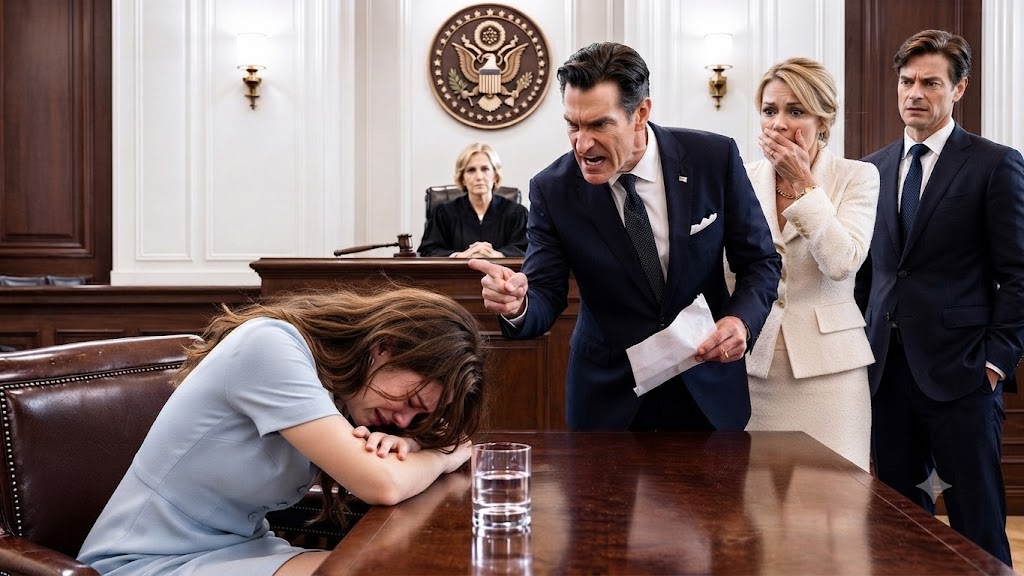
Silence pressed down on Courtroom 302 like a physical weight.
Morning light cut through the tall arched windows, throwing hard shadows across the polished mahogany. Elena Voss sat rigid in the heavy oak chair, knuckles bone-white around the edge of the table. She wore the same simple black dress she had worn to her grandfather’s funeral two months earlier. Beside her, her estate lawyer, Elias Quinn, shuffled a disorganized stack of folders and looked like he hadn’t slept in days.
Across the aisle, Aunt Victoria Hale occupied the plaintiff’s table with the easy arrogance of someone who already considered the victory hers. She wore a flawless cream Chanel suit and a small, satisfied smile. Beside her slouched her son, Dominic, twenty-five, trust-fund casualty, currently hiding a smirk behind a perfectly manicured hand.
They had come to dismantle Harold Voss’s life.
Harold had built Voss Logistics from a single delivery truck into a regional shipping empire worth more than forty million dollars. To Elena he had simply been Papa—the man who took her in after her parents died in a car crash when she was six. For the last four years of his life, as Parkinson’s and a series of strokes stole his independence, Elena had deferred her admission to Northwestern to become his full-time caretaker. Victoria had visited exactly three times, usually to ask for capital to fund Dominic’s failed tech startups.
Yet here, in this courtroom, the narrative had been violently inverted.
Richard Gable, a high-powered Chicago litigator whose suits cost more than Elena’s car, paced the floor with predatory grace, holding a pristine legal document.
“Your Honor,” Gable’s voice boomed, rich and theatrical. “The document before the court is the final, authenticated last will and testament of Harold James Voss, dated October fourteenth of this year—barely three weeks before his unfortunate passing. In it, the deceased makes his intentions painfully, unavoidably clear.”
Elena felt a cold hollow open in her stomach. October fourteenth. That had been during the worst of her grandfather’s final hospital stays. He had been heavily medicated, drifting in and out of delirium. He barely knew what year it was, let alone had the cognitive capacity to draft a new will.
Gable continued, turning slowly to lock eyes with Elena, his gaze dripping with manufactured pity. “Mr. Voss revokes all prior wills. He leaves the entirety of his estate—including his controlling shares in Voss Logistics, all liquid assets, and the family estate in Evanston—to his devoted daughter, Victoria Hale. And as for his granddaughter, Elena…” He paused for maximum effect. “He leaves her nothing. The wording, Your Honor, is quite explicit. Section four, paragraph two: ‘I intentionally leave no provision for my granddaughter, Elena Voss, due to her increasing alienation and the undue distress she has caused me in my final years.’”
Elena gasped aloud. “That’s a lie—”
Judge Lydia Kane slammed her gavel. The sharp crack startled the gallery. “Ms. Voss, you will restrain yourself or I will have the bailiff remove you. Is that understood?”
Elena swallowed hard, tears pricking her eyes, and nodded. Elias put a clammy hand on her arm and whispered, “Quiet. Let me handle this.”
But Elias was handling nothing.
When it was his turn to challenge the will’s validity, his arguments were weak, technical, and unconvincing. He pointed out the shakiness of Harold’s signature. Gable countered effortlessly with a paid medical expert who claimed that while Harold had physical tremors, his mind had been sharp as a tack on the day of the signing. Gable also produced the two witnesses—a private nurse and a notary—both conveniently hired by Victoria days earlier.
The ambush had been meticulously planned. Victoria hadn’t just come for the money. She had come to erase Elena’s history, framing her as an abusive, neglectful granddaughter who had isolated the old man.
Gable marched back to the center of the floor, pulling a thick binder from his table. “Your Honor, the defense claims this will is a sudden, uncharacteristic departure from Mr. Voss’s wishes. But we have evidence that Ms. Voss was systematically draining her grandfather’s accounts, isolating him from his true family, and causing him immense psychological harm. This new will was Harold Voss’s desperate, final act of self-preservation.”
Victoria met Elena’s gaze and offered a tiny, chilling smile, lifting her chin in absolute triumph.
Elena realized with terrifying clarity that she wasn’t just losing her inheritance. She was being legally branded a monster. And she was entirely powerless to stop it.
After a grueling morning session, the courtroom felt like a pressure cooker. The air conditioning was failing. The heavy, humid heat of a Chicago summer pressed against the frosted glass. It was time for Elena to take the stand.
She walked to the witness box on legs that felt like lead. She placed her hand on the Bible, swore to tell the truth, and sat down. Elias led her through a few gentle questions, allowing her to explain her daily routine with her grandfather—the pureed meals, the midnight panics, the hours spent reading his favorite maritime history books aloud until his breathing steadied. She spoke softly, her voice wavering but deeply sincere. For a moment she thought she saw a flicker of sympathy in Judge Kane’s stern eyes.
Then Elias sat down and Richard Gable stood up.
Gable didn’t walk. He prowled. He approached the witness stand holding a sheaf of bank statements highlighted in aggressive neon yellow.
“Ms. Voss,” he began, voice dripping with false gentleness. “You painted a very touching picture of your devotion. But let’s look at the finances, shall we? You had power of attorney over your grandfather’s secondary checking account. Did you not?”
“Yes,” Elena said. “For household expenses and his medical needs.”
“Medical needs,” Gable repeated, tasting the words as if they were sour. “I see. Could you please explain to the court the transaction made on September twenty-eighth—a wire transfer of exactly fifty thousand dollars to an offshore account in Geneva, Switzerland?”
A murmur rippled through the gallery. Elena gripped the railing of the witness box.
“That wasn’t offshore to hide it. It was for the clinic of Dr. Aris Caldwell. He is an experimental neurologist. Papa was in agony. The doctors here said there was nothing more to do, but Dr. Caldwell had a new trial. I paid for the consultation and the initial transport fee.”
“A trial that never happened,” Gable snapped, “because he deteriorated too quickly.”
“He had a secondary stroke two days later,” Elena shot back, her voice rising. “I was trying to save his life. Victoria wouldn’t authorize the funds from the main trust. She said he was a sunk cost.”
“Objection!” Gable bellowed. “Hearsay and incredibly prejudicial.”
“Sustained,” Judge Kane said sharply. “The jury will disregard the witness’s last statement regarding Victoria Hale.”
Gable leaned in, resting his hands on the wooden rail, boxing Elena in. “Isn’t it true, Elena, that this Geneva clinic is known for non-FDA-approved pseudoscience? Isn’t it true that you panicked when you realized your grandfather was dying because once he died, your free ride in his mansion would be over? You funneled fifty thousand dollars out of his account, and when he found out in a rare moment of lucidity in October, he was so disgusted by your theft that he called his daughter Victoria and begged her to draft a new will.”
“No,” Elena cried, tears finally spilling over her lashes. “No. He never said that. He loved me. He couldn’t even hold a pen that day. You guided his hand—”
“That’s enough,” Judge Kane snapped. “The witness will answer only the questions put to her.”
Gable smiled, small and cold. “No further questions, Your Honor.”
Elena stepped down from the stand feeling gutted. The afternoon session was a formality. Gable’s case was airtight on paper. Elias’s objections were brushed aside. By three o’clock Judge Kane was preparing to rule.
Then the courtroom doors opened.
A tall man in a conservative gray suit entered, carrying a sealed leather portfolio. He approached the bench with the calm authority of someone who had done this many times before.
“Your Honor,” he said clearly. “My name is Samuel Crowe. I am the independent executor named in a sealed instrument executed by Harold James Voss on June third of last year—well before the onset of his final decline. Mr. Voss instructed that this document be delivered to the court only in the event that any subsequent will was presented that contradicted his long-standing intentions. I believe that condition has now been met.”
Gable shot to his feet. “Objection! This is a blatant attempt to introduce unauthenticated—”
“Sit down, Mr. Gable,” Judge Kane said. Her voice had changed. “Mr. Crowe, approach.”
Samuel Crowe opened the portfolio and handed the judge a thick envelope bearing Harold Voss’s personal seal. The judge broke the seal, read in silence for several long minutes, then looked up. Her expression was unreadable.
“This court will take a thirty-minute recess,” she said. “Counsel, chambers. Now.”
When they returned, the atmosphere in the courtroom had shifted. Judge Kane’s face was carved from stone.
“After careful review,” she began, “this court finds that the will dated October fourteenth is invalid. The medical testimony regarding Mr. Voss’s capacity on that date is contradicted by contemporaneous hospital records showing severe cognitive impairment and heavy sedation. Furthermore, the two witnesses were retained and paid by the beneficiary herself—creating an irreconcilable conflict.”
Victoria’s face drained of color.
Judge Kane continued. “The sealed instrument delivered today is a holographic will, written entirely in Harold Voss’s own hand, dated June third of last year, properly witnessed by two disinterested parties, and stored with an independent executor under strict instructions. In it, Mr. Voss explicitly reaffirms his earlier estate plan and adds the following language:”
She put on her glasses and read aloud.
“‘Should any member of my family attempt to alter, challenge, or circumvent my clear wishes regarding the care and future of my granddaughter Elena, I direct that such person or persons be disinherited entirely, and that the full residue of my estate pass to Elena Voss alone. I further direct that any evidence of undue influence, forgery, or coercion be turned over to the appropriate authorities.’”
The courtroom was utterly silent.
Judge Kane looked directly at Victoria. “Ms. Hale, this court finds clear evidence of undue influence and likely forgery. The October will is set aside. The sealed will is admitted to probate. Elena Voss is the sole heir of the estate of Harold James Voss.”
Victoria stood so abruptly her chair scraped loudly. “This is a travesty—”
“Sit down,” Judge Kane said, voice like ice. “Or I will have you removed. Mr. Gable, your clients are advised that the Cook County State’s Attorney’s office will be receiving a full copy of this record. This court is adjourned.”
Elena sat frozen as the gavel fell. Elias was saying something, but the words didn’t reach her. Across the aisle, Victoria’s perfect composure had shattered. Dominic stared at the floor, the smirk long gone.
Samuel Crowe approached Elena’s table and placed a second, smaller envelope in front of her. Her name was written on it in her grandfather’s familiar, slightly shaky script.
She opened it with trembling fingers.
My dearest Elena,
If you are reading this, then someone tried to take what was never theirs. I knew they might. That is why I prepared. You gave me four years of your life when you could have been living your own. You stayed when others only visited. You read to me when I could no longer hold a book. You fought for treatments others called hopeless. You were my family when blood proved insufficient.
The company, the house, the accounts—they are yours. Not because you are my granddaughter, but because you earned them with every sleepless night and every act of quiet loyalty. Do not let anyone convince you otherwise.
Live well, my girl. Build something of your own. And if they come for you again, remember: dead men can still speak. And this one is furious.
—Papa
Elena pressed the letter to her chest and finally let the tears fall—not of defeat this time, but of something fiercer. Relief. Grief. And a deep, steadying certainty that the man who had raised her had never stopped protecting her, even from beyond the grave.
Outside the courthouse, the Chicago wind was sharp and clean. Elena stepped into it with her head high, the letter still in her hand, the empire her grandfather had built now legally, irrevocably hers.
Victoria and Dominic would face investigations. The forged will would not survive scrutiny. But none of that mattered as much as the simple truth written in a dead man’s hand:
She had never been alone.
And the people who tried to erase her had just been erased instead.