THE BILLIONAIRE’S RING IS A LOADED GUN: HE STOLE MY ARCHITECTURE, MY HUSBAND STOLE MY IDENTITY—UNTIL A SHADOWY MAGNATE STOOD UP AND CALLED ME HIS WIFE.
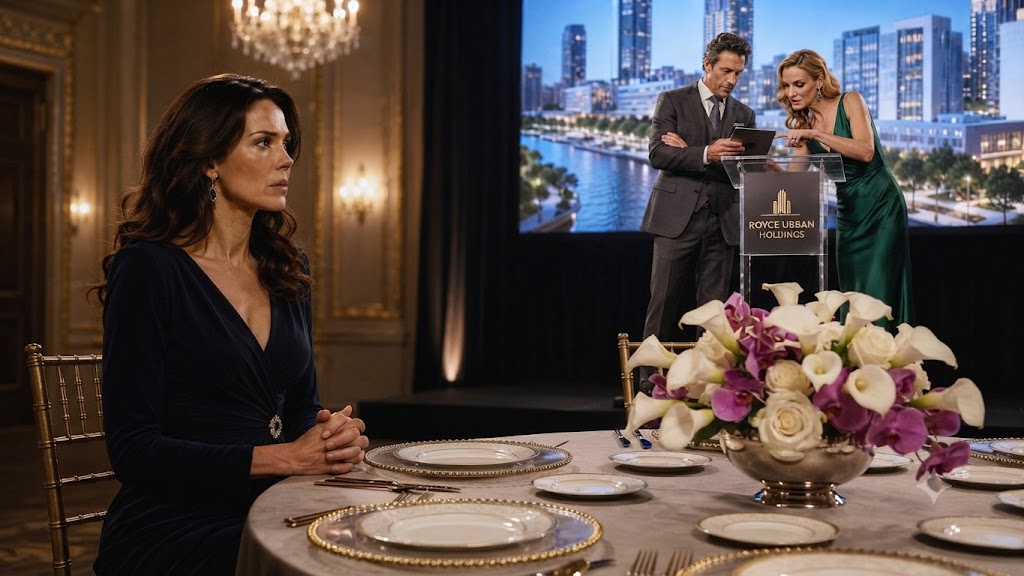
The crystal chandeliers of the Grand Ballroom hummed with expensive electricity, vibrating against the base of my skull. Down on the stage, beneath a towering holographic projection of the riverfront city I had spent three brutal years designing, Malcolm Royce—my husband of seven years—was gently lifting another woman’s hand to his lips.
“Courage sometimes means choosing happiness over obligation,” Malcolm told the six hundred gathered elites, his voice rich with carefully manufactured sorrow. He looked stunning, silver catching at his temples, tailoring hugging his broad shoulders.
Beside him stood Bianca Lane, his communications director of eighteen months, wearing a sleek gold gown and—glinting cruelly under the spotlights—the antique emerald drop earrings my grandmother had left me, locked securely in our country estate’s safe.
At the founders’ table, just three seats down from the man who had secretly divorced me that very morning, my fingers tightened around my water glass until my knuckles turned bloodless.
I was Celeste Ardan. An architect. A creator. And, according to a court clerk who had called me at 4:15 PM, a legally discarded woman.
At 10:00 AM that day, a Nevada court had entered a divorce decree. Malcolm had claimed residency via a Las Vegas condo he’d visited twice. The filing stated I had waived all rights to support, notice, and my massive ownership stake in Royce Urban Holdings. The signature looked like mine only because Malcolm’s lawyers had lifted it from a building permit application I’d signed two years ago. The notary swore I had appeared in Las Vegas on a day when I was standing in front of three hundred witnesses in Boston delivering a keynote lecture on public housing preservation.
“Bianca reminded me that a life without truth is only architecture without a soul,” Malcolm continued, looking deeply into the cameras.
Several heads in the crowd turned to look at me. The phrase wasn’t just a cliché; it was stolen verbatim from my own academic lecture. Malcolm had always cannibalized my language whenever he needed to sound deeper than his own hollow ambitions.
“Tonight,” Malcolm smiled, his teeth flashing white under the lights, “I am honored to introduce the woman who will stand beside me as Royce Urban enters its next era. Bianca and I are engaged.”
Polite, terrified applause rippled through the room. The Heritage League dinner ostensibly honored historic preservation, but its tables were packed with developers, zoning commissioners, and city council members who knew how fast a building permit could stall when a powerful man felt insulted.
Malcolm cast a sweeping, magnanimous glance toward my seat. “Celeste and I have ended our marriage respectfully. We ask our friends to support this transition. She will remain a valued creative consultant through the completion of Harbor Crown.”
A consultant. I had drawn every master plan of Harbor Crown. I had negotiated the land acquisition, designed the public parks, and secured the vital conservation easements without which the entire multi-billion-dollar project was legally dead. He was reducing me to a decorative employee right in front of the city council members scheduled to vote on his revised zoning package on Monday morning.
I didn’t scream. I didn’t throw my glass. I remained seated, my spine rigid, because I was waiting for the man sitting quietly in the shadows at the very back of the room to keep his promise.
Two hours earlier, in a sterile private room at Bennett Loenstein’s law offices, I had met Gabriel Thorne for the first time.
To the public, Gabriel was the elusive, reclusive chairman of Thorne Civic Capital—a multi-billion-dollar family office that financed clean energy grids, mass transit, and entire university districts. To me, he had previously been a series of razor-sharp, analytical margin notes signed G. Thorne on public planning proposals, the anonymous donor who funded my independent neighborhood design lab, and the only investor who had ever consistently asked whether low-income residents would still be able to afford the communities shown in our glossy renderings.
Gabriel walked into the room carrying a copy of the fraudulent divorce decree and a complete forensic audit of Harbor Crown’s finances. He was forty-four, broad-shouldered, and entirely unpolished compared to the glossy profiles written about him in financial magazines. His dark tie was crooked.
His very first words to me weren’t about business.
“Before we discuss the project,” Gabriel had said, his voice deep and rumbling, “do you have somewhere safe to sleep tonight?”
I had nearly laughed—a sharp, hysterical sound born of absolute shock. My own divorce lawyer had spent twenty minutes lecturing me on how challenging Malcolm’s decree would damage corporate stock value. My chief financial officer had asked if I could “delay making trouble” until after Monday’s zoning vote. And Gabriel Thorne, a man I had never met face-to-face, was asking where I would sleep.
“The Ardan House is mine,” I told him. “It was my father’s. Malcolm cannot remove me.”
“Good. Do you want to be left alone, or do you want help?”
“I want the decree vacated, my digital design seal locked, and every penny of Harbor Crown’s public funds accounted for.”
He nodded once, neither patronizing nor surprised. “My counsel can give your lawyer the evidence, but you choose the strategy. Malcolm approached our lenders last week. He intends to replace your conservation easements with transferable density rights and sell the public parcels to luxury developers right after the zoning vote.”
I understood the trap instantly. My father’s trust had contributed prime riverfront land on the absolute condition that it remain mixed-income and publicly accessible. If Malcolm converted the easements using a forged divorce waiver, he could liquidate the highest-value blocks and pocket millions to cover a massive, hidden deficit in the project’s books.
“Why help me?” I had asked him, staring at his rugged, unreadable face.
“Because the plan is yours. Because eight thousand residents should not lose their homes to a ledger scam. And because I have admired your work longer than is useful for a purely commercial discussion.”
“We have never met,” I whispered.
“Thirteen years ago, you defended a student housing proposal at the Cooper Forum. I sat in the last row. Your husband took questions afterward and accepted all the congratulations for your model. I wanted to introduce myself, but you left before I found the courage. Since then, I’ve followed your work closely.”
It was an extraordinary, unprompted confession delivered without expectation. But Gabriel didn’t offer empty platitudes. He laid out the grim tactical reality: Malcolm believed public acceptance of the divorce at this gala would make the false decree bulletproof. If I stood up and screamed in the ballroom, Malcolm would paint me as a hysterical, unstable ex-wife. If I stayed silent, he would claim it as legal consent.
“What do you recommend?” I asked.
“Legally, your attorney files tonight and serves all project entities before the zoning vote,” Gabriel said evenly. “Publicly… I can stand with you if you want me to.”
I frowned. “As an investor? That would let Malcolm spin it as a hostile corporate takeover—a billionaire exploiting a vulnerable woman to seize her land.”
Gabriel hesitated, his dark eyes locking onto mine. “There is another option, but I will not use it without your explicit permission. I can state in that room that I have asked for a future with you, and that you have agreed to consider it. The room will understand that Malcolm no longer controls the narrative of your desirability or your alliances. It will also create massive public speculation about us—which may be unpleasant, but it shatters his monopoly on power.”
I studied him for a long, heavy moment. “You would tell hundreds of strangers that I am your future wife after meeting me once?”
“Only if you signal yes in that room. Afterward, you may define that statement however you choose—an engagement, an intention to court, a strategic alliance, or a complete mistake you must publicly correct.”
“And what do you receive?”
“A chance to prevent Malcolm from isolating you. Nothing else.”
I knew public theater couldn’t replace raw evidence, but I also knew Malcolm had built his entire assault on the assumption that shame would shrink me into silence.
“Wait for me to nod,” I had told him.
Now, back in the glittering ballroom, Malcolm kissed Bianca beneath the shadow of my stolen words. Bianca smiled moistly, showing off my grandmother’s emeralds.
I turned my head slowly toward the back of the room.
Gabriel sat alone at an unmarked table. He didn’t look at the cameras. He looked straight at me, his expression calm, waiting.
I gave him a single, measured nod.
Gabriel stood up.
“There is a factual problem with Mr. Royce’s announcement,” he said.
His voice wasn’t shouty, but the acoustic design of the hall carried it effortlessly across the sea of tables. Every head whipped around.
“Miss Ardan did not consent to the divorce decree entered this morning, and she did not surrender her interests in Harbor Crown,” Gabriel continued, walking steadily down the center aisle. “Her counsel has already filed an emergency motion to vacate the decree on grounds of systemic fraud.”
Malcolm gripped the edges of the wooden lectern, his knuckles turning white. “Who the hell are you?”
Gabriel reached the front of the room. Recognition finally hit a senior commercial banker near the aisle, who stood up abruptly. Someone whispered Gabriel Thorne, and the name rippled through the crowd like a live wire dropped in water.
Malcolm’s face hardened into stone. Thorne Civic Capital had flatly refused to finance Harbor Crown once my environmental protections were stripped out. Worse, Gabriel controlled the primary bond insurer whose approval Malcolm desperately needed to survive Monday’s zoning vote.
Gabriel stopped right beside my chair, extending a large, steady hand. He waited until I placed my fingers in his palm before turning back to the stage.
“For those who haven’t met me, I am Gabriel Thorne,” he said clearly. “I am also the man who hopes to make Celeste Ardan my wife—if I can prove worthy of the future she chooses.”
Dead silence fell over the ballroom.
Bianca’s calculated smile shattered. Malcolm violently stepped back from the podium as if physical distance could erase the catastrophe he had just triggered.
“This is absurd!” Malcolm roared, his voice cracking. “She is my wife! She’s—”
I rose slowly beside Gabriel, drawing myself up to my full height. “You told this room our marriage ended at ten o’clock this morning, Malcolm. Which lie would you like them to believe?”
Chaos erupted instantly, but it wasn’t the kind Malcolm could control.
True to his word, my attorney, Miriam Lowe, pushed through the double doors at the back of the ballroom flanked by two official court process servers. They marched straight down the aisle, bypassing the gasping guests, and dumped thick stacks of emergency legal packets directly onto Malcolm Royce’s corporate secretary, the Harbor Crown development entities, and the representatives of the three primary project lenders.
At the same time, Adelaide Price, a retired federal judge who chaired the Heritage League, marched onto the stage, wrested the microphone from Malcolm’s trembling hand, and demanded answers.
“Mr. Royce,” Judge Price’s voice boomed. “Did Miss Ardan receive proper statutory notice of this Nevada proceeding?”
“Our private legal matters are not part of this program!” Malcolm snarled, his face mottled with purple rage.
“You made them part of this program the moment you broadcasted them to six hundred people,” Adelaide snapped. “Step down.”
Down on the floor, Bianca Lane made a tactical error. Flush with panic, she stomped over to where I stood with Gabriel and Miriam. Up close, the emerald earrings shimmered with malicious triumph.
“You planned this cheap ambush!” Bianca hissed, her voice trembling with venom. “You couldn’t stand that Malcolm finally chose a woman capable of actual warmth instead of a cold, sterile blueprint!”
I looked down at the emeralds resting against her flushed neck. “Those earrings are registered trust property, Bianca. Each stone was hand-cut by my grandmother. They are insured under a strict rider prohibiting transfer without a signed trust receipt.”
Bianca touched her earlobe defensively. “Malcolm gave them to me!”
“Then Malcolm gave you something he didn’t own,” I replied smoothly, my voice cold as winter steel. “You can return them voluntarily right now, or the court can recover them via a conversion order.”
“Do not threaten my fiancée,” Malcolm barked, abandoning the stage and charging toward us.
Gabriel didn’t throw a punch or create the kind of violent spectacle Malcolm was desperately praying for to validate his narrative. He simply stepped one solid inch closer to my shoulder, his presence altering the physical gravity of the room without taking a single decision out of my hands.
Miriam Lowe calmly opened a small black evidence envelope. “Miss Lane, the emerald settings bear microscopic serial numbers matching the Ardan Trust inventory. Retaining them after this formal notice exposes you to felony civil conversion charges. I strongly advise you to hand them over.”
Camera flashes exploded around us. Bianca looked wildly at the journalists circling like sharks. Her entire public brand was built on effortless, untouchable luxury—not a viral video of her being stripped of stolen jewelry on a ballroom floor.
With a look of pure, unadulterated hatred, Bianca unclipped the earrings with shaking fingers and dropped them heavily into Miriam’s gloved palm.
“Happy?” she spat at me.
“No,” I said quietly. “Accurate.”
By 2:00 AM, the digital war had escalated beyond anything Malcolm’s PR team could spin.
At Ardan House, our secure server logs and forensics reports were pouring in. Gabriel sat across from me in my father’s mahogany-paneled library, a laptop glowing between us as we picked through scrambled eggs and cold black coffee. He hadn’t touched my hand or pressed our public “engagement” into private intimacy. He was treating me like a peer, a strategist, and an equal.
“The financial map is worse than we thought,” Gabriel said, sliding a digital folder across the table. “Harbor Crown is short at least seventy-two million dollars. Malcolm reported to lenders that the gap was covered by advanced sales to private buyers. Those buyers are shell entities entirely controlled by Bianca’s brother and Malcolm’s private attorney.”
I stared at him, the pieces snapping together with terrifying clarity. “The deposit money… where did it come from?”
“A city affordable housing grant. It was laundered through two local nonprofits.”
My breath hitched. “That grant was supposed to renovate six hundred low-income apartments before Harbor Crown construction displaced the tenants. That means…”
“That means hundreds of families have been living through winters with broken heating, black mold, and failing elevators,” Gabriel finished grimly, “while Malcolm used renderings of luxury towers to trick investors.”
“And the revised plans?” I asked.
“They carry your digital architectural seal. They cut the community health clinic entirely, reduced affordable housing by half, and—most dangerously—shifted a major flood barrier away from the luxury towers and directly toward the low-income residential blocks.”
I slammed my fork down. “If a major storm hits, his luxury towers stay dry while drowning eight thousand families. Someone altered the elevation tables. That requires my private cryptographic hardware key.”
Gabriel’s eyes met mine, sharp and dark. “When was the last time someone had access to your key?”
A cold memory surfaced. Three months ago, during a sudden hospital visit for a minor exhaustion flare, Malcolm had insisted on carrying my designer bag. He had claimed the company needed an emergency signature on a fire-code revision. I had refused to give him my password, but my bag had disappeared from his sight for twenty minutes in the hospital corridor. The next morning, it was back in my possession. I had brushed it off as paranoia.
“He cloned it,” I whispered. “He cloned my digital signature while I was in a hospital bed.”
Gabriel didn’t offer pity. He stood up, walked to the window overlooking the dark gardens, and looked out into the night. “We have twenty-four hours before the Monday zoning vote is legally restructured. The emergency motion to freeze the project entities is already signed by the judge. But Malcolm is desperate, and a desperate man with seventy million dollars missing will try to burn the board down.”
“Let him try,” I said, standing up to join him at the glass. “He built an empire on the assumption that I would stay quiet to protect his name. He forgot who drew the foundations.”
The final collapse didn’t happen in a courtroom; it happened in a blazing inferno of mutual betrayal.
Three days after the gala, the city council held an emergency open hearing to review the forensic audit and the fraudulent zoning filings. The chamber was packed to capacity, overflowing with angry residents holding copies of the flood simulations, reporters with cameras rolling, and a row of paid union workers Malcolm had bused in to chant outside.
Malcolm arrived flanked by high-priced defense attorneys, looking every bit the defiant entrepreneur wronged by a bitter ex-wife. Bianca sat on the opposite side of the aisle, separated from him by empty seats and a wall of icy silence.
When my turn came to testify, I didn’t yell or wave my arms. I let the cold, unfeeling data do the screaming for me.
We projected the hospital security footage of Malcolm swiping my bag onto the massive chamber screens. We displayed the digital server logs showing the exact timestamp when my cryptographic key was cloned inside Bianca’s corporate office. We played the hydrologic simulations showing how the altered flood walls would drown Ruth Alvarez’s public housing complex to protect luxury penthouses.
And then, Miriam Lowe dropped the atomic bomb.
She submitted an audio recording lawfully obtained through a cooperating whistleblower within Royce Urban’s inner circle.
The courtroom speakers crackled, broadcasting Malcolm Royce’s distinct, arrogant voice: “Use your mother’s trust for the shell deposits. Once the city council approves the rezoning, we move the parcels and pay back just enough of the grant to make the rest look like a routine accounting dispute. Celeste is too proud to fight dirty; she’ll take a quiet settlement.”
Gasps echoed through the chamber.
Malcolm leaped to his feet, veins bulging in his neck, pointing a shaking finger across the room at Bianca. “She edited that! She recorded me out of context! She set this whole thing up!”
Bianca snapped. The brittle, untouchable façade she had worn for eighteen months shattered into jagged pieces. She leaped up from her seat, her lawyer lunging vainly to grab her arm.
“I set it up?” Bianca screamed, her voice echoing off the marble walls. “You chose my mother’s trust because you said no one would ever connect a poor immigrant woman to a luxury developer! You told me her forged Nevada waiver was our engagement gift! You told me Celeste was too cold to fight back!”
“Shut up, you stupid bitch!” Malcolm roared, lunging across the aisle before two massive court bailiffs slammed him hard back down into his chair, pinning his arms to his sides.
The council chair banged his gavel repeatedly, the sound ringing out like gunshots. “Order! Order in this chamber!”
I stood at the podium, looking down at the two architects of my destruction as they tore each other apart in public, exactly as I knew they would if given enough pressure and zero escape routes. They hadn’t loved each other; they had been accomplices bound together by greed, arrogance, and the fatal underestimation of a woman they thought they could erase with a forged signature.
Sixteen months later, the federal prison sentence was handed down.
Malcolm Royce received sixteen years without parole for wire fraud, identity theft, conspiracy, and the systematic looting of public housing funds. The judge ordered over ninety million dollars in total restitution, stripping him of his corporate titles, his unvested shares, his luxury penthouse, and his illusion of untouchable brilliance.
Bianca received five years after her plea deal, her professional licenses permanently revoked, her name synonymous with corporate corruption.
The project wasn’t called Harbor Crown anymore. Following a unanimous vote by the resident council, it was renamed River Commons.
On a crisp autumn afternoon, the community health clinic we had fought so hard to preserve finally opened its doors. There were no corporate banners, no PR stunts, and no billionaire CEOs cutting ribbons for the cameras. Ruth Alvarez cut the ceremonial red ribbon using a pair of heavy electrician’s scissors, surrounded by her neighbors, her children, and the steady, hum of a neighborhood that had reclaimed its own ground.
I stood near the back of the plaza, watching the sunlight catch the copper panels of the library roof—the one shaped like an open book.
A pair of warm, familiar arms wrapped gently around my waist from behind. I didn’t stiffen or flinch. I leaned back against his broad chest, letting out a long, slow breath that felt like shedding armor I hadn’t realized I was still wearing.
“The scale on that clinic sign looks a little tall,” Gabriel murmured softly into my hair, a quiet smile in his voice.
I turned in his arms, looking up into his dark, steady eyes. “The students who designed it insist the architect should always look larger than the building.”
“Do you agree?”
“Only if the architect remembers to build a fire exit.”
Gabriel laughed, a rich, grounded sound that made the remaining ghosts of my past dissolve entirely into the wind blowing off the river. He didn’t pull out a ring box or make a grand public declaration for the tabloids. He simply reached into his coat pocket, pulled out a small, simple platinum band set with a low-profile emerald-cut diamond designed specifically not to catch on my drafting tools, and held it out on his open palm.
“No strategies, no cameras, no emergency motions,” Gabriel said quietly, his eyes searching mine with absolute, unwavering respect. “Just a question. Will you choose me as your husband, Celeste—not because of a dramatic night in a ballroom, but because we’ve learned how to stand beside each other every single day since?”
I looked down at the ring, then up at the community center, the children playing in the park, and the river flowing freely past the uncompromised sea walls.
“Yes,” I whispered, sliding my hand into his.
This time, the future wasn’t something someone else wrote for me, forged in Vegas, or announced behind my back. It was drawn in my own hand, measured by my own rules, and shared with a man who had waited patiently for my real answer.