She Slapped Me Twice at My Own Engagement Party… Thirty Minutes Later She Was Begging Me Not to Press Play.
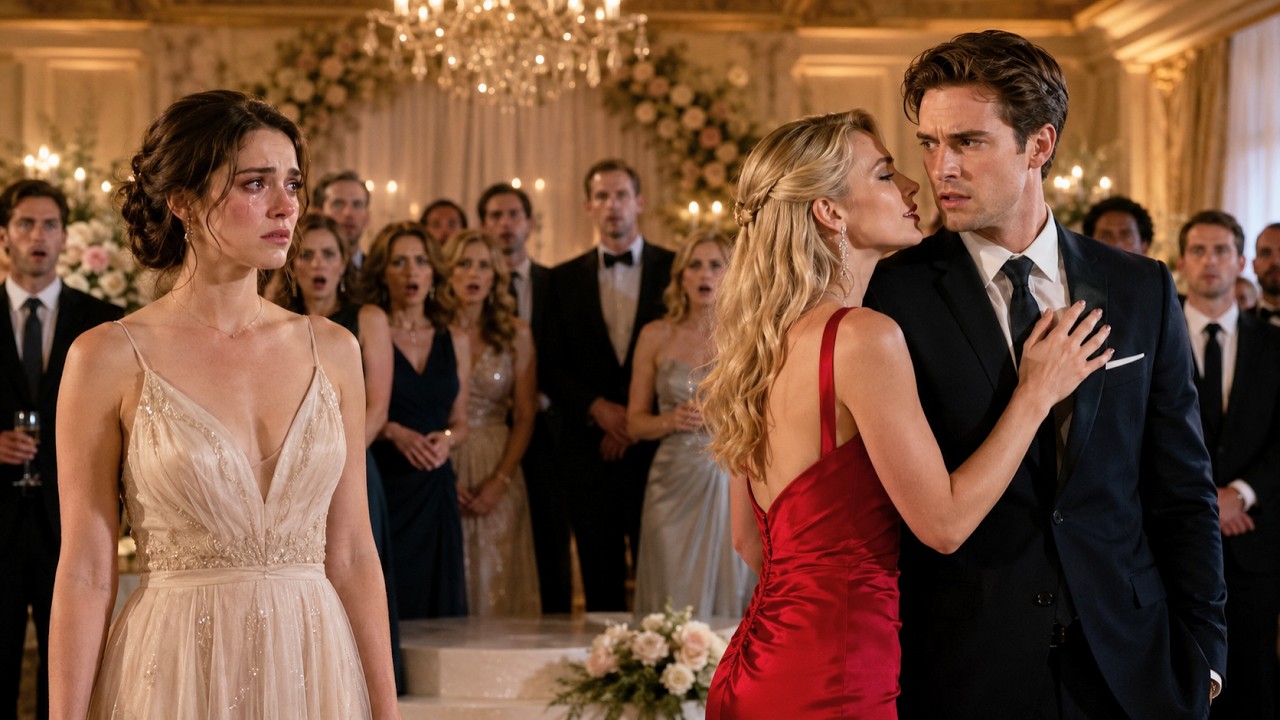
The first slap silenced the string quartet.
The second made every phone in the ballroom rise.
I stood beneath the crystal chandeliers of my own engagement party with one cheek burning, one hand resting against the champagne table, and two hundred guests staring as if they had just watched a bride become a headline.
Across from me, Sienna Vale lowered her hand slowly. She was beautiful in the way expensive knives are beautiful—sleek black dress, red mouth, diamond earrings that caught the light when she tilted her chin. She looked not ashamed, not frightened, but satisfied.
“That is for pretending you do not know who I am,” she said.
The room inhaled.
My fiancé, Julian Crowe, moved at last. Not toward me. Toward her. He caught her wrist with a tenderness that made my stomach turn colder than my cheek was hot.
“Sienna,” he said, low and warning. “Enough.”
Enough. Not stop. Not how dare you. Enough, as if she had simply taken a scene too far.
I looked at him, then really looked. Julian wore the navy tuxedo I had chosen, the watch I had given him, and the expression of a man calculating which woman would cost him less in public. The engagement ring on my finger felt suddenly ridiculous—heavy, bright, borrowed from a story that had ended before I arrived at the ballroom.
His mother, Celeste Crowe, stepped forward with a smile polished thin enough to cut.
“Everyone, please. This is a private misunderstanding.”
Private. I almost laughed. Nothing became private after two slaps under chandeliers and fifty recording phones.
Sienna’s eyes flashed. “Private? He promised me he would end this tonight.”
Someone gasped near the dessert table. Julian’s face hardened. “Do not—”
But she had already tasted the room’s attention. She turned toward me and looked me up and down with contempt so practiced it almost looked elegant.
“You think a ring makes you important? He was with me last night. He told me this engagement was for business.”
The room went very still.
I felt the heat in my cheek spread to my ear. My eyes did not water. That surprised me. I had always imagined humiliation would arrive wet and loud. Instead it arrived clean, like a blade sliding into place.
Thirty minutes earlier I had stood in the bridal suite while Julian kissed my forehead and told me I looked perfect. His hands had been gentle on my shoulders. He had smelled of cedar, champagne, and another woman’s perfume. I had known then—not all of it. Enough. I had still walked into the ballroom because I wanted him to make his choice in front of witnesses.
He had.
I straightened slowly. My cheek stung with every movement. The guests watched, hungry and horrified. Sienna waited for tears. Celeste waited for obedience. Julian waited for me to save him, because that was what I had done for two years. I had translated his lateness into ambition, his coldness into stress, his missing money into startup pressure, his mother’s cruelty into old-fashioned nerves. I had been so busy explaining him that I had almost forgotten to listen to myself.
Now I did.
My voice was calm when I spoke.
“Julian.”
He turned to me quickly, relieved by the sound of his name. “Lena, I can explain—”
“No.” The word was soft. It stopped him anyway. “You can do that later. With counsel.”
His eyes narrowed. “What?”
I removed the engagement ring. It slid over my knuckle with a small resistance, as if even the metal knew a performance was ending. I placed it on the champagne table beside a tower of untouched glasses.
“This engagement is over.”
Sienna smiled for eight seconds.
Then I turned to the event manager at the side door. “Mr. Lang, please close the exits for media control. No one deletes footage. Security will escort Miss Vale to the private lounge—not outside.”
Sienna blinked. “Excuse me?”
I looked at her. “You wanted attention. You will have a full audience in thirty minutes.”
Julian stepped closer. “Lena, stop being dramatic.”
There it was. The old leash. I looked at him until his mouth closed.
“The gala screen is connected to the main server, correct?” I asked the event manager.
Mr. Lang nodded, pale but professional. “Yes, Miss Hart.”
“Good. Then we will use it.”
Celeste grabbed Julian’s arm. “What is she talking about?”
I did not answer. I walked through the room with a red mark across my cheek and every camera following me like a flock of bright insects. Behind me, Sienna’s smile faded completely.
Thirty minutes later she would beg—but not for forgiveness. For silence.
Most guests believed I was the quiet daughter of a dead architect and a former art teacher, a woman who ran a modest urban-renewal charity and owned one tasteful apartment near the river. I wore simple jewelry. I drove myself. I said thank you to waiters by name. I seemed fortunate but not dangerous.
That was the mistake.
My father had not merely been an architect. He had been the founder of Hartwell Urban Trust, a private land-and-development fund that quietly owned blocks of historic property across the city. He had built the structure carefully, away from society gossip, because he believed visible wealth attracted both taxes and sons-in-law with clean shoes. When he died I inherited voting control through a trust that did not put my name on signs. I became chair at twenty-eight. I learned quickly that quiet money was safer than loud money, and quiet women heard more than praised women.
Julian Crowe heard only the first part. He believed I was useful because my charity had connections, my name had old respect, and my father’s estate might someday become accessible if he married patiently enough. He did not know that the buildings his family desperately wanted to acquire for their luxury hotel project were controlled by my trust.
He also did not know I had discovered his plan three weeks before the engagement party.
It began with a wrong email. Julian’s assistant sent me a draft investor deck meant for Celeste. The subject line read: Revised Post-Engagement Acquisition Strategy. I opened it expecting seating charts or hotel blocks. Instead I found myself reduced to a transaction.
Slide 12 showed a map of the East Market District—the exact area Hartwell Urban Trust protected through long-term community leases. The Crowe family’s company wanted to demolish half of it for a luxury hotel, spa, and private residences. Slide 13 read: Marriage alignment creates pathway to Hartwell influence. Slide 14 listed my nonprofit as a reputation bridge. Slide 15 named Sienna Vale as external pressure contingency.
I sat at my desk for a long time after reading that phrase.
External pressure contingency. Not mistress. Not affair. Contingency.
Men like Julian loved turning betrayal into business language. It made cruelty look clean on slides.
I did not confront him. Instead I called Maya Singh. Maya was my attorney, best friend, and the only woman I knew who could make a silence sound like a legal threat. She read the deck, then said, “He put his affair in a presentation.”
“Apparently.”
“Ambitious and stupid. My favorite combination.”
The investigation took eleven days. What they found was worse than an affair. Julian had been meeting Sienna for over a year. She was not merely his lover. She was a public-relations consultant hired under a shell contract through the Crowe family company. Her job was to create leverage if I refused to support the East Market project after marriage. The plan included staged leaks about my charity finances, rumors that my father had mismanaged trust property, and a possible confrontation at a public event to make me appear unstable.
The engagement party was the chosen stage.
I had walked into the ballroom knowing the script. I had simply decided to rewrite the ending.
At the twenty-nine-minute mark I returned to the center of the room. The string quartet had been replaced by silence. The gala screen flickered to life. The first image was the investor deck—page by page, slow enough for every guest to read the words “marriage alignment” and “external pressure contingency.” The second set of files showed bank transfers from the Crowe company to Sienna’s consulting shell. The third showed hotel records and travel receipts that matched Julian’s unexplained absences. The fourth was a voice memo, recorded without her knowledge during one of their strategy calls, in which Sienna calmly discussed “public embarrassment as negotiation leverage.”
The room did not erupt. It froze.
Sienna’s face drained of color. Julian’s mother pressed a hand to her throat. Julian himself stared at the screen as if the numbers might rearrange themselves into something less damning.
I spoke into the quiet.
“This engagement was never about love. It was about access. The East Market District is not for sale. The trust will not be redirected. And any further attempt to manufacture leverage against me or the properties under my care will be met with the full legal resources of Hartwell Urban Trust.”
I turned to Sienna. “You wanted a scene. You received one. Now you may leave through the private lounge, or you may stay and answer questions from the people currently recording every word. Choose carefully.”
She chose the lounge.
Thirty minutes after the second slap she was in a side room begging me not to release the remaining files—the ones that showed her personal attempts to plant false stories about my father’s will. Her voice shook. The satisfaction was gone. Only calculation remained.
“I was hired,” she said. “I can testify. I can undo this.”
“You already did the part you were hired for,” I answered. “The rest is not my problem.”
Julian found me near the service corridor as guests began to leave in careful clusters. His tuxedo was still perfect. His face was not.
“You could have come to me,” he said.
“I did. For two years. You were busy calculating which version of me would cost less.”
He reached for my hand. I stepped back.
“The ring is on the table,” I said. “Keep it. Or don’t. It never belonged to a real future.”
I walked out of the ballroom with the red mark still visible on my cheek and the knowledge that quiet money, when forced into the light, can speak louder than any slap.
In the weeks that followed the Crowe family attempted damage control, then silence, then quiet retreat from the East Market proposal. Sienna disappeared from the city’s social calendar. Julian sent one letter that I did not open. Celeste sent none.
I returned to the work my father had left me—protecting the blocks of the city that still remembered their own names. The charity continued. The trust remained closed to outsiders who mistook patience for weakness.
Sometimes I still touch the place on my cheek where the second slap landed. It no longer burns. It simply reminds me that the most dangerous women in a ballroom are not the ones who raise their hands.
They are the ones who wait until the screen turns on—and then refuse to look away.