On Our Wedding Night He Left Me in My Dress for His First Love — Days Later He Lost Everything.
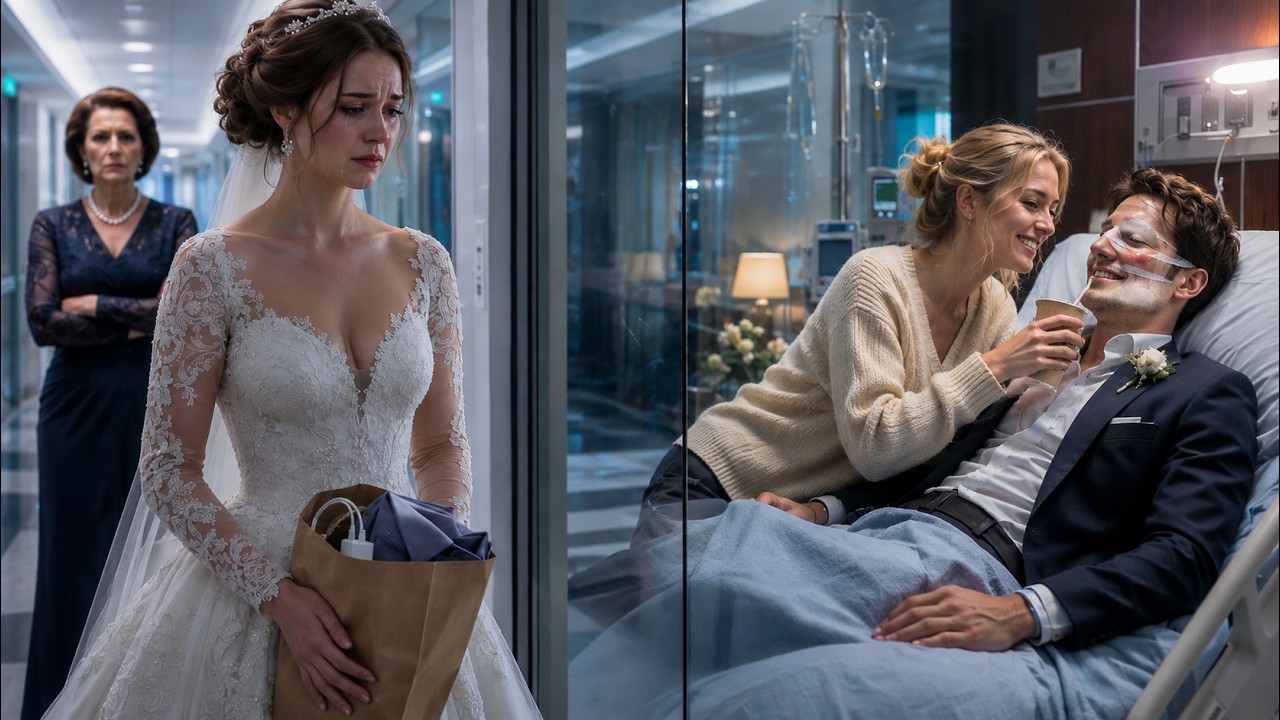
On our wedding night my husband left me in my dress. His car keys shook in his hand when he said her name.
“Sophia is in the hospital,” Adrian told me. “I have to go.”
The reception had ended forty minutes earlier. White roses still crowded the foyer of our new condo. My veil hung from one pearl comb, half pinned and half falling down my back. The zipper of my wedding dress had left a red line between my shoulder blades. Adrian stood beside the front door in his black tuxedo. His bow tie was in his pocket. His hair was still damp from the rain outside the hotel. He looked tired. He did not look married.
“Sophia called twice,” he said. “She had another panic episode.”
I kept one hand on the marble console table. The stone felt cold under my palm.
“Tonight?” I asked.
He flinched, but only a little. “I promised her before the wedding. If she had a real emergency, I would come.”
Behind me my maid of honor made a sharp sound. Mia had been kneeling on the floor, lifting the train of my dress so I would not trip. She stood so fast the silk slipped from her hands.
“Are you out of your mind?” she said. “Adrian, this is your wedding night.”
Adrian did not answer her. His eyes stayed on me.
“Elena,” he said lower now. “I told you about Sophia before we got married.”
He had. One week before the wedding he took me to a steakhouse with low lights and linen napkins. He waited until the waiter poured the wine before he told me about Sophia Hayes, his first love, his almost-wife, the woman his family had rejected because she had no money, no pedigree, and no useful last name.
“We were together for seven years,” he said that night. “She’s fragile. My family broke her trust. I cannot abandon her just because I am getting married.”
I had set down my knife. “Then why are you getting married?”
“My father wants to see me settle before his surgery,” Adrian said. “He trusts your family. He trusts you.”
That was the clean version. The real version was simple. Walker Medical Systems needed my father’s logistics network. My father needed access to the Walker hospital contracts. Adrian needed a wife who would not embarrass him. I needed a marriage that could protect my mother’s old foundation from a lawsuit Adrian’s father had promised to settle. Love was never listed in the agreement. Respect was.
I had told Adrian my only line. “Do not humiliate me.”
He had looked straight at me. “I won’t.”
Now he stood in front of me with the rain still on his shoes, asking to leave me for the woman he had never really left.
Mia stepped between us. “Give me the keys.”
Adrian’s jaw tightened. “Move.”
“No.”
I touched Mia’s arm. “Let him go.”
She turned toward me as if I had slapped her. “Elena—”
I looked at Adrian. His fingers had gone white around the keys.
“Go,” I said.
For a second shame crossed his face. Then relief swallowed it.
“I will be back as soon as I can.”
“Take an umbrella.”
He stared at me. I picked up the black umbrella from the stand and held it out. He did not take it. The door closed softly behind him. That soft click sounded worse than a slam. A slam would have meant anger. The click meant he still wanted to seem decent.
Mia opened the door again, but the hall was empty. She turned back with tears of rage in her eyes.
“You cannot let him do this.”
I reached behind my neck and found the first pearl pin. “Can you unzip me?”
“No, Elena. No. I am not helping you act calm while your husband runs to his ex.”
“His first love,” I said.
“That does not improve the sentence.”
My laugh came out thin. I pulled another pin from my hair. My scalp ached from smiling all day. The ache felt cleaner than the one in my chest.
“I knew about her.”
“You knew he had an ex. You did not know he would leave during the first hour of your marriage.”
“I knew enough.”
Mia stared at me in the mirror. Behind her our wedding portrait leaned against the wall. It had not been hung yet. Adrian and I looked polished and rich and empty.
“Why did you marry him?” she asked.
I placed the pearl pins in a straight line on the console. “Because Richard Walker asked me to.”
Mia went still. Richard Walker was Adrian’s father. He had built Walker Medical Systems from one Ohio supply company into a national hospital vendor. Six months earlier he asked to meet me in a private room at his club.
“My son is drowning in the past,” he said. “I do not have time to watch him sink.” He wanted me to marry Adrian for one year. In return he would settle the lawsuit against my mother’s foundation, protect my father’s warehouse routes, and give me a seat in the Walker Charitable Trust. I told him I was not a rehabilitation center. He said I was a Bennett, and Bennetts understood contracts.
I did not love Adrian then. That made the choice easier. Then I met him. He was not warm, but he was honest. He asked about my cases. He remembered my coffee. Once after a charity dinner he fixed a cut heel strap with medical tape from his wallet. Small things can fool a lonely person. By the wedding I did not love him, but I had started to hope. That was my first mistake.
Mia finally unzipped the dress. Her hands shook while she worked.
“Come home with me,” she said.
“No.”
“Elena, please.”
“This condo is half mine. So is the humiliation.”
I stepped out of the dress and folded it over a chair. “Then I will sleep with it.”
I did not sleep. At 12:17 a.m. my phone lit up. The number was unknown. The photo showed a hospital room. Sophia sat in bed under a gray blanket, her hair loose over one shoulder. Adrian stood beside her with a paper cup in his hand. He was leaning close enough that his sleeve touched her pillow. The message below it said: You have such a kind husband.
Mia saw my face and snatched the phone. “I will destroy her.”
“No.”
“Elena—”
“She wants a reaction. She deserves one. Not from me.”
I took the phone back and set it face down. The second message came at 1:03. This one showed Adrian asleep in a chair beside Sophia’s bed. His jacket covered her knees. Thank you for lending him to me tonight.
I got up and walked to the kitchen.
“What are you doing?”
“Making tea.”
“You hate tea.”
“I know.”
The kettle clicked. Steam rose against the dark window. My reflection looked pale and expensive, like a woman in a magazine ad for regret.
At 3:40 a.m. Adrian texted: She’s stable. I will come home after the doctor sees her.
I typed one word. Okay. Then I deleted it.
At dawn I showered, put on a navy suit, and went to work. Our firm occupied the twenty-third floor of a glass tower downtown. I specialized in contract disputes and forensic review. Numbers were easier than people. A balance sheet could lie, but it left fingerprints.
At 9:15 my assistant congratulated me and looked at my left hand. The name Mrs. Walker landed wrong. Then Margaret called.
“Where is my son?”
“Sophia had an emergency.”
A pause told me she already knew. “You let him go.”
“He is thirty-two.”
“He is your husband now. A wife should know when her husband needs her.”
I looked at my ring. The diamond was a square cut Adrian’s father had chosen. “I will keep that in mind.”
By noon Sophia sent a photo from Adrian’s car. The hospital entrance blurred behind her window. He insisted on driving me home. Please do not be angry.
I saved the photo under her name. Evidence should have a name.
Adrian came home at 7:10 that evening. I was at the dining table with my laptop reading a debt covenant from Walker Medical Systems. It was not part of my client work. It was public, pulled from a bond filing. His shirt was wrinkled. His face had the gray look of a man who had not slept.
“You are home,” he said.
“So are you.”
He set his keys in the bowl. They landed hard. “Sophia had a real episode.”
“I did not say she didn’t.”
“You did not answer my text.”
“You did not ask a question.”
He stood across from me. “Elena—”
I closed the laptop. “Did you sleep in her room?”
His mouth tightened. “In a chair.”
“Did you give her your jacket?”
“She was cold.”
“Did she send me photos?”
He blinked. “What?”
I turned my phone around and slid it across the table. He looked at the screen. The blood left his face slowly.
“I did not know she sent those.”
“Now you do.”
“I will talk to her.”
“You should.”
He looked up. “That is it? What else do you want? I expected you to be angry.”
“I am.”
“You don’t sound angry.”
“I learned young that anger is expensive.”
He frowned. “What is that supposed to mean?”
“It means I do not spend it where it cannot buy anything.”
The silence between us sharpened. Adrian pulled out a chair, then did not sit.
“I know last night looked bad.”
“It was bad.”
“I am trying to be responsible.”
“You are trying to keep both doors open.”
He flinched. I opened the laptop again and turned the screen toward him.
“Walker Medical Systems is carrying more short-term debt than your father admitted. The bond covenants require continuous control of the logistics routes my father’s company provides. If those routes are interrupted, the interest rate resets. If the rate resets, the company misses the next interest payment. If it misses the payment, the charitable trust your father used as collateral becomes available to the senior lender.”
Adrian stared at the screen. “How do you know this?”
“I read. You sleep in hospital chairs.”
He sat down hard. “My father said the debt was manageable.”
“Your father says many things. The filings say otherwise.”
I closed the laptop. “I will not compete with Sophia. I will not wait for you to decide which woman is the emergency. I will also not let this marriage become the reason my mother’s foundation loses the settlement your father promised.”
Adrian’s voice was quiet. “What are you going to do?”
“I am going to protect the only thing that was ever actually mine.”
Three days later I met Julian Cross in a private conference room overlooking the river. He was the senior lender behind the Walker Medical bonds and the quiet majority holder of the note that could call the company into default. Adrian’s father called him a vulture. My mother had once called him the only honest man in a room full of hospital contracts.
Julian listened while I laid out the timeline, the photos, the messages, and the covenant language. He did not offer sympathy. He offered a question.
“Do you want him punished or do you want the foundation secured?”
“Both,” I said. “In that order.”
He almost smiled. “Good.”
By the end of the week the senior lender issued a formal notice of review. Walker Medical’s board was forced into emergency session. Adrian’s father tried to blame market conditions. The filings blamed the loss of logistics control that would follow any disruption of the Bennett contracts. The settlement for my mother’s foundation was executed within forty-eight hours—quietly, completely, and irrevocably.
Adrian came to the condo one final time. He looked older than he had on our wedding night.
“You planned this,” he said.
“No,” I answered. “You left. I simply stopped pretending the door you walked through was still open.”
Sophia sent one last message: He is better when he is needed. I hope you understand.
I blocked the number.
The divorce was final in ninety days. The condo was sold. I kept the original partnership documents that protected the foundation and the single photograph of my mother that had always sat on my desk. Adrian retained the family name and the company that was no longer as solid as it looked. Julian Cross never asked for anything in return. He only sent one note: Contracts remember longer than people.
I still have the wedding dress. It hangs in a garment bag at the back of a closet I rarely open. Some nights I think about the soft click of the door and the way Adrian’s relief looked almost like love. Then I remember the photos on my phone and the bond covenants that never learned how to lie.
He left me on our wedding night for the woman he had never truly left. He never expected the wife who stayed quiet to read the filings, call the lender, and close every door he thought would remain open.
I did not scream. I did not beg. I simply collected the evidence, protected what mattered, and let the numbers finish what the wedding night began.