On Our Wedding Eve He Held His First Love and Said Tomorrow Should Have Been Hers — Then the Bride Played the Video for 200 Guests.
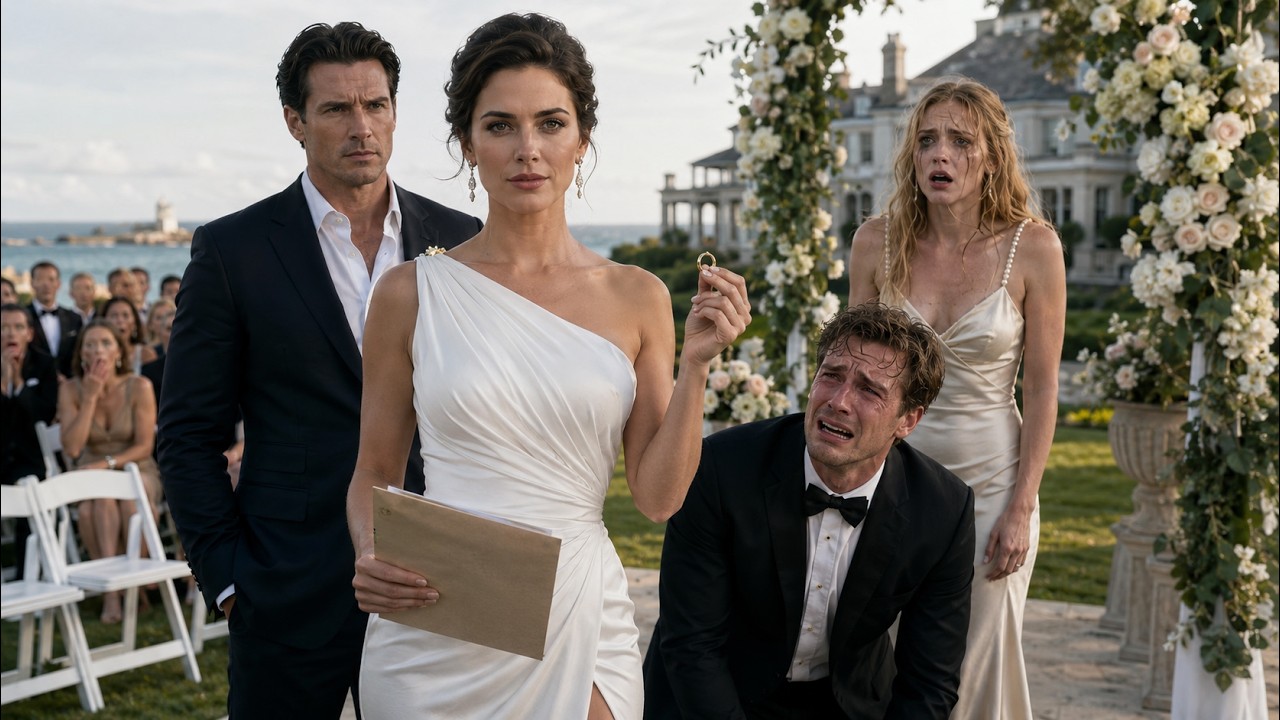
My fiancé missed our wedding rehearsal because his first love needed him to hold her hand while she said goodbye to being single.
I found out from a video sent by a bridesmaid who thought I deserved to know before I walked down the aisle. There he was, my groom, standing under red bar lights with Sophia’s arms around his neck, telling her, “If you had stayed, tomorrow would have been ours.”
The room around me did not move. The planner kept talking about linen changes. My mother kept folding place cards into perfect little tents. The chapel coordinator asked whether the groom’s party had arrived. I watched the video again. Tristan taught me that betrayal could sing over a nightclub speaker while wearing the watch I bought him. His first love laughed against his throat and my future ended in twelve seconds of shaky phone footage.
I did not scream. I did not faint. I asked the coordinator for the Wi-Fi password. That was the first decision that saved me. The second was forwarding the video to my attorney. The third was calling Julian Cross.
Julian was not my lover. Not then. He was Tristan’s most important business target. The man whose private-equity fund was supposed to announce a partnership with Holloway Home the morning after the wedding. Tristan needed that partnership more than he needed sleep, more than he needed decency, more than he needed me.
Holloway Home looked like an American success story from the outside. Luxury furniture, Southern craftsmanship, magazine kitchens full of pale oak and expensive bowls nobody used. Tristan was the handsome founder with rolled sleeves and a family name old enough to make investors sentimental. I was the woman who made the company work. Not in the photographs. Never there. I handled vendor disputes, packaging redesign, compliance problems, late shipments, customer anger, investor decks, and every emergency Tristan called boring until it threatened his valuation. He called me his anchor. I should have known anchors are useful because they stay out of sight.
Sophia had been his high-school sweetheart. She left him after college for a musician, then a chef, then a tech founder. Each time she returned, Tristan became seventeen again—softer, angrier, easier to manipulate. She did not love him steadily. She loved him as a place to land when other men stopped applauding. Tristan knew that. That was why he kept trying to prove she had been wrong to leave. I became part of the proof. The fiancée with the architecture degree. The woman from a respectable family. The woman who could make investors believe his chaos was vision.
For three years I told myself he chose me. By the time the video reached my phone I understood something colder. He had chosen the life I made possible. Sophia was still the woman he wanted to impress inside it.
Our wedding was scheduled for Saturday at the Old Harbor Club. Not a church. Tristan said churches made him feel judged. The club had white columns, ocean views, and enough inherited money in the walls to make his mother comfortable. His mother had spent six months calling it a society correction. She never said correction of what. My family was wealthier than hers, but newer. My father made money building hospitals. Tristan’s family lost money preserving portraits. In her mind that made us both useful and slightly unfortunate.
The rehearsal dinner was supposed to begin at seven. At 6:20 Tristan texted: Running late. Sophia had a panic attack. Do not make it weird.
Do not make it weird. That was how he translated my boundaries into inconvenience.
At 6:45 my maid of honor pulled me into a coatroom and showed me the first video.
“I am sorry,” she whispered.
I watched Tristan hold Sophia’s face between his hands. I watched her cry into his shirt. I watched him kiss her forehead while her friends screamed in the background. Then came the sentence: If you had stayed, tomorrow would have been ours.
My friend’s eyes filled. “Elena, what do you want to do?”
My name in her mouth brought me back. Elena, not Mrs. Holloway, not almost, not abandoned.
“I want the guest-list spreadsheet,” I said. “The final one. With emails.”
She understood slowly, then completely. “You are not canceling.”
“No,” I said. “He can explain himself to everyone he invited to watch me become useful forever.”
That night I smiled through the rehearsal dinner. Tristan arrived at 8:17 with Sophia’s perfume on his jacket and a lie already polished in his mouth.
“Her friends over-served her,” he said, loud enough for my parents to hear. “I had to make sure she got home safe.”
Sophia arrived ten minutes later. That was the insult that clarified everything. She wore ivory satin—not white, close enough to be cruel. Her hair was loose. Her eyes were pink. She moved through the room like a wound asking to be kissed. Tristan’s mother rose from her chair and hugged her.
“Sweet girl,” she said. “You should have told us you were struggling.”
My mother stared at me. My father put down his wine. Tristan came to my side and squeezed my shoulder too hard.
“Be kind,” he murmured. “She is fragile.”
There it was again. Fragile. The word men use when they want a woman’s bad behavior handled with gloves.
I looked at Sophia across the candlelit table. She was already looking at me. Mouth curved, eyes wet. She wanted me to break in public so Tristan could protect her from my cruelty.
Instead I stood. The room quieted. I lifted my glass.
“Thank you all for coming,” I said, “especially those who traveled far and those who traveled through complicated feelings.”
Tristan’s hand froze on his fork. A few guests laughed uncertainly. Sophia tilted her head.
“Tomorrow will be unforgettable,” I said. “I promise.”
Then I sat down.
Tristan leaned close. “What was that?”
“A toast.”
“Do not start.”
I turned to him with a smile no one else could read. “I already did.”
At midnight, after the guests left, Tristan followed me to the hotel suite. He expected tears then. Men like him believe a woman saves her dignity for public and her begging for private. I gave him neither.
He closed the door and loosened his tie. “Sophia is going through something you cannot understand.”
“Her bachelorette party?”
His eyes flashed. “Her engagement is unstable. Her fiancé treats her like an accessory.”
“So you auditioned?”
“Elena.”
“I saw the video.”
The color left his face. Only for a second. Then anger replaced it.
“Who sent that to you?”
“Did I hurt you?” I asked. “Not ‘I am sorry.’ Who exposed me?”
That question saved me from one last night of doubt.
“Several people,” I said. A lie. A useful one.
He began pacing. “It was emotional. She was drunk. I said something stupid to calm her down.”
“You told her tomorrow should have been hers.”
“Because she was spiraling.”
“And I am what? Medication?”
He stopped. “You are my future.”
“No. I am your financing.”
That landed. His mouth tightened.
“Your father offered capital because he believes in us.”
“My father offered capital because I asked him to believe in you. Do not threaten me with money the night before our wedding.”
“Do not humiliate me with your first love the night before our wedding.”
For the first time he looked afraid. Not of losing me. Of losing the structure around me. The investors arriving tomorrow. The announcement with Julian Cross. The feature in the magazine. The private showroom lease my father had quietly guaranteed.
Tristan loved romance when it made him look noble. He loved business when someone else handled the risk.
“We can fix this,” he said. “After tomorrow.”
There it was. After tomorrow. After vows made retreat expensive. After my family money crossed into his company. After my name became legally attached to his debts.
I walked to the desk, opened my laptop, and pulled up the prenup.
“Sign the amended disclosure schedule tonight.”
He stared. “What?”
“You listed no related-party transactions with Sophia or her businesses. Sign an update confirming that.”
His expression changed again. Too fast. Too revealing.
“Why would she have anything to do with a prenup?”
“That is what I want you to confirm.”
“You are being paranoid.”
“Then sign.”
He did not. He slept on the couch after calling me cold, controlling, and influenced by my family. I did not sleep. I spent the night with my maid of honor, my attorney, and two laptops. We found the first thread through a vendor payment that should never have left the company account. Then the second. Then the third.
By dawn we had the full picture. Tristan had been routing design fees for custom pieces—pieces I had sketched and refined—into a side account controlled jointly with Sophia. He had used my name and my father’s soft guarantees to inflate the valuation for Julian’s fund. The partnership announcement scheduled for the morning after the wedding was built on numbers that would collapse the moment anyone looked closely at the source of the designs.
I did not cancel the wedding.
At 11:00 a.m. I walked down the aisle in the gown I had chosen months earlier. Two hundred guests rose. Tristan waited at the altar looking every inch the devoted groom. The minister began. We exchanged the ceremonial words. We signed the preliminary papers.
Then, before the first toast, I stepped to the microphone.
“Before we continue,” I said, “there is a short video I would like everyone to see. It was recorded last night.”
The large screen behind the head table lit up. Tristan’s face drained of color as the nightclub footage played—his arms around Sophia, the red lights, the exact words: If you had stayed, tomorrow would have been ours.
Gasps rolled through the room. Tristan started toward the stage. My attorney stepped into his path.
The second slide appeared: bank transfers, design invoices with my sketches attached, the side account bearing both his name and Sophia’s. The third slide showed the draft partnership announcement with Julian Cross, complete with the inflated valuation numbers that depended on work I had never been credited for.
I looked at Tristan. “You spent our wedding eve telling another woman that tomorrow should have been hers. You spent three years building a company on my work while keeping my name off every public document. You invited two hundred people here to watch me become legally useful. I decided they should watch something more honest instead.”
Julian Cross rose from his seat in the third row. He did not look surprised. He looked as if a calculation had finally resolved.
“The partnership will not proceed under the current structure,” he said, voice carrying. “Any future discussion will be with the person who actually produced the work.”
He looked at me. I nodded once.
Tristan’s mother began to cry. Sophia, seated near the back in ivory satin, stood and left without a word. Tristan tried to speak and found no audience willing to listen.
I did not stay for the rest of the reception. I walked out into the salt air with my maid of honor on one side and my attorney on the other. Behind us the orchestra had stopped. The only sound was the ocean and the low murmur of two hundred people rewriting the story they had come to celebrate.
Three months later the company was restructured. The designs were properly attributed. The side account was closed and the funds returned. Julian’s fund eventually invested—under terms that listed my name where it belonged. Tristan retained a minority interest and a permanent reputation for confusing ownership with entitlement.
I kept the watch I had given him. I sold it and donated the proceeds to a scholarship for women in design. The empty box sits on a shelf in my studio as a reminder that some gifts reveal more about the giver than the receiver.
On the night before what was supposed to be my wedding, Tristan held another woman and told her the future should have been theirs. He never expected the bride to have the evidence, the guest list, or the willingness to use both.
I did not need to raise my voice. I simply turned on the screen and let two hundred people see exactly who he had chosen.
The rest was arithmetic.