He Handed My Wedding Bouquet to His First Love in Front of 300 Guests — Then the Screen Lit Up.
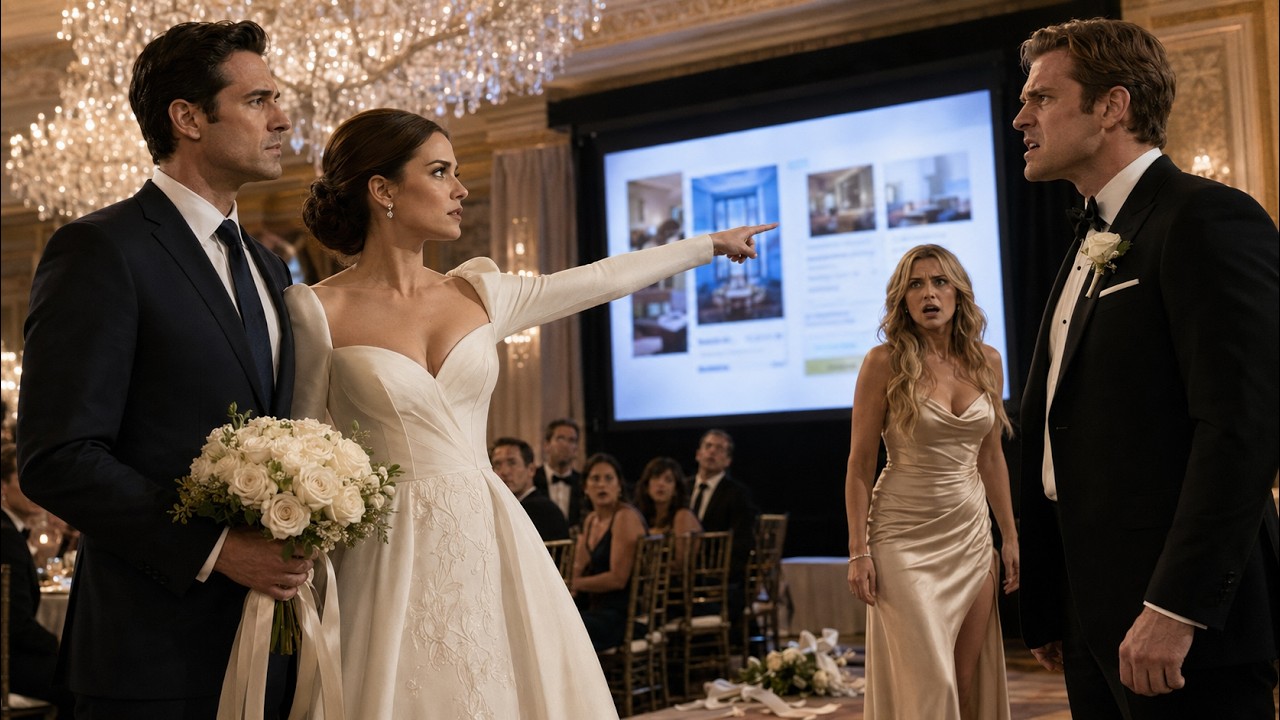
My fiancé handed my bouquet to his first love in front of every guest at our wedding.
Lila raised the white roses like she had been waiting years for someone to return them to her. Mason smiled at her, touched the small of her back, and told me, “Juliet, let her have this. She needs one happy moment after her divorce.”
The photographer lowered his camera. That was how quiet the ballroom became. Even the people paid to make the day look beautiful understood that something ugly had just happened.
I stood beneath a ceiling of crystal chandeliers in the grand hotel wearing a gown I had designed myself for the bridal line my mother founded and my father nearly lost. Mason stood ten feet away with his hand on Lila’s waist and my bouquet in her arms. Three hundred guests watched to see whether I would cry.
I smiled instead.
“Of course,” I said. “Let her throw it.”
Mason blinked. Lila’s smile faltered for half a second. They had expected pain. They had dressed for it. Lila wore a champagne silk dress cut close enough to look bridal without letting anyone accuse her of wearing white. Mason wore the expression he used whenever he wanted the room to see him as generous. He had used that expression on me for eighteen months.
At first I loved it. Mason was charming in the old-hotel way. He remembered names, opened doors, sent handwritten notes, and never raised his voice. He came from a family that once owned department stores in three states before online retail hollowed them out. He had inherited polish and debt. I had inherited the biggest competitor to his family’s fading bridal departments.
My mother built the atelier from one sewing room and a borrowed machine. By the time she died, her gowns were in magazines, her veils were copied by factories, and her private sketches were locked in a climate-controlled archive above our flagship salon. After my father’s stroke, I became creative director at twenty-eight. Mason arrived as a merger consultant. He told me our companies could become one American bridal house—old department-store reach married to couture credibility. He told me he believed in my work. He told me my mother would have wanted me to stop carrying everything alone.
Loneliness made those sentences sound like vows.
The actual vows were scheduled for five o’clock. At 4:48 Mason gave my bouquet to Lila.
“Ladies,” Lila called, turning toward the group gathered by the dance floor. “Apparently I get a second chance.”
A few women laughed weakly. My cousin gripped the edge of her champagne flute so hard I thought it might break. Mason came back to me, lowering his voice.
“Thank you for being kind. I have learned a lot about kindness from you.”
He missed the blade in it.
“After the ceremony we can talk,” he said. “Lila has been fragile since the divorce. You know what her ex did to her.”
I looked across the ballroom. Andrew stood near the service doors in a dark suit, his hands folded in front of him, his face unreadable. He was Lila’s ex-husband, a forensic accountant with a reputation for being so cold that clients joked he could audit a fire and find where it had overspent. Mason had told me Andrew destroyed Lila—too controlling, too suspicious, too obsessed with money trails.
I believed him until Andrew sent me one envelope. No note. No plea. Just a copy of a vendor invoice from my wedding florist. The invoice listed a second bridal bouquet, champagne silk ribbon, and delivery instructions to a private suite under Lila’s name. At the bottom, the payment account was not Mason’s. It was mine.
After that came the hotel suite booking, then the honeymoon change order, then the shell company attached to a licensing deal Mason wanted me to sign after the ceremony. Andrew did not ask me to trust him. He gave me numbers that did not care whether I liked him.
So when Lila raised my bouquet above her shoulder and prepared to toss it, I turned to the wedding planner.
“Lights to presentation mode,” I said.
The planner went pale. “Now?”
She had been with my mother’s company for twelve years. She had hemmed sample gowns at midnight, held my father’s hand during his first rehab walk, and cried in the archive after Mom’s funeral. She did not ask questions.
The ballroom lights lowered. Lila froze with the bouquet above her head. Mason turned slowly.
“Go ahead,” I said to Lila. “Throw it.”
She tried to laugh. “Maybe we should wait.”
“No. You wanted one happy moment.”
The silence sharpened. Lila tossed the bouquet. It landed directly in Andrew’s hands. He did not reach for it. It hit his chest and he caught it by reflex. The room gasped.
For the first time all day, I laughed.
Mason’s face hardened. “That is enough.”
“No,” I said. “We have not even started.”
The large screen behind the head table lit up. It was supposed to show a video montage—my mother pinning lace on a mannequin, Mason proposing in the atelier garden, my father lifting one shaky hand to bless the engagement. Instead the first slide showed a hotel booking.
Hotel Rémy. Presidential Suite. Guest names: Mason Bellamy and Lila Vance. Check-in tonight.
The room inhaled as one body. Lila dropped her hands. Mason crossed the floor toward the audio table. Andrew stepped into his path, bouquet still in hand.
“Move,” Mason said.
Andrew’s voice was quiet. “No.”
Mason looked ridiculous trying to intimidate him. Andrew was not taller by much, but he had the stillness of a locked door.
The second slide appeared. Private island resort transfer. Two passengers. Names blurred for privacy by counsel, but the initials were not blurred. M.B. L.V.
My guests began turning to each other. Phones rose. Reporters who had come for bridal-society coverage suddenly remembered they were journalists.
Mason pointed at me. “You are making a scene based on fake documents from her bitter ex-husband.”
“Then you will be relieved to know the hotel confirmed them.”
The hotel’s general manager stood near the bar with a folder against her chest. She had not wanted to be involved. Then Andrew showed her that the charges had been routed through my wedding master account. She was very involved now.
Lila’s voice shook. “Mason told me Juliet knew.”
There it was again—the coward’s prayer. He told me you knew.
I walked toward her. The train of my gown moved behind me like water over marble. My mother had sketched the neckline twenty years ago. I had finished the sleeves after she died. Every stitch had felt like talking to her. Seeing Lila hold my bouquet had hurt. Seeing Mason try to use my mother’s company to fund his escape did something colder.
“Give me your phone,” I said.
Lila clutched her beaded bag.
“If Mason lied to you, give me your phone. Let the messages prove it.”
Her eyes darted to him. Mason said, “Do not hand anything over. She is unstable.”
My father stood from his wheelchair at the front table. He should not have. My cousin moved to help him, but he raised one hand. The stroke had taken some of his speech and most of his balance, but not his timing.
“My daughter,” he said slowly, each word hard-won, “is not unstable.”
The room went dead quiet. I could have forgiven a lot before that moment. Not Mason making my father spend strength on dignity he should never have had to defend.
Andrew placed the bouquet on the nearest table and opened a slim folder.
“There is more,” he said.
Mason laughed bitterly. “Of course there is. The bitter ex brings a folder.”
Andrew did not look at him. He looked at me. “Do you want to proceed?”
That question mattered. The whole room watched him give me control.
I nodded.
Andrew handed one document to my attorney, who had been sitting in the third row in a silver dress. Nobody noticed until she stood. She was seventy-one, sharp as cut glass, and had represented my mother since the atelier was one sewing room. Mason called her old-fashioned because she believed signatures should mean what they said.
She faced the guests. “At noon today Mr. Bellamy delivered a postnuptial intellectual-property assignment to Miss Marlowe’s bridal suite.”
Mason’s father groaned.
Mason said, “It is standard merger housekeeping.”
“It transfers future bridal designs, archive patterns, unpublished sketches, and licensing rights to a new holding company,” my attorney continued.
The screen changed. Marlowe-Bellamy Heritage Licensing LLC. Registered agent: a Nevada service address. Beneficial interest masked through two companies.
Andrew raised his voice just enough to carry. “The holding company was formed six weeks ago. The beneficial owners are Mason Bellamy and Lila Vance. The licensing deal Mason wanted signed after the ceremony would have moved the archive—the one my client’s mother spent thirty years building—out of the family’s control.”
The ballroom erupted. Chairs scraped. Voices rose. A woman in the second row began to cry.
Mason’s face had gone the color of the champagne silk Lila wore. “This is a setup. You planned this with him.”
I looked at Andrew. He still held the folder. He had never asked for thanks. He had simply handed me the truth and stepped back.
“I did not plan the bouquet,” I said. “That was your contribution. Everything else is just arithmetic.”
Lila’s voice broke. “He said the company was already half his. He said you were going to sign it tonight so the families could finally merge.”
“I was never going to sign it,” I said. “And the company was never half his.”
My attorney held up the final document. “The assignment is void. The charges to the wedding account will be reversed. The hotel suite and the island transfer have been canceled. And a formal complaint regarding misappropriation of intellectual property will be filed Monday morning.”
Mason took one step toward me. Andrew moved again, placing himself between us without raising his hands. Mason stopped.
I turned to the room. “The ceremony is canceled. The dinner will still be served. Anyone who wishes to leave may do so with my thanks for coming. Anyone who wishes to stay is welcome to toast my mother instead of a marriage that never should have reached this room.”
I walked off the stage. The train of the gown whispered across the marble. Behind me I heard Lila start to sob and Mason begin to argue with his father. I did not look back.
Andrew fell into step beside me near the service doors. He still held the bouquet.
“You can keep it,” I said.
He looked down at the white roses as if surprised they were still in his hands. “I think it belongs in the archive.”
I almost smiled. “My mother would have liked that.”
Three weeks later the licensing company was dissolved. The archive remained locked above the salon. Mason’s family issued a quiet statement about “personal differences” and retreated from the bridal market entirely. Lila left the city. Andrew never asked for payment. When I offered, he only said, “Some ledgers balance themselves.”
I kept the gown. Not because I planned to wear it again, but because every seam still felt like a conversation with my mother. On quiet nights I take it out and run my fingers over the sleeves I finished after she was gone. The stitches are even. The lines are clean. Nothing about it looks unfinished.
Mason tried to hand my future to someone else in front of three hundred people. I simply turned on the lights and let the numbers speak.
The bouquet never left the building. Neither did the truth.