How the System Failed Lily and Jack Sullivan: The Chilling Disappearance of Two Siblings from Their Nova Scotia Home.
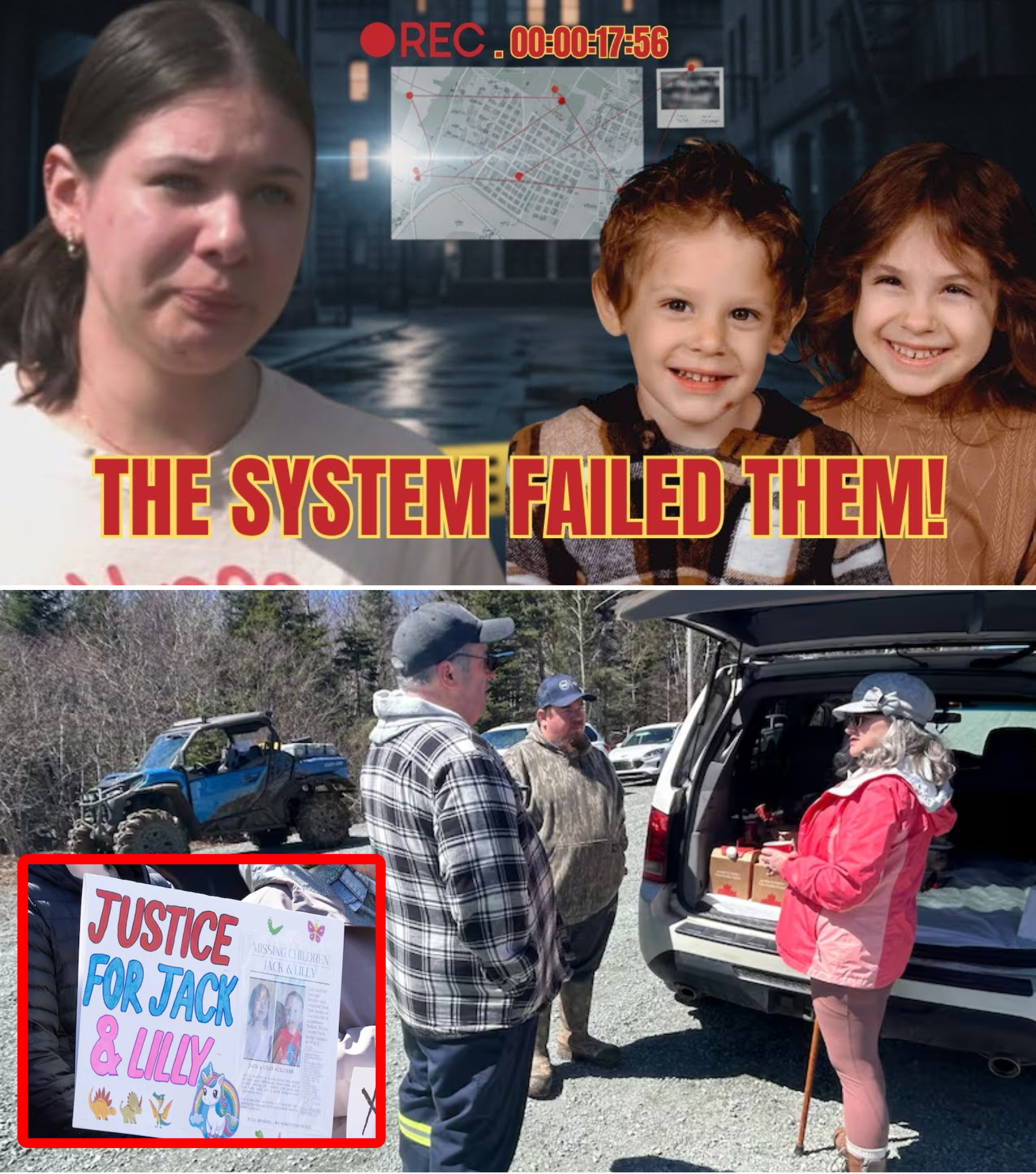
In the quiet rural community of Lansdowne Station, Pictou County, Nova Scotia, two young siblings — six-year-old Lilly Sullivan and her four-year-old brother Jack — vanished without a trace on the morning of May 2, 2025. What began as a seemingly ordinary school day has become one of Canada’s most baffling and heartbreaking missing children cases, exposing serious gaps in child protection, family oversight, and search protocols that many now say failed the children long before they disappeared.
Lilly and Jack lived with their mother, Malehya Brooks-Murray, stepfather Daniel Martell, and younger sister Meadow in a mobile home surrounded by dense woods, steep banks, and thick brush. On the evening of May 1, the family had been out running errands. Surveillance footage captured them together at a Dollarama store in nearby New Glasgow. According to initial statements, the children were put to bed around 9–10 p.m. The next morning, Brooks-Murray marked the older children absent from school due to illness via an app at 6:15 a.m.
Between approximately 8:00 and 9:40 a.m., the parents claimed they were in the bedroom with baby Meadow. They reported hearing Lilly come in and out of the room and Jack in the kitchen. Then the house fell silent. By 10:01 a.m., Brooks-Murray called 911 to report the children missing. Martell and family members immediately began searching the surrounding forest. A helicopter was called in, and Martell later told police he thought he heard a child’s scream, but the noise from the aircraft made further verification impossible.
Extensive searches involving hundreds of volunteers, dogs, helicopters, and ground teams covered the rural property and beyond. Despite the massive effort, no sign of Lilly or Jack has ever been found — no clothing, no footprints (beyond one disputed child-sized boot print), and no definitive evidence of abduction or accident. The case remains open, officially treated as a suspicious disappearance rather than a confirmed abduction.
What has troubled investigators and the public most are the inconsistencies in the parents’ timelines and statements. Brooks-Murray changed details about bedtime and events of the previous days. Questions have also been raised about prior child welfare involvement, family dynamics, and whether the children were truly safe in the home environment. Court documents later revealed aspects of the couple’s relationship that added layers of complexity to the investigation.
One year later, in May 2026, the case is still unsolved. Renewed searches, including one that uncovered a child-sized boot print in the mud, have brought fresh hope but no breakthroughs. A pink blanket reportedly found in two separate distant locations is undergoing urgent DNA analysis. Daniel Martell has voluntarily provided a blood sample as police re-examine the timeline. The Nova Scotia government has offered a reward of up to $150,000 for information leading to the children’s recovery.
Criminologists and missing children experts have described the double disappearance as “profoundly rare.” Most children who go missing are found quickly, often within hours or days. The fact that two siblings vanished simultaneously from inside their home in broad daylight, with parents nearby, defies simple explanations like wandering off. The surrounding terrain is challenging — dense woods, water hazards, and remote areas — but experienced searchers insist the children could not have traveled far on their own without leaving traces.
The tragedy has sparked widespread criticism of the “system” that should have protected Lily and Jack. Questions linger about whether earlier red flags in the household were adequately addressed by child protection services. The rural location meant slower response times, and coordination between agencies has faced public scrutiny. Many in the true crime community and local residents feel the investigation has been hampered by changing stories, delayed full federal involvement, and a lack of transparency.
For the Sullivan family and the broader community, the pain remains raw. Lilly was described as outgoing and loving pink, while Jack was quieter and fascinated by dinosaurs. Their absence has left a void not only in their family but in the small Nova Scotia community that rallied so hard to find them. Annual remembrance searches continue, and digital billboards still display their photos across the province.
This case serves as a sobering reminder of vulnerabilities in child safety systems, especially in rural areas. It highlights how quickly ordinary mornings can turn into nightmares and how gaps in oversight, communication, and rapid response can have devastating consequences. While hope remains that Lilly and Jack will be found safe — or that answers will bring closure — the silence surrounding their disappearance continues to echo.
As investigators pursue every lead, from digital evidence to genetic genealogy, the public’s role remains crucial. Tips continue to come in, and the reward stands as a powerful incentive. Lily and Jack Sullivan deserved better from the systems designed to protect them. Their story is not just a mystery — it is a call for stronger safeguards so that no other children fall through the cracks in the same way.
The woods around Lansdowne Station have been searched repeatedly, but the real answers may lie in overlooked details, inconsistencies, or someone who has yet to come forward. Until that moment arrives, two small children remain missing, and a family — along with an entire nation watching — waits for resolution in a case that has exposed the heartbreaking limits of protection when the system fails.