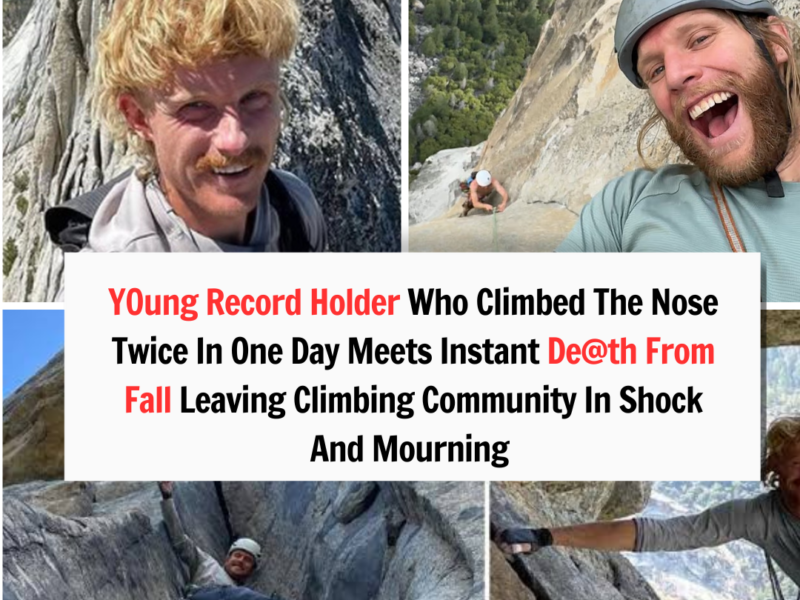
Young Record Holder Who Climbed The Nose Twice In One Day Meets Instant Death From Fall Leaving Climbing Community In Shock And Mourning 😭💔
The granite walls of California’s high country claimed another of their own on August 3. Jake Whisenant, the 30-year-old Mammoth Lakes climber who had rewritten the speed record books on Yosemite’s most famous face, fell during an ascent in Sequoia National Park and died from blunt force trauma. Witnesses watched the accident unfold. Death came instantly. The Tulare County Coroner ruled the manner accidental. Toxicology results remain pending, but the preliminary finding leaves little ambiguity about the immediate cause.
Whisenant’s body was recovered after a search-and-rescue operation that began the day before. National Park Service teams worked the Sequoia and Kings Canyon wilderness, an area of steep granite, thin air, and unforgiving exposure. Exact details of the route and the moment of the fall have not been released publicly. What is known is that a climber who moved with rare efficiency on some of the hardest big-wall terrain in North America lost his footing or protection in an environment he knew intimately.
The climbing community learned of the death through a quiet, heavy post from lifelong friend Bailee Moore. “It is with an impossibly heavy heart that I share the passing of my lifelong friend and confidant—Jacob Daniel Whisenant,” she wrote. “Our family is absolutely devastated by this news but find solace in the fact that Jake died doing what he loves in the beautiful Sierra Nevada.” The message spread quickly among those who had shared rope, camps, and long approaches with him. Condolences poured in from partners who described his strength, grace, thoughtfulness, and relentless optimism. One climber wrote of favorite days in the mountains spent together. Another simply said he could not believe Jake was gone.
Whisenant had become a recognized name in speed climbing circles only recently, yet his achievements already stood out. In October 2024 he and partner Brant Hysell attacked the Lurking Fear route on El Capitan, the 3,000-foot granite monolith that dominates Yosemite Valley. They finished in two hours, fifty-five minutes, and thirty-two seconds, shaving nearly ten minutes off the previous mark set by Yuji Hirayama and Nick Fowler more than two decades earlier. Whisenant posted about the day with characteristic understatement and joy. “A truly magical day that I’ll never forget,” he wrote. “We both tapped into a flow state, fully committed to our plan, and most importantly, had an absolute blast on our favorite rock. We had perfect weather for a shirtless ascent and the entire route to ourselves.”
The record did not arrive in isolation. Two days earlier the same pair had climbed the route in just over four hours, refining systems and finding rhythm. That pattern of preparation and rapid improvement defined Whisenant’s approach. In May 2025 he returned to El Capitan with Noah Fox and completed the Nose—the park’s most storied big-wall line—twice in a single day. The combined time was fourteen hours and thirty-eight minutes. Fox later described the privilege of those months together and the memories he would carry for life. Other reports credited Whisenant with additional fast ascents, including a strong time on The Prow of Washington Column, a classic training ground for the bigger walls.
Beyond the stopwatch, Whisenant’s social media captured a broader mountain life. He posted from the Kings-Kern Divide, a rugged six-mile ridge in the High Sierra where he spent four days alone skiing, scrambling, and sleeping under the open sky. He summited eight peaks above 13,500 feet via new-to-him routes and skied lines off each. “I had a truly life-enhancing experience out there, gaining confidence with each new ridge scrambled, basin traversed, and ski line descended,” he wrote. “By the end of my short stay… I felt sad hiking out, wishing for more time to explore and enjoy the simple mountain lifestyle.” The photographs showed sunrises over granite, a sleeping bag laid beside a rock in darkness, and the quiet satisfaction of self-supported movement through remote terrain.
Friends remembered a climber who balanced serious objectives with an approachable presence. He worked a regular job while chasing records, an amateur in the purest sense of the word. That combination—full commitment without professional sponsorship or constant media attention—earned respect among those who understood the difference between posting climbs and living them. His Instagram remained a record of process as much as achievement: the long approaches, the weather windows, the moments of flow, and the inevitable fatigue that follows hard days on the wall.
The Sierra Nevada has a long history of taking skilled practitioners. The same high-altitude granite that rewards precision and boldness also punishes the smallest miscalculation. Sequoia and Kings Canyon, like Yosemite, demand respect from even the most experienced. Search-and-rescue teams know the terrain well. They also know how quickly conditions can shift and how final a fall can be when the margin for error disappears. Whisenant’s death adds another name to a list that grows quietly each season.
In the days since the coroner’s announcement, tributes have continued. Climbers who shared rope with him spoke of his optimism and the way he moved through the mountains with both intensity and gratitude. Moore’s farewell carried a particular weight: “I will look for you in every life, my brother. Now go rest high up on that mountain.” The words captured what many felt—that the peaks he loved had claimed him, and that there was a strange, incomplete comfort in knowing he left doing the thing that defined him.
Whisenant’s records on Lurking Fear and the double Nose still stand as markers of what focused, joyful climbing can achieve. The images he left—of shirtless speed ascents in perfect weather, of solo nights in the High Sierra, of granite faces rising into blue sky—remain. The community that watched him move so efficiently across those walls now carries the harder knowledge that efficiency offers no permanent protection. Gravity, rock, and the thin edge between commitment and catastrophe remain constants.
At thirty, Jake Whisenant had already left a clear imprint on the modern history of Yosemite speed climbing. He died on August 3 in the same mountain range that shaped him, after a fall that witnesses said ended in an instant. The coroner’s report is brief: blunt force trauma, accident. The fuller story lives in the routes he climbed, the partners he trusted, and the quiet posts that showed a young man still hungry for more time in the high country. That time ran out among the granite and the sky he loved.