The Ghost of Southie Who Never Smiled—Until She Hummed His Lost Love’s Song

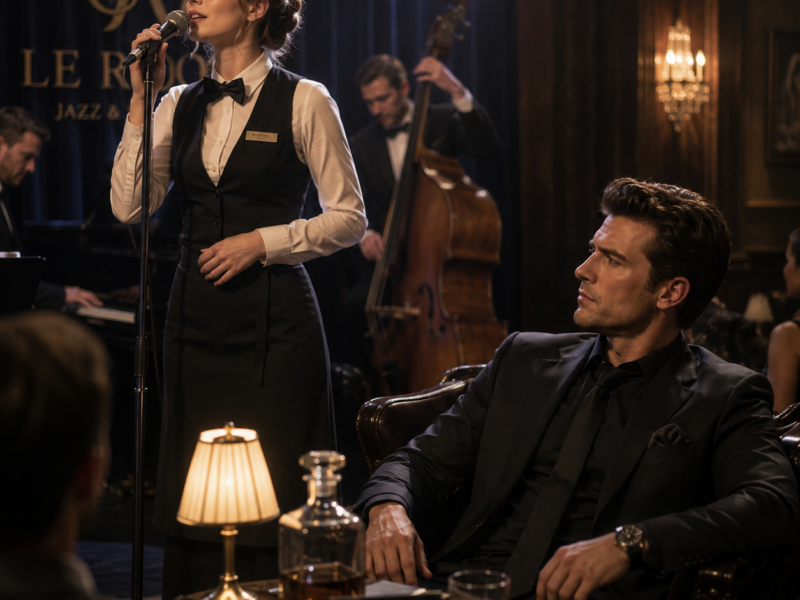
The midday sun bounced blindingly off the polished marble exterior of The Velvet Note, a jazz café nestled in a quiet corner of South Boston. Inside, however, the afternoon was perpetual twilight—thick with the aroma of freshly ground espresso beans, expensive Kentucky bourbon, and the heavy, stagnant air of a man waiting for his own quiet execution.
I hadn’t smiled in three years. Not since the night the glass shattered, the sirens wailed, and the smoke took everything that mattered. People called me “The Ghost of Southie,” a syndicate boss who ruled the harbor docks with a ledger in one hand and a silenced pistol in the other. They said my heart was made of cold-rolled steel. They were mostly right.
I didn’t come to The Velvet Note for the coffee. I came for the corner booth. It was the only place in the city with sightlines to every entrance, every exit, and every shadow. It was my cage, and I had locked the door from the inside.
Until she walked in behind the service counter with a faded denim apron and a voice that felt like sunlight breaking through cracked concrete.
Her name was Maeve. According to my background checks—because I check everyone who breathes within ten feet of my orbit—she was just a twenty-four-year-old art school dropout working double shifts to pay off her mother’s medical debts. No ties to the families, no police record, entirely invisible to the criminal underworld.
Except she wasn’t invisible to me.
Because when the lunch rush died down and the afternoon sunlight slanted across the grimy windows, Maeve didn’t clean in silence. She sang.
It wasn’t the polished, autotuned pop blaring from car radios. It was old folk music, bluesy and raw, humming softly under her breath as she wiped down the espresso machine. The first time I heard it, three weeks ago, my hand had frozen halfway to my tumbler of scotch. It was the exact melody an old ghost from my past used to hum while painting in our cramped studio before the world went up in flames.
Today, the drama wasn’t hiding in the shadows; it was sitting three tables away, wearing a cheap designer suit and sweating through his collar.
Vince.
Vince was a low-level enforcer from the North End who didn’t know his place. He had been harassing Maeve for an hour, cornering her near the register, dropping heavy hints about “protecting” the café if she went out for drinks with him. He thought because he wore a flashy tie, the world owed him compliance. He didn’t know who owned the building. He didn’t know that every brick, every espresso cup, and every breath taken inside these four walls was backed by my signature.
I sat in my booth, half-shrouded in the dim amber light, watching the scene unfold in the mirror behind the bar. My fingers tapped a slow, rhythmic beat against the scarred mahogany table.
“Come on, sweetheart,” Vince sneered, his voice carrying over the low hum of the refrigerator. He reached out, his thick fingers grabbing Maeve’s wrist as she tried to slip past with a tray of empty mugs. “Don’t be like that. A pretty girl like you shouldn’t be slinging coffee for pennies. I can show you a real city.”
Maeve tried to yank her arm back, her face flushing with a mixture of humiliation and sharp anger. “Let go of me, Vince. I’ve told you twice. I’m working.”
“You’ve got an attitude problem,” Vince muttered, tightening his grip, his eyes flashing with the fragile ego of a bully backed into a corner. He raised his free hand, pointing a finger directly into her face. “You think because this dive is quiet, you’re safe? People like you—”
That was the exact moment the universe decided to stop testing my patience.
I stood up.
The movement was slow, deliberate, and entirely silent. In this neighborhood, when I stood, the air pressure in the room seemed to drop. The bartender dropped a rag. Two men at a poker table near the back instantly averted their eyes.
I walked across the checkered tile floor, my leather shoes clicking softly against the ground. I didn’t rush. Haste is for men who haven’t already won.
“Vince,” I said.
The name slipped out of my mouth like a drop of freezing water on a hot stove.
Vince froze mid-sentence. His hand slipped off Maeve’s wrist as if he’d touched a live wire. He spun around, his knees buckling slightly as recognition hit him like a physical blow. The color drained from his face until he looked like chalk.
“D-Dante?” Vince stammered, his eyes darting frantically toward the door, realizing too late that every exit was blocked by my quiet, towering shadow. “I—I didn’t know you frequented this place. We were just… catching up. Old friends—”
I stopped a foot away from him. I didn’t look at Maeve, though I could feel the heat of her gaze burning into my shoulder. I looked down at Vince the way a coroner looks at a textbook case.
“Friends don’t grab what doesn’t belong to them,” I said, my voice quiet, smooth, and utterly devoid of warmth. “And nothing in this district happens without my ledger knowing about it. You’ve been shaking down local businesses, Vince. Using my name as a threat. That’s bad for commerce.”
“Mr. Rossi, I swear on my mother—”
“Save your mother the grief,” I interrupted, reaching out to lazily brush a speck of dust off the lapel of his cheap suit. My fingers brushed his collar, and I felt him shudder violently. “You’re banned from every establishment south of the river. If I see your face, your car, or your shadow within three miles of this zip code again, I won’t just break your legs—I’ll liquidate every asset your uncle owns in the shipping yards. Clear?”
Vince nodded so fast his neck looked like it might snap. “Clear. Perfectly clear, Mr. Rossi. I’m leaving. Right now.”
He scrambled backward, tripping over a chair before righting himself and bolting out the front door, the brass bell jangling wildly behind him.
The café fell into a heavy, suspended silence. Sunlight streamed lazily through the front windows, illuminating floating dust motes.
I turned around slowly.
Maeve was standing behind the counter, leaning against the stainless-steel prep table for support. Her breath came in short, uneven gasps, and her eyes—wide, luminous hazel—were searching my face with a terrifying intensity.
“You didn’t have to do that,” she whispered, her voice barely louder than the hum of the fridge. “He was just a nuisance. I could have handled him.”
“You shouldn’t have to handle garbage while trying to earn an honest living,” I replied, my voice losing its razor-edge, though I kept my posture rigid.
She pushed a stray lock of dark hair behind her ear, stepping out from behind the counter. Up close, I realized she was even shorter than I thought, barely reaching my chest, yet she looked at me not with the cringing terror everyone else in South Boston reserved for my name, but with a profound, aching curiosity.
“Everyone calls you a monster, you know,” she said quietly, tilting her head. “They say you don’t feel anything. That you traded your soul for a ledger.”
“They aren’t entirely wrong,” I said, looking away toward the sunlit window.
“Then why did you learn the lyrics?”
My gaze snapped back to hers. My heart—that cold-rolled steel engine—did a violent, painful stutter.
“What?” I murmured.
Maeve took another step closer, closing the distance between us until the scent of roasted coffee filled my senses. A faint, knowing smile touched the corners of her lips.
“For three weeks, you’ve sat in that exact corner booth,” she said softly. “And every time I hummed that old lullaby—The Sailor’s Return—your fingers tapped out the exact second-part harmony on the table. Not the rhythm. The melody. People who are dead inside don’t remember obscure folk songs from abandoned coastal towns in Maine.”
The room seemed to shrink. The air grew thin.
“How do you know that song?” I asked, my voice dropping to a gravelly rasp.
Maeve reached up, her hand trembling slightly as she pulled a silver chain from beneath her collar. Resting against her palm was a small, tarnished copper locket shaped like an anchor.
“My grandmother painted a mural on a harbor wall in Portland twenty-five years ago,” she whispered, a tear finally spilling over her lashes, catching the bright afternoon light. “She used to talk about the young man who helped her mix the pigments before he vanished into the city to build an empire he thought he needed to protect her. She called him her ghost.”
I stared at the locket. The world stopped spinning. The last three years of darkness, of ledgers, of blood and cold iron—it all fractured in a single, blinding second.
“Elena…” I breathed, the name slipping out like a forbidden prayer.
“She passed away last winter,” Maeve said, her voice breaking. “Before she went, she told me that if I ever found a man in a black coat who tapped out a second-part harmony to her song in a sunlit café, I should tell him she never stopped painting him.”
She looked up at me, the resemblance in her eyes—the fierce, unyielding light of the woman I had lost to a senseless tragedy years ago—hitting me with the force of a tidal wave. Elena hadn’t been alone that night; her sister had survived, and her legacy had walked right back into my life, disguised as a barista with a song on her lips.
For the first time in three years, the tight knot in my chest unspooled.
A single, involuntary breath escaped my lungs, and the corners of my mouth twitched upward. It was small, hesitant, and rusty from disuse—but it was a smile.
Maeve saw it, and her own face broke into a watery, radiant grin, mirroring the ghost of the happiness I thought I had buried forever.
“You’re late for your shift, boss,” she whispered, wiping her cheek with the back of her hand. “The espresso machine needs cleaning, and I happen to know you take yours with a splash of cream and no sugar.”
I looked down at her, the heavy weight of the underworld finally slipping off my shoulders.
“Make it a double,” I said, and for the first time in a very long time, I stepped out of the shadows and into the light.