Lily’s Cart Was Marked for Demolition Until Dominic Vance Put Her Under His Protection
The blueprints for the downtown redevelopment project sat rolled up on my mahogany desk like a row of dormant artillery shells. As the head of Vance Holdings—and the man whose shadow quietly governed the city’s sprawling architectural expansion—I didn’t usually inspect construction sites in person. My vice presidents handled the logistics; my enforcers handled the resistance.
But Tuesday afternoon felt suffocating in the high-rise penthouse, so I traded my tailored jacket for a simple dark wool coat, stepped into my black town car, and ordered the driver to take me to Site 42.
The old commercial district was a maze of rusted scaffolding, thick concrete dust, and the relentless metallic symphony of jackhammers. My boots crunched over gravel as I walked the perimeter, flanked silently by Dante, my head of security. We were inspecting the demolition zone where a row of archaic brick storefronts was slated for total demolition to make way for a luxury commercial plaza.
That was when the rich, unmistakable aroma of toasted garlic, simmering lemongrass, and charred galangal cut straight through the industrial smog.
It didn’t belong here. Nothing organic or warm belonged within a mile of my demolition sites.
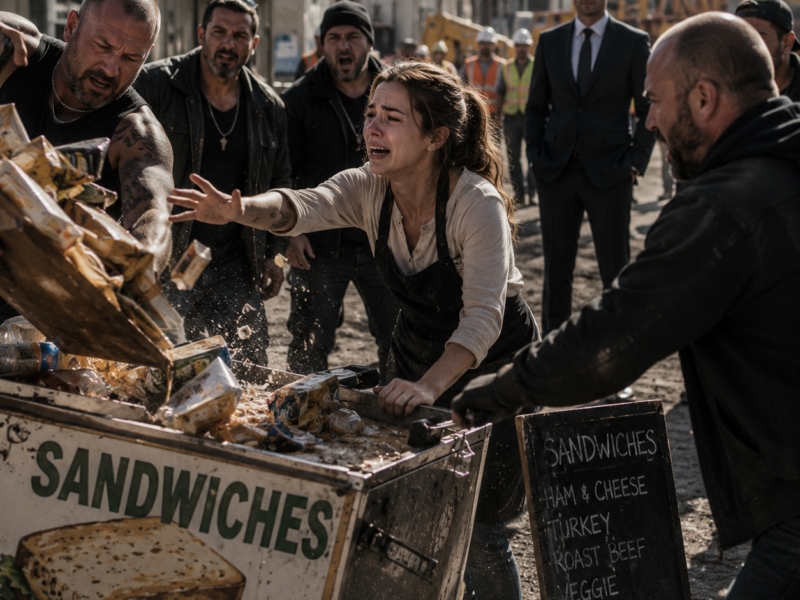
Following the scent past a towering stack of steel beams, I found the source. Tucked into the recess of a crumbling brick archway, sheltered by a faded blue canvas tarp, was a makeshift food stall. A weathered wooden cart was packed with steaming aluminum pots, jars of fresh herbs, and a hand-painted cardboard sign that read: Auntie May’s Hot Buns & Broth – $5.
Standing behind the cart was a young woman.
She wore a faded denim apron over a cream sweater, her dark hair tied back in a messy knot with a stray pencil holding it together. Her face was flushed from the heat of the portable stove, and she was deftly wrapping spiced pork into delicate white dough with rhythmic, mesmerizing precision.
Her name, as I would later discover from the municipal vendor permit taped crookedly to the side of her cart, was Lily.
“Excuse me, miss,” I said, my voice cutting through the hiss of escaping steam as I stepped under the canvas canopy.
Lily looked up, wiping a stray damp curl from her forehead with the back of her wrist. Her eyes—a striking, luminous amber brown—widened slightly as they swept over my expensive wool coat, the custom leather shoes, and Dante standing like a stone wall three paces behind me. In this part of town, men who looked like me usually meant trouble for small-time operators.
“If you’re here about the health inspection, the paperwork is filed with the city,” she said, her voice steady, carrying a quiet, melodic resonance that felt entirely out of place amid the construction roar. “And if you’re here to tell me to move, the lease on this sidewalk runs through the end of the month.”
I didn’t answer right away. I looked past her shoulder at the massive red spray-painted X stamped across the brick wall directly behind her stall—the universal demolition mark indicating the building was coming down in forty-eight hours.
“That mark,” I pointed calmly, “means this entire block is scheduled for heavy demolition this Thursday morning. Your lease may say the end of the month, but municipal code clause twelve invalidates street vending licenses the moment structural razing begins.”
Lily froze. The dough wrapper slipped from her fingers onto the stainless-steel prep table. She stared at me, the brief flash of defiance in her eyes collapsing into a heartbreaking, heavy despair.
“Thursday?” she whispered, her voice cracking. “They… they told me I had until the end of next month. My supplier just delivered two hundred pounds of flour this morning. If I pack up now, I lose everything. My savings… my daughter’s tuition…”
She didn’t cry. That was what struck me hardest. She didn’t throw a tantrum, and she didn’t beg. She just gripped the edge of the wooden counter, her knuckles turning white, absorbing a crushing blow with a stoic, quiet dignity that I rarely saw in boardrooms among executives worth billions.
Something in my chest—a cold, rusted compartment I hadn’t unlocked in years—shifted.
“Give me a bowl of the pork buns and whatever broth you have ready,” I said, sliding a crisp hundred-dollar bill across the metal counter.
Lily blinked, looking at the bill, then up at me with sudden suspicion. “I don’t give change for hundred-dollar bills. I’m a street cart, not a bank.”
“Keep the change,” I replied quietly, stepping back. “Consider it an advance payment for tomorrow’s lunch. I’ll be back.”
I returned the next day. And the day after that.
Sitting on a plastic milk crate under the blue tarp, eating steaming pork buns that tasted better than anything served at Michelin-starred restaurants downtown, I watched her. I watched how she handed free extra broth to elderly construction workers who couldn’t afford a full meal. I watched how she gently comforted a crying four-year-old girl sitting on a folding chair behind the cart—her daughter, Mia.
My enforcers thought I had lost my mind. Dante looked at me sideways every time I ordered him to reroute our afternoon patrols past Site 42. But I couldn’t stay away. For a man whose entire life was governed by calculated risk, hostile takeovers, and cold ledgers, Lily represented a world of uncalculated, pure warmth.
By Wednesday afternoon, the tension broke.
I was standing by the cart, watching Mia color in a battered coloring book, when Lily walked out from behind the counter, wiping her hands on a cloth. She looked at me with an intense, searching gaze.
“Who are you really?” she asked softly, folding her arms across her apron. “You don’t talk like an architect, and you certainly don’t look like a construction worker. Men in thousand-dollar overcoats don’t eat street food three days in a row out of pure appreciation.”
“I’m Dominic,” I said simply. “And I happen to like good food.”
“Dominic what?” she pressed, tilting her head. “Because the foreman over there tipped his hard hat when you walked by, and he looks at you like you own the sky.”
Before I could answer, a loud, aggressive crash echoed from the alley behind the cart.
Three heavy-set men in matching leather jackets stepped out from the shadows, led by a local loan shark named Bruno. Bruno was a third-tier parasite who operated in the old district, shaking down struggling vendors for “protection fees”—an operation my syndicate had been slowly purging, though a few cockroaches still lingered in the cracks.
“Well, well, well,” Bruno sneered, walking right up to Lily’s cart and slamming his heavy palm onto the glass display case. “Look at this. Little Lily found herself a sugar daddy in a fancy coat. Time for your weekly rent adjustment, sweetheart. Prices just went up to five hundred dollars.”
Lily shrank back instinctively, her face draining of color. “I paid you on Monday, Bruno! That was all I had!”
“Monday was last week’s rate,” Bruno laughed coarsely, reaching out to grab a jar of chili paste off the counter. “Pay up, or me and my boys take the cart apart piece by piece.”
That was the exact moment the universe decided to test my patience for the final time that week.
I didn’t raise my voice. I didn’t rush. I simply stood up from the plastic milk crate, buttoned my wool coat, and stepped between Bruno and Lily.
Bruno stopped, squinting at me in the dim light of the tarp. “Who the hell do you think you—”
He didn’t finish the sentence.
From the shadows behind the stacked crates, Dante and two other operatives moved with the terrifying, synchronized silence of ghosts. Before Bruno’s goons could reach for the switchblades tucked in their belts, Dante had them pinned face-first against the rusted chain-link fence, their arms twisted behind their backs with bone-cracking efficiency.
I stepped directly into Bruno’s personal space, towering over him by half a foot. I looked down at him the way a surgeon looks at a cancerous tumor.
“You’re standing on private property,” I said, my voice smooth, cold, and dripping with an absolute, lethal finality. “And you’re harassing a vendor operating under my direct personal protection.”
Bruno’s eyes widened as recognition finally flickered across his terrified face. He had seen my photo in the inner-circle intelligence briefs. He knew the name Dominic Vance. His knees buckled instantly, his heels clicking together as he began to shake uncontrollably.
“M-Mr. Vance… I swear to God, I didn’t know she was with you! I didn’t know—!”
“Dante,” I interrupted, never breaking eye contact with the whimpering worm. “Take him and his boys down to the East River docks. Have them spend the weekend reflecting on the concept of municipal boundaries. And make sure Bruno never sets foot in this zip code again.”
“Right away, Boss,” Dante muttered, hauling Bruno away like a sack of garbage as the loan shark babbled frantic apologies.
The alley fell dead silent, save for the distant hum of the city traffic.
I turned around slowly. Lily was standing behind her cart, her hands clamped over her mouth, her amber eyes swimming with a turbulent mix of shock, fear, and sheer disbelief. Little Mia was clinging safely to the hem of her mother’s apron, wide-eyed.
“You’re… you’re Dominic Vance,” Lily whispered, her voice trembling. “The billionaire developer. The man who owns half the skyline.”
“I am,” I admitted quietly, bracing myself for the inevitable recoil—the sudden terror and distrust that every ordinary person felt when they realized the monster hiding behind the corporate facade.
Instead, Lily let out a long, shaky breath, dropped her hands, and looked down at the stainless-steel counter. A soft, ironic smile touched the corners of her lips.
“Figures,” she murmured, shaking her head. “I thought you were just a very stubborn customer with too much money. Turns out you’re the one tearing down my block.”
“The block is coming down, Lily,” I said, taking a cautious step closer, my voice softening. “That part is true. The city council voted on it six months ago. But your stall doesn’t have to disappear.”
She looked up, her eyebrows lifting in surprise.
“I own the entire commercial footprint of the new plaza,” I continued, my gaze locked onto hers with absolute, unwavering resolve. “There’s a prime ground-floor retail space reserved right in the center of the atrium—fully equipped, rent-free for the first five years, designed specifically for artisanal food vendors. I was going to let my leasing agents auction it off next month. But I think the first tenant has already earned her spot.”
Lily stared at me, the magnitude of the offer sinking in. A single tear spilled over her eyelashes, catching the afternoon sunlight, but her smile grew radiant, fierce, and entirely genuine.
“You’re playing a very dangerous game, Mr. Vance,” she whispered, stepping around the counter to stand just inches away from me, the scent of galangal and warm spices wrapping around us like home. “Handing out prime real estate just because you like my pork buns?”
I reached out, my fingers gently brushing a stray lock of hair from her cheek, feeling the soft warmth of her skin against my calloused hand.
“Not just the pork buns,” I murmured, a rare, genuine smile breaking through my guarded armor. “The chef, too.”
Lily laughed—a bright, musical sound that chased away the last gray shadows of the industrial yard. As little Mia tugged playfully on my coat hem, demanding another dumpling, I knew the concrete towers I built would stand for decades, but the foundation of my real life had just been poured right here under a blue canvas tarp.