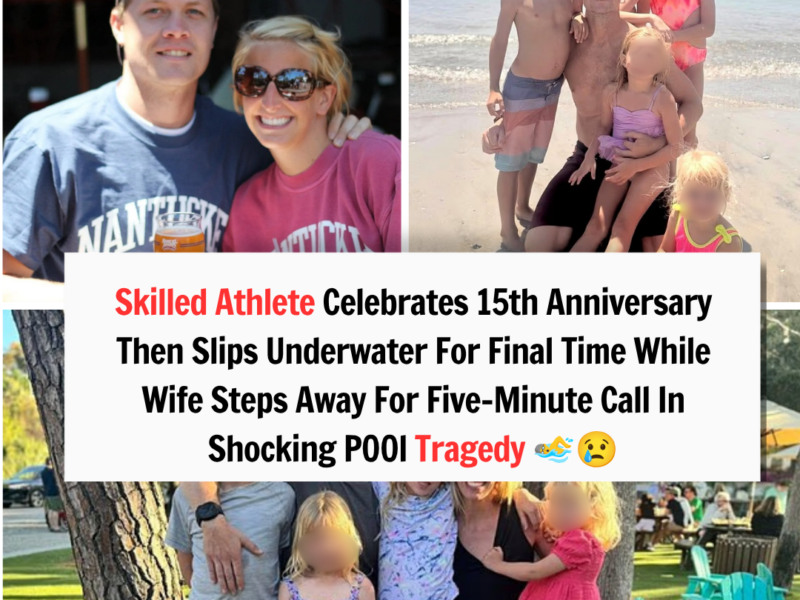
Skilled Athlete Celebrates 15th Anniversary Then Slips Underwater For Final Time While Wife Steps Away For Five-Minute Call In Shocking Pool Tragedy 🏊♂️😢
The community pool sat quiet under the fading light of a July evening when a routine family outing turned into irreversible tragedy. Jack Roney, the 39-year-old former North Carolina State swimming coach known for his competitive spirit and deep love of the water, slipped beneath the surface one final time and never came back up.

Just weeks after celebrating his 15th wedding anniversary with his wife Maresa, Roney had joined her at their community pool following dinner on July 5. An avid swimmer who once held the NC State program record in the 200-yard breaststroke, he began practicing the underwater breathing exercises he had long mastered. According to the autopsy report, he submerged for more than two minutes, surfaced briefly for air, then went under again.
Maresa stepped away for a short phone call that lasted roughly five minutes. When she returned, her husband floated unresponsive in the water. She pulled him from the pool, called 911, and began CPR while waiting for first responders. Emergency crews continued resuscitation efforts for nearly an hour as they transported him to the hospital. Roney was pronounced dead upon arrival.
The autopsy, released more than a month after the incident, paints a stark picture of those final moments. Medical examiners noted no signs of trauma, no evidence of foul play, and no indication of suicide or substance abuse. Pathologists at the Office of the Chief Medical Examiner accepted the case due to the unusual circumstances surrounding the drowning. A separate statement from the medical examiner’s office confirmed that Roney had a history of ADHD and was last known to be alive that evening while at the pool with his wife.
Friends and former colleagues described Roney as a man defined by discipline and quiet strength. He had served as an assistant coach for the NC State swimming and diving team during the 2014-2016 seasons, leaving a lasting mark on the program. The university’s swimming and diving team issued a statement the day after his death: “Our thoughts and prayers are with the Roney family during this difficult time. His impact on our program and community will be remembered.”
Roney leaves behind Maresa and their five young children—Gunnar, Scout, Beau, Archer, and Crew. The sudden loss has forced the family into an unimaginable new reality. A GoFundMe campaign launched in their support describes Jack as “a true Wolfpacker, a man of Christ, and a beloved father, friend, and husband.” The page notes that Maresa now faces the challenge of raising the children alone and asks for help covering daily expenses, childcare, and educational opportunities for the kids. “Jack and Maresa have always been there for others,” the fundraiser reads. “In this difficult time, we have the chance to give back.”
The circumstances of the death have left many struggling to understand how a skilled swimmer could perish while performing exercises he had done countless times before. Holding one’s breath underwater for extended periods carries inherent risks, even for experienced athletes. Shallow-water blackout—a sudden loss of consciousness caused by lack of oxygen—can occur without warning, especially when repeated breath-holding is involved. The autopsy findings suggest this may have played a role, though officials have not publicly confirmed a precise medical mechanism beyond the drowning itself.
Those who knew Roney remember a coach who demanded excellence yet remained approachable. Former athletes recalled his calm presence on the pool deck and his ability to push swimmers past their perceived limits. His own competitive record spoke for itself. The 200-yard breaststroke mark he set as a student-athlete stood for years before eventually being broken, a testament to the standards he once set.
The timing of the tragedy compounds the grief. The family had only recently marked a significant wedding anniversary. Summer evenings at the community pool were meant for relaxation and simple joy, not emergency calls and hospital corridors. Neighbors and friends have rallied around Maresa and the children, offering meals, childcare, and quiet presence in the days since the funeral.
Law enforcement reviewed video footage of the incident as part of the investigation, a standard step given the circumstances. The medical examiner’s office found no red flags that would suggest anything other than a tragic accident. That conclusion has brought a measure of clarity even as it fails to ease the pain for those left behind.
Roney’s death has also prompted conversations within the swimming community about the hidden dangers of breath-holding drills. Coaches and safety advocates have long warned that repeated underwater apnea can lead to blackouts, particularly when performed alone or without close supervision. In this case, the brief separation of only a few minutes proved enough for disaster to strike.
As the family continues to navigate life without their husband and father, the GoFundMe remains open for those who wish to help. Donations are intended to provide stability while Maresa works to keep the children’s lives as steady as possible. The page emphasizes that Jack’s legacy lives on through the lives he touched and the love he shared.
The image of a strong, capable swimmer floating motionless in a familiar pool will linger for many who followed Roney’s career. At 39, he stood at an age when many coaches are still building programs and raising young families. The suddenness of the loss has left the NC State swimming community and the broader circle of friends searching for ways to honor a man who lived with purpose both in and out of the water.
Investigators have closed the active inquiry into the cause of death, classifying it as an accident. For Maresa and the five children, the official findings offer no real comfort. They must now move forward without the man who once held his breath beneath the surface and always came back up—until the evening he did not. The pool where it happened has returned to its ordinary summer routine, yet for one family the water will never look the same again.