He Asked About My Necklace, Never Expecting to Find the Girl He Lost Eighteen Years Ago

The grand ballroom of the Zenith Hotel smelled of expensive perfume, aged bourbon, and old money. Beneath the cascading crystal chandeliers, Chicago’s elite moved in slow, calculated motions—politicians shaking hands they should have washed, executives discussing hostile takeovers over flutes of vintage champagne, and socialites guarding their reputations like medieval fortresses.
I stood near the balcony, nursing a glass of scotch, watching the theater unfold.
People called me a mafia boss, a ruthless syndicate leader, a man who built an empire on blood and silence. In truth, I was simply a man who understood how the world worked. Power wasn’t maintained by cruelty; it was maintained by paying attention to the details everyone else ignored.
That was why my eyes drifted away from a corrupt city councilman and locked onto a young woman weaving through the crowded tables.
She was a waitress, hired through a last-minute temp agency to handle the overflow of the charity gala. She wore the standard uniform—a stiff black vest, a white button-down shirt, and her dark hair pulled back into a practical, no-nonsense bun. Her face was flushed with exhaustion, her movements precise and hurried as she balanced a heavy silver tray laden with empty crystal flutes.
She looked entirely out of place among the billionaires and heiresses.
Yet, something about the way she carried herself—the sharp, defensive tilt of her chin, the way her eyes scanned the exits like someone constantly calculating an escape route—made her impossible to ignore.
Then, as she turned slightly to avoid a clumsy investor swaying with a drink, the overhead spotlight caught the hollow of her throat.
A delicate silver chain rested against her skin. Suspended from it was a small, peculiar pendant: a tiny, hand-carved silver compass, its needle permanently frozen, dangling beside a mismatched sapphire chip.
My breath caught in my throat. The glass of scotch in my hand nearly slipped from my fingers.
That necklace.
I hadn’t seen it in eighteen years. I had buried it, along with a part of my soul, in a shallow, muddy grave behind an abandoned orphanage in upstate New York when I was just a desperate, terrified twelve-year-old boy.
Without thinking, I pushed off the pillar and began cutting through the crowd.
“Sir?” one of my bodyguards, Marcus, stepped into my path, his brow furrowing. “Is there a problem?”
“Clear the way,” I murmured, my voice dropping an octave, carrying the kind of quiet authority that made people step aside without asking questions.
I crossed the polished marble floor, closing the distance between the bar and the service alcove. The waitress had just set her tray down on a side table and was pressing the heels of her hands against her eyes, taking a deep, shuddering breath to steady herself.
I stopped less than two feet away from her.
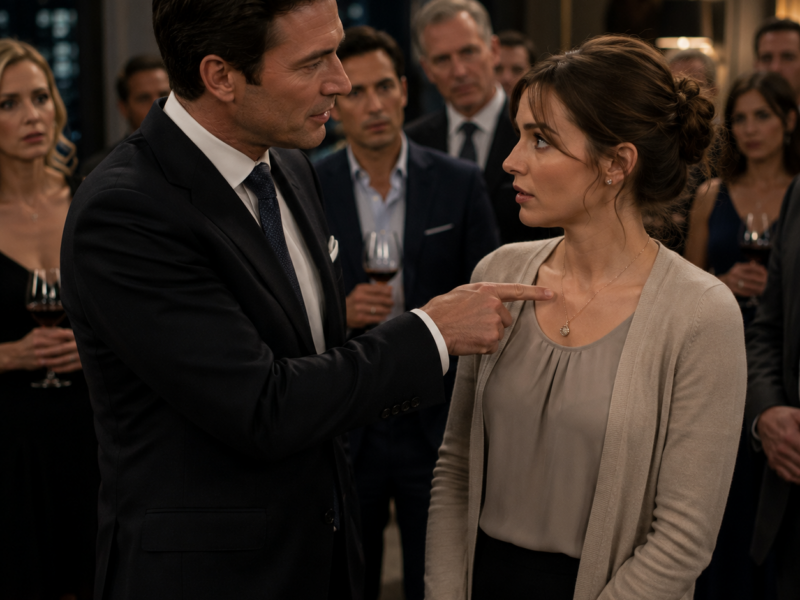
“Where did you get that necklace?” I asked.
My voice wasn’t loud, but it carried a razor-sharp edge that cut straight through the ambient noise of the ballroom.
The waitress froze. Slowly, she dropped her hands and looked up.
Up close, her eyes were a striking, piercing green—eyes that looked right through the expensive custom-tailored tuxedo, right through the terrifying reputation, right into the terrified boy I used to be.
She blinked, startled by the intensity of my gaze, before a defensive flash of pride sparked in her expression. She instinctively tucked the silver compass beneath her collar, her fingers trembling slightly.
“Excuse me?” she said, her voice breathy but remarkably steady. “I’m on duty. If you need a drink, the bar is over there.”
“I don’t want a drink,” I said, taking another step closer, ignoring the murmurs of nearby guests who were beginning to watch us with curious eyes. “I want to know where you got that necklace. Because that particular piece of jewelry hasn’t existed outside of my memories since the winter of 2008.”
The Ghost of the Past
For a long, agonizing moment, the noise of the gala seemed to fade into a distant hum.
She stared at me, searching my face—the sharp jawline, the faint scar across my left eyebrow from a long-ago street fight, the dark eyes that she was suddenly realizing looked entirely too familiar.
Color drained rapidly from her cheeks. Her lips parted.
“Vance?” she whispered.
The name hit me like a physical blow. No one in this city called me Vance anymore. To the underworld, I was Mr. Thorne. To the boardrooms, I was Director Thorne. Only one person in this entire world had ever called me by that childhood nickname—a girl with mud on her knees and bruises on her arms who used to share stale crackers with me behind the boiler room.
“Clara?” I breathed, the word tasting foreign and heavy on my tongue.
She let out a shaky, disbelieving laugh, pressing a hand against her chest. “Oh, God. You’re… you’re Vance Mercer. The shipping tycoon. The… the man everyone on the news says runs half the city.”
“Never mind what the news says,” I stepped closer, ignoring the stares of the entire room, and gently reached out, catching her wrist before she could pull away. Her skin was ice cold. “Clara, how are you wearing that necklace? On the night the fire broke out, I put that in the pocket of the coat I left behind when the state separated us. I searched for you for ten years after I aged out of the system. Every agency, every database—you vanished.”
Clara’s eyes filled with tears, though she fought fiercely to keep them from falling.
“I didn’t vanish, Vance,” she choked out, her voice cracking. “I was adopted three days after the fire by a family two towns over. They changed my name, enrolled me in private schools, and made me forget everything about the shelter. But I kept the coat. The social worker handed me your old denim jacket before I left, saying it was ‘personal property left behind.’ I found the necklace stitched into the lining.”
The world tilted. All the power, all the wealth, all the ruthless control I had spent a lifetime accumulating suddenly felt utterly meaningless compared to the small, trembling hand I was holding.
“You’ve been wearing it all this time,” I whispered.
“It was the only thing I had left of you,” she replied, a tear finally tracking down her cheek. “The only proof that I wasn’t entirely alone in this world.”
The Twist
Before I could pull her into my arms—something my hardened self hadn’t done for another human being in decades—a harsh voice cut through the air behind us.
“Is there a problem here, Mr. Thorne?”
I turned my head slightly. Standing a few feet away was Arthur Sterling—one of the city’s most prominent real estate developers, a man whose massive commercial loans were currently underwritten by my private financial firm. He was glaring at Clara with undisguised contempt, his nose wrinkled as if he were smelling garbage.
“This incompetent little wretch just spilled water on my wife’s designer gown,” Sterling sneered, stepping forward. “She’s clearly unqualified for a venue like this. Get her out of my sight, Vance, or I’ll have management pull her agency license.”
The temperature in the alcove dropped below freezing.
The ambient chatter of the ballroom died down completely as nearby guests realized the city’s most feared mafia boss had just been interrupted by an arrogant developer who had no idea who he was talking to.
Marcus stepped out of the shadows, his hand resting ominously inside his jacket.
I slowly turned back to face Sterling. I didn’t raise my voice. I didn’t yell. I just looked at him the way a cat looks at a trapped mouse.
“Arthur,” I said smoothly.
“Yes, Vance? Let’s handle this trash and get back to—”
“Your company, Sterling Properties, currently holds a forty-million-dollar construction debt financed through my primary holding company,” I interrupted, my tone dangerously calm. “A debt that comes due for full refinancing at midnight tonight.”
Sterling blinked, his smug expression faltering. “W-well, yes. We’ve already discussed the terms—”
“The terms have changed,” I said, stepping between Sterling and Clara, shielding her from his hateful gaze. “As of right now, I am calling in the entire loan. In cash. Furthermore, my legal team will be auditing your commercial permits by 8:00 AM tomorrow morning. If there is a single code violation—which I happen to know there are at least fourteen of—I will strip you of your assets, repossess your headquarters, and ensure you never work in this state again.”
Sterling’s face turned the color of curdled milk. He staggered back a step, trembling violently. “Vance—you can’t be serious! Over a waitress?! Are you out of your mind?!”
“She’s not a waitress,” I said, my voice cutting through the hall like a razor blade. “She is my past, my present, and the only person in this room worth more than the dirt you stand on. Now get out of my sight before I decide to take your home instead of just your business.”
Sterling didn’t wait to be told twice. He turned on his heel and fled through the crowd, practically tripping over his own patent-leather shoes in his panic.
The Resolution
The ballroom was dead silent. Every eye was locked on us.
I didn’t care. I turned back to Clara, whose jaw was slightly slack as she stared at me in a mixture of shock and awe.
“You… you just ruined one of the most powerful developers in the city,” she whispered.
“He insulted you,” I replied simply, as if it were the most natural equation in the world. “In my world, actions have consequences.”
I reached out, gently untying the black service vest from her waist and letting it drop to the marble floor. She didn’t protest. She just watched me with those wide, green eyes.
“You’re done working here, Clara,” I said, my voice softening, the cold mob boss melting away to reveal the boy who had once promised her the stars behind an old brick orphanage.
“Vance, I have rent to pay, college tuition—”
“You have nothing to worry about ever again,” I interrupted, taking her hand and intertwining my fingers with hers. “You’re coming home with me tonight. And tomorrow, we are going to sit down, and you are going to tell me every single thing I missed over the last eighteen years.”
Clara looked down at our joined hands, then up at me. A slow, radiant smile broke through her exhaustion, lighting up her face in a way that made the crystal chandeliers overhead look dim by comparison.
“Only if we stop for cheap diner pancakes first,” she teased softly. “Just like old times.”
I laughed—a real, genuine sound I hadn’t heard from myself in a decade.
“Pancakes it is,” I said.
I looped her arm through mine, turned my back on Chicago’s terrified elite, and walked out of the grand ballroom into a future I finally had a reason to look forward to.