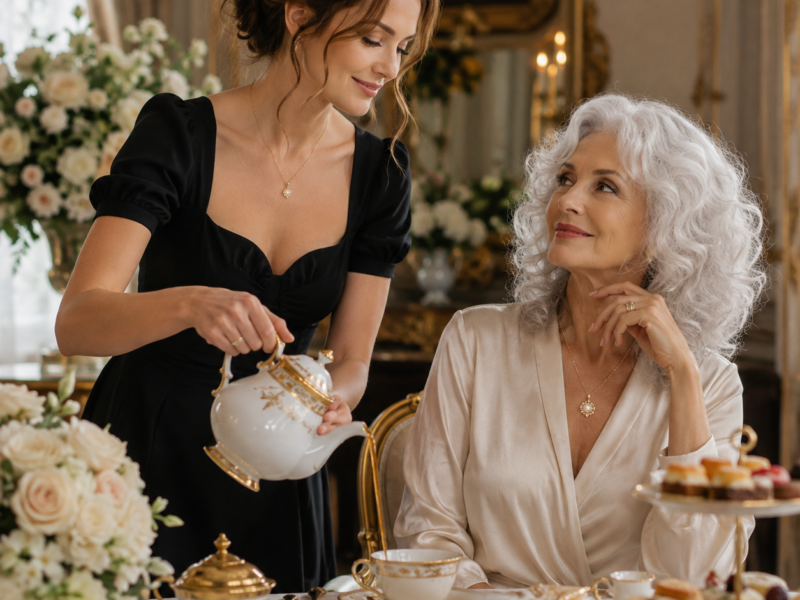
The grease on table four always smelled faintly of burnt toast and old butter.
The grease on table four always smelled faintly of burnt toast and old butter.
For three years, that smell had been the background hum of my life. My name is Mia, and I was a waitress at The Rusty Anchor, a diner wedged between a fading industrial wharf and a stretch of highway that saw more semis than tourists. My uniform was a polyester dress the color of bruised eggplant, my sneakers were permanently scuffed at the toes, and my posture was a permanent slouch born of carrying heavy ceramic mugs and twelve-hour shifts.
Yet, despite the gray exhaustion that usually settled into my bones by 3:00 PM, I always wore one thing that didn’t belong in that diner: a silver chain holding a small, intricate locket.
The locket wasn’t gold, and it didn’t flash with diamonds. It was made of tarnished sterling silver, shaped like a teardrop, with a delicate vine pattern hand-engraved along its edges. It had no clasp that I could figure out for a long time; it was sealed tight, a tiny secret I carried against my collarbone.
My foster mother, Martha, had given it to me the day I aged out of the state system at eighteen. “Your birth mother left this wrapped in your blanket, Mia,” she had told me, her hands rough from decades of cleaning motel rooms. “It’s all you have. Don’t ever hock it, no matter how hungry you get.”
I never did. Even when the rent doubled, even when the electric company threatened to pull the plug, that cold piece of metal stayed against my skin. It was my anchor. My proof that once, someone, somewhere, might have looked at me and wanted me to have something beautiful.
It was a Tuesday afternoon in late autumn when everything shifted. The diner was mercifully slow. I was wiping down the sticky laminate of booth seven, watching the rain streak the plate-glass window, when the bell above the door chimed.
A sleek, midnight-black town car had pulled up outside—a rare sight in our zip code. Out stepped a woman who looked like she had stepped off the glossy pages of Vogue, despite the miserable weather. She wore an impeccably tailored camel-hair coat, dark designer sunglasses, and a scarf tied with effortless elegance. But it wasn’t her clothes that commanded the room; it was her presence. She carried herself with an air of unyielding authority, though her shoulders carried an unmistakable, heavy grief.
She walked in, her heels clicking sharply against the linoleum, and slid into booth four—my station.
I grabbed a menu and a coffee pot, slapping on my best retail smile. “Welcome to the Anchor. Can I start you off with some hot coffee, ma’am? It’s brutal out there.”
The woman pulled down her sunglasses, resting them on the bridge of her nose, and looked up at me.
Her eyes stopped dead.
The color drained from her face so fast it was alarming. Her breath hitched, a sharp, audible intake of air that made the ambient hum of the diner seem to vanish. She gripped the edge of the laminate table so hard her knuckles turned chalk-white.
“Ma’am?” I asked, taking a step back, the coffee pot suddenly feeling heavy in my hand. “Are you alright? Do you need a doctor, or…”
She didn’t answer. Her gaze wasn’t on my face; it was locked entirely on my chest. I looked down instinctively.
The silver teardrop locket had slipped out of the V-neck of my eggplant-colored uniform while I was wiping the table.
“Where…” The woman’s voice was a fractured whisper, stripped of all its polished composure. She reached across the table, her manicured hand trembling violently, her fingers hovering inches from the metal pendant. “Where did you get that?”
I instinctively stepped back, pulling the chain closer to my collarbone. In our neighborhood, people looked at what you had, and sometimes they tried to take it. “It… it belongs to me. It was my mother’s.”
“No,” she breathed, tears instantly pooling in her eyes, spilling over her dark lashes and cutting tracks through her immaculate makeup. “No, that’s impossible. Open it.”
“I can’t,” I said defensively, my guard shooting up. “It doesn’t open. It’s sealed.”
“It’s not sealed,” she wept, a raw, choking sound that tore from her throat, drawing the startled gaze of the cook from behind the counter. “Press the hidden catch on the stem. The vine leaf on the left… press it downward.”
My heart hammered against my ribs like a trapped bird. My fingers moved of their own accord, reaching for the locket. My thumb found the tiny, raised engraving of the vine leaf she had specified. I pressed down.
Click.
The tiny hinge gave way after decades of silence, springing open with a faint metallic breath. Inside, behind a thin sheet of yellowed plastic, was a miniature photograph: a young, smiling woman with dark, expressive eyes holding a newborn baby wrapped in a yellow knit blanket.
Beside it was a tiny slip of paper with faded handwriting: Evelyn, July 14.
The woman in the booth let out a sob that shattered the quiet afternoon. She stood up so fast her chair screeched against the floor.
“Evelyn,” she whispered, her hands flying to her mouth. “My God… my little girl.”
Her name was Eleanor Vance.
Within twenty minutes, we were sitting in the back corner booth of a quiet diner office, with cups of cold coffee untouched between us. The diner owner, seeing the commotion and recognizing the name Vance—synonymous with one of the largest shipping and real estate empires in the state—had practically pushed us into the back room with hushed apologies.
Eleanor clutched my hands between hers. Her skin was warm, and her grip was fierce, as if she were afraid I would dissolve like smoke if she let go.
“Twenty-four years,” she choked out, her voice breaking. “For twenty-four years, I thought you were dead.”
“I don’t understand,” I stammered, my head spinning. “Martha told me my mother left me at a clinic with this locket. She said she was a teenager who had nothing.”
“A lie,” Eleanor spat, though her anger was directed at the past, not at me. She took a deep, shuddering breath, trying to steady herself. “Mia… my family was wealthy, yes. But when I was nineteen, I fell in love with a man my father despised. He wasn’t ‘from our world.’ When I became pregnant, my father went ballistic.”
She closed her eyes, the memories clearly causing physical pain.
“He forced me to go away ‘to finish school’ in a private estate upstate. But it wasn’t a school. It was a secluded facility managed by people who took orders from my father. The night you were born, they told me there was a complication. They told me my baby girl had a weak heart… that she didn’t survive the night.”
A cold shudder ran down my spine. “They lied to you?”
“They lied to protect the family name from a scandal,” Eleanor said, a tear dropping onto our intertwined hands. “They took you away while I was still under anesthesia. When I finally found out the truth years later—after my father passed away and I tore through his private records—it was too late. The trail went cold at a state-run adoption clearinghouse. I spent millions hiring private investigators, searching every database, every orphanage… I never stopped looking.”
She looked at me with a depth of love and sorrow that nearly brought me to my knees. “And all this time, you were working three miles away from our corporate headquarters, wearing the very locket I left wrapped in your blanket.”
The coincidence was so staggering, so cinematic, that my brain refused to process it all at once. I was a diner waitress. My biggest worry an hour ago was whether the Sunday shift manager would cut my hours. Now, I was looking at a woman who commanded empires—and who happened to be looking at me like I was the only treasure in the world.
“I… I don’t know what to say,” I whispered, a tear finally escaping my own eye. “I spent my whole life wondering if anyone cared, if anyone ever looked for me.”
“Every single day,” Eleanor promised fiercely, pressing a kiss to my knuckles. “Every single day of my life, Mia.”
The transition wasn’t an instant fairy tale. You don’t just step out of a polyester waitress uniform on a Tuesday and seamlessly become a billionaire heiress on Wednesday.
There was paperwork, DNA tests—though the locket and the striking resemblance in our eyes made it a formality—and a mountain of media frenzy once the tabloids caught wind that the notoriously private billionaire matriarch had found the daughter she lost decades ago.
My foster mother, Martha, cried tears of relief when I told her, genuinely happy that I had finally found where I belonged, and Eleanor immediately made sure Martha’s future was secured for life.
A month after that rainy Tuesday, Eleanor invited me to move into the sprawling estate on the cliffs overlooking the bay. It was a magnificent house, filled with marble, art, and echoes of a past I hadn’t shared. For the first few weeks, I felt like an impostor. I kept looking for my apron pockets, reaching for order pads that weren’t there, feeling clumsy in rooms that felt more like museums than homes.
One evening, I stood on the grand balcony, wrapped in a cashmere shawl, watching the moonlight dance across the dark water of the ocean.
Footsteps approached softly, and a warm blanket was draped over my shoulders. Eleanor stood beside me, looking out at the same horizon.
“Still feels like a dream?” she asked gently.
“Sometimes,” I admitted, leaning my head softly against her shoulder. “Sometimes I miss the diner, too. The rhythm of it. The people.”
Eleanor smiled, wrapping her arm around my waist. “You can visit anytime you want. In fact, I bought the building next door to The Rusty Anchor last week. I was thinking of opening a community center for kids aging out of the foster care system. A place where they can learn skills, find support, and never feel like they have to carry the weight of the world alone.”
I looked up at her, my heart swelling with a warmth I had never known. The bitterness of the past, the loneliness of the empty holidays, the endless grind of low-wage shifts—they hadn’t defined me. They had simply shaped me into someone who knew the value of kindness.
I reached up, my fingers brushing against the cold silver of the locket resting against my chest. It was open now, showing the picture of a young mother and her newborn baby. But it wasn’t a secret anymore. It was a bridge.
“I’d love that, Mom,” I whispered.
For the first time in my life, the word didn’t feel foreign. It fit, perfectly and forever.