Fourteen minutes before I was supposed to marry the woman I loved
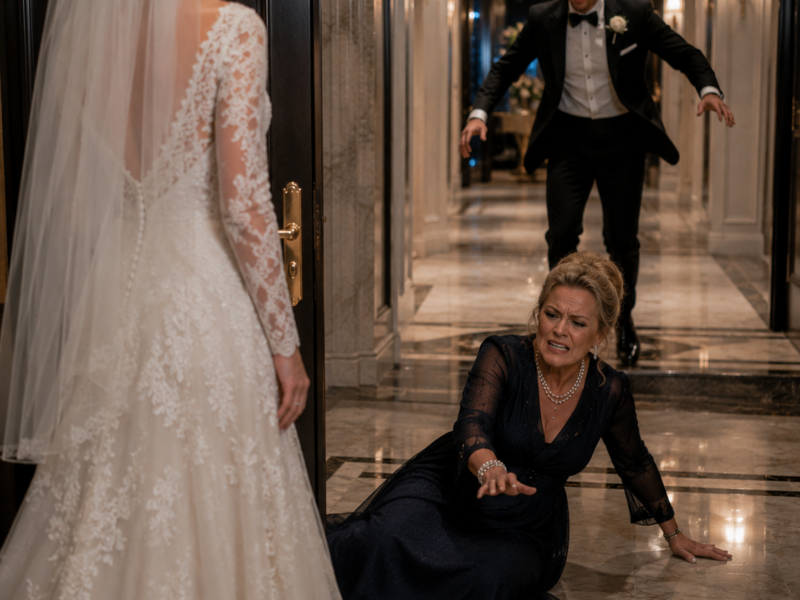
Fourteen minutes before I was supposed to marry the woman I loved, I watched her deliberately send my disabled mother crashing toward a marble floor.
The sound of Mom’s cane striking the ground was sharper than the wedding bells ringing outside.
It skidded across the elegant corridor, spun against a cream-colored wall, and vanished beneath a table overflowing with white roses.
One second, my mother was standing beside the bridal dressing-room doors.
The next, she was falling.
And I saw everything.
I saw Victoria’s jeweled heel extended behind her. I saw the satisfied flicker in her eyes before she quickly rearranged her expression. I saw my mother’s fingers reach desperately for something—anything—to stop herself.
The folder in my hand hit the floor as I lunged forward.
I caught Mom around the waist just before her head struck the marble, but I couldn’t prevent her damaged leg from folding beneath her.
She cried out.
The sound sliced straight through me.
“Mom!”
I lowered her carefully onto the cold floor, keeping one arm behind her shoulders. Her face had already gone pale. One hand clutched the sleeve of my tuxedo while the other pressed tightly against her left hip.
“I’m all right,” she said immediately.
She always said that.
She had said it after the doctors told her she might never walk normally again. She had said it through months of rehabilitation, painful exercises, and three separate surgeries.
But she was not all right.
That hip had never healed properly after the car accident that killed my father four years earlier.
My mother had survived, but survival had come with a price. She could walk only with a cane, only slowly, and only when every step was carefully placed. Some mornings, the pain was so severe that she could barely make it from her bedroom to the kitchen.
Victoria knew every detail.
She had visited Mom during rehabilitation. She had brought flowers to the hospital and sat beside her bed, holding her hand as she promised that she would help our family through the loss.
She had told Mom that when she married me, she would finally have a daughter to depend on.
Now that same woman stood several feet away, smoothing the front of her wedding dress.
She glanced into the mirror and adjusted her veil.
As if nothing had happened.
As if my mother were not lying injured on the floor because of her.
“Are you insane?” I shouted.
Victoria turned toward me slowly.
Her expression wasn’t guilty.
It wasn’t frightened.
She looked irritated, as though I had raised my voice because a centerpiece had been placed on the wrong table.
“She fell,” Victoria said.
My hands tightened around my mother’s shoulders.
“You kicked her cane.”
“I moved my foot.”
“You kicked it out from under her.”
Victoria’s mouth tightened. Her eyes flicked toward the closed doors at the end of the corridor, where hundreds of guests were waiting for us.
“Don’t start this today, Julian.”
For a moment, I couldn’t speak.
I stared at the woman wearing the wedding dress I had helped pay for, standing inside the venue where we were supposed to promise each other a lifetime of love and loyalty.
“Don’t start this?” I repeated.
“My wedding begins in fourteen minutes.”
My wedding.
Not our wedding.
She said “our wedding” when speaking to guests, photographers, or vendors. In private, she had called it “my wedding” for nearly a year.
My dress.
My flowers.
My photographs.
My perfect day.
I had ignored it because I thought she was simply overwhelmed. I had convinced myself that planning a large wedding made people behave differently.
But as I looked at my mother trembling on the floor while Victoria worried about her schedule, something inside me shifted.
Mom tugged weakly at my jacket.
“Julian, please help me sit up.”
I turned my attention back to her immediately.
“Don’t move yet.”
“I didn’t hit my head,” she whispered.
Her voice was steady, but her breathing wasn’t. Each breath came short and shallow. Her fingers were still pressed against her hip, and I could feel her trembling through the fabric of my sleeve.
Behind me, Victoria let out an impatient sigh.
I ignored her.
“Mom, look at me,” I said. “Where does it hurt?”
“I’m fine. You have guests waiting.”
“I don’t care about the guests.”
Victoria stepped closer, the expensive beads on her dress catching the light.
“Julian, we cannot delay the ceremony because your mother lost her balance.”
I slowly looked up at her.
My mother had not lost her balance.
Victoria had taken it from her.
And from the cold expression on my bride’s face, I suddenly realized this might not have been the first cruel thing she had done when I wasn’t watching.
I looked back at Mom and lowered my voice.
“Your hip?”
Her eyes filled with fear before she could answer.
“Yes,” Mom whispered, her voice barely audible over the distant murmurs of the guests filtering through the heavy double doors at the end of the corridor. “Julian… please don’t make a scene. Just… help me up.”
I didn’t move.
Instead, I looked up at Victoria. My fiancée stood tapping her jeweled heel against the marble floor, her expensive lace train catching the dust. She didn’t look at my mother with pity, or even annoyance. She looked at her with pure, unadulterated disgust.
“Are you done yet?” Victoria snapped, glancing at the diamond watch strapped to her wrist. “Ten minutes, Julian. That’s all we have before the coordinator starts the processional. If you make me walk down that aisle alone because you’re playing nursemaid to an old woman, our relationship is over.”
The words hung in the air, heavy and sharp.
Fourteen minutes earlier, I would have panicked. Fourteen minutes earlier, I would have apologized, swallowed my pride, and begged Victoria for patience just to keep the peace.
Now, looking at her cold, immaculate face, the only thing I felt was a profound, suffocating silence.
“Our relationship?” I echoed softly.
I gently shifted my mother’s weight, resting her upper body against the cream-colored wall, and slowly stood up. I didn’t brush off my tuxedo trousers. I didn’t rush.
Victoria raised an eyebrow, misinterpreting my calm as capitulation. “Good. Help her into a chair in the back, tell the photographer to wait five minutes, and let’s go. People are watching.”
“People are watching,” I agreed.
I reached into the inner pocket of my tuxedo jacket, pulled out my phone, and unlocked the screen. With two quick taps, I tapped the live feed application connected to the hallway’s high-definition security cameras—systems I had installed myself as the lead engineer for a local smart-home security firm.
I turned the screen toward Victoria.
Playing in crisp, flawless 4K resolution was the exact moment from three minutes ago: Victoria extending her foot, the deliberate, malicious strike of her heel against my mother’s cane, the violent collapse, and the cold, triumphant smile that flashed across Victoria’s face as Mom hit the floor.
The color drained from Victoria’s face instantly. Her immaculate poise fractured, her mouth parting in silent panic.
“What… what is that?” she whispered, her voice trembling.
“That is the truth,” I said, my voice dangerously quiet. “And right now, it’s being streamed live onto the massive projection screens in the grand chapel where three hundred of your elite friends, your parents, and our wedding guests are sitting.”
Victoria gasped, her hands flying to her mouth. “You didn’t—”
Before she could finish, the heavy wooden doors of the bridal suite swung open, and the venue coordinator rushed in, face pale and sweating.
“Mr. Julian! Everyone’s watching the screen in the chapel! Your mother’s lawyer just stood up in the front row, and—and federal marshals just walked in—”
“Federal marshals?” Victoria shrieked, whirling around to face the coordinator. “What are you talking about? This is a wedding!”
“Not anymore,” a deep, commanding voice echoed from the hallway.
Step by measured step, a tall, impeccably dressed man walked into the dressing room, flanked by two federal agents in dark suits. It was Arthur Sterling, my mother’s lifelong corporate attorney and one of the country’s most ruthless litigators.
My mother looked up from the floor, her face pale with pain, but her eyes sharp. “Thank you for coming, Arthur.”
“Always, Elizabeth,” Arthur replied respectfully. He turned his cold, calculating gaze onto Victoria, who was now trembling so violently her veil was shaking.
“Victoria Vance,” Arthur said smoothly, pulling a thick packet of legal documents from his briefcase. “You are being formally served with an emergency restraining order on behalf of Elizabeth Sterling, alongside criminal charges for intentional assault causing grievous bodily harm, elder abuse, and financial fraud.”
“Fraud?!” Victoria screamed, tears of pure rage springing to her eyes. “You can’t do this! I am marrying into money! Julian, tell them to stop this! Tell them it’s a mistake!”
I looked down at the woman I had spent three years loving, realizing I had never truly known her at all.
“You wanted my family’s name, Victoria,” I said, my voice devoid of any emotion. “You wanted the estate, the trust, and the social standing. But you forgot one thing.”
I gestured toward my mother, who was now being carefully lifted into a wheelchair by the medical staff Arthur had brought with him.
“My mother didn’t survive a devastating accident and build a multi-million-dollar philanthropic foundation by being weak. And I am not the kind of man who lets someone hurt her.”
Victoria lunged forward, desperate, clawing at my sleeve. “Julian, please! It was a mistake! I was stressed about the wedding! Please don’t do this to me—”
The two federal agents stepped forward, gently but firmly pulling her arms back. The sharp, heavy click of steel handcuffs echoed through the elegant bridal room, louder than any wedding bells could ever hope to be.
“Take her away,” Arthur commanded.
As Victoria was dragged weeping and screaming down the corridor, her white lace dress sweeping across the marble floor like discarded trash, the silence returned to the hallway.
I knelt beside my mother’s wheelchair, taking her fragile, trembling hands in mine.
“Are you alright, Mom?” I asked softly.
She smiled, a small, genuine smile that reached her eyes for the first time in years. She reached up, gently adjusting the lapel of my tuxedo jacket.
“I am now, son,” she whispered. “I am now.”
We turned away from the dressing room together, leaving the white roses, the shattered glass, and the wreckage of a lie behind us. As we headed toward the exit and out into the bright, clean afternoon air, I knew the hardest part was over.
We were finally safe.