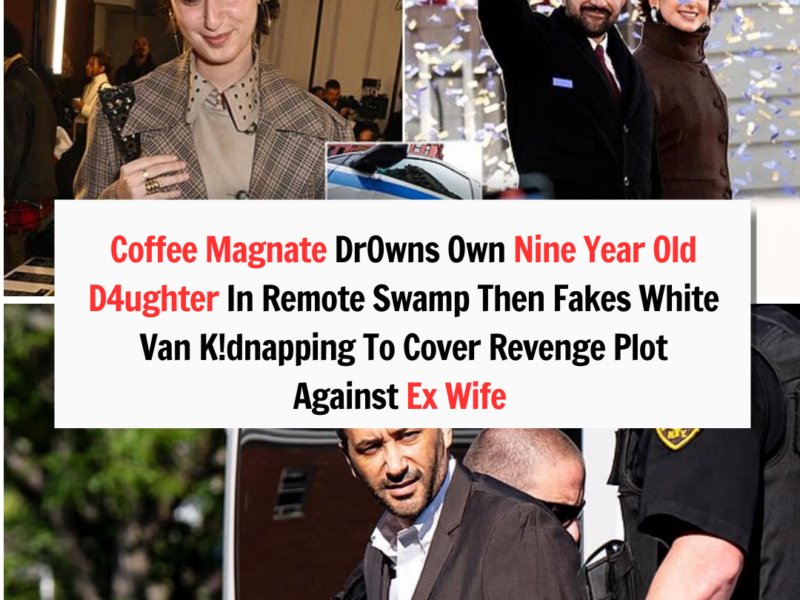
Coffee Magnate Drowns Own Nine Year Old Daughter In Remote Swamp Then Fakes White Van Kidnapping To Cover Revenge Plot Against Ex Wife 😱💔
The jury needed barely an hour. On a Monday afternoon in a quiet upstate New York courtroom, twelve people returned to deliver the verdict that ended any remaining doubt about what happened to nine-year-old Melina Frattolin on a summer evening one year earlier. Luciano Frattolin, the 46-year-old Montreal coffee entrepreneur who once called his daughter the light of his life, was found guilty of second-degree murder and concealment of a human corpse. Family members in the gallery sobbed and clung to one another. Frattolin, standing between his attorneys, shook his head slightly and kept a neutral expression before being led away in handcuffs.

Prosecutors had argued from the start that the crime was no random tragedy. They said Frattolin deliberately drowned his own child in a shallow, muddy pond in the Adirondacks and then staged an elaborate kidnapping story to cover his tracks. The motive, they told jurors, was rooted in bitterness toward Melina’s mother, Kali Galanis, and a desire to escape the obligations of fatherhood. In the end, the digital trail he left behind proved stronger than the story he invented.
Melina’s body was discovered on July 20, 2025, in a remote wetland off Route 74 near Ticonderoga. Forest rangers and state police found her partially submerged in about a foot of water, her head and shoulders under a fallen log, a large rock resting on her torso. Dirt and grass clung to the long black hair she had recently taken out of braids. An autopsy determined the cause of death as asphyxia due to drowning. The manner of death was ruled a homicide. The location was isolated, steep, and difficult to reach—exactly the kind of place someone might choose if they wanted a body to stay hidden.
The night before, Frattolin had dialed 911 from near Lake George. He claimed two men had forced Melina into a white van at a rest area along Interstate 87 while he stepped away to relieve himself. He said he chased the van for fifteen or twenty minutes before stopping to call police. The report triggered an Amber Alert and a widespread search for white vans across the region. Officers stopped vehicles. News helicopters circled. For a few hours, the public believed a little girl from Montreal had been snatched by strangers.
That narrative began to collapse almost immediately. Investigators noticed inconsistencies. Frattolin’s directions to the supposed abduction site kept changing. What should have been a short drive stretched into hours as he redirected officers. Cellphone and GPS data from the Toyota Prius he had rented told a different story. The vehicle had been near a trailhead leading to the Ticonderoga pond around 7:55 p.m. and remained in the area until roughly 9 p.m. Melina’s own phone had gone silent after a stop at a McDonald’s in Saratoga Springs earlier that evening—the last place surveillance cameras captured both father and daughter together. Her mother, who had been tracking the device, lost the signal after that stop and grew increasingly alarmed.
When police searched the rental car, they found wet clothes and shoes stuffed into a garbage bag that had been discarded along the interstate. Surveillance video from the McDonald’s showed Frattolin wearing different clothing than the outfit he had on when he reported Melina missing. Notes recovered from the vehicle revealed a man wrestling with dark thoughts. One spoke of “ending the madness.” Another described a future “Luciano Frattolin 2.0” living with a “10/10 blond” and driving a Porsche. Still another read, “Don’t let Melina suffer anymore.” During questioning, investigators later testified, Frattolin remarked that it “would’ve been easier” to kill the girl overseas—either in Italy or in Ethiopia, the country of his birth.
Galanis took the stand and described a relationship that had ended years earlier. She held full custody. Melina lived with her in Montreal and saw her father on occasional visits. In early 2025 Frattolin had proposed taking their daughter to Ethiopia for two weeks. Melina resisted. The girl told her mother she did not want to go. Galanis grew uneasy and ultimately refused permission. Frattolin then suggested a trip through the northeastern United States instead. She agreed. That decision, she told the court, haunted her. In the months leading up to the vacation, Melina had expressed fear about traveling with her father. Those warnings now carried unbearable weight.
Frattolin never took the stand. His attorneys argued that the prosecution’s case rested on circumstantial evidence and that no direct physical proof—such as DNA on the rock that held Melina’s body—tied him to the act itself. They maintained that the kidnapping story was true and that investigators had tunnel-visioned on the father. The jury was unpersuaded. After roughly sixty minutes of deliberation, they returned guilty verdicts on both counts.
The conviction closes one chapter while leaving others open. Frattolin faces a potential life sentence when he returns to court for sentencing on October 14. He has thirty days to file an appeal. For Melina’s mother and extended family, the verdict offered a measure of accountability but no restoration of the child they lost. Galanis had waited through the night of July 19 for her daughter to come home. The next day she received the call that Melina had been found in a New York marsh.
In the year since the killing, the case has drawn attention to the dangers that can hide inside fractured custody arrangements and the ease with which digital evidence can either corroborate or destroy a carefully constructed lie. Frattolin’s coffee company, once promoted with warm photographs of father and daughter, has faded from public view. The notes recovered from the rental car continue to circulate in coverage of the trial—fragments of a man imagining a new life free of the obligations that tethered him to his former partner and their child.
Melina Frattolin was nine years old. She had long dark hair, a mother who tracked her phone out of love and worry, and a father who took her on a vacation that ended in a shallow pond under a fallen log. The jury’s swift decision made clear what investigators concluded within hours of discovering her body: the white van never existed. The strangers never appeared. The only person who knew exactly what happened in those final hours on a remote Adirondack trail was the man who had driven her there. On Monday, a courtroom in Elizabethtown confirmed what the evidence had already shown.