BREAKING: Chuck Norris, the invincible legend who defied death for decades, has passed away at 86… the world just lost its toughest hero forever 😢💔

The world lost a towering icon of American toughness and unyielding resolve on March 19, 2026, when Carlos Ray “Chuck” Norris, the martial arts legend, action film powerhouse, and enduring symbol of unbreakable spirit, passed away at the age of 86. His family confirmed the sudden death the following day through a heartfelt statement posted on his official Instagram and Facebook accounts, revealing that Norris had died peacefully in Kauai, Hawaii, surrounded by loved ones. “It is with heavy hearts that our family shares the sudden passing of our beloved Chuck Norris yesterday morning,” the message read. “While we would like to keep the circumstances private, please know that he was surrounded by his family and was at peace.”
Norris had been hospitalized earlier that day after experiencing a medical emergency, according to reports from multiple outlets including The New York Times, which first broke the news in its obituary published March 20. Though the exact cause remained undisclosed at the family’s request, the announcement sent shockwaves through Hollywood, the martial arts community, and millions of fans worldwide who had long joked that death itself feared Chuck Norris. In an era where internet memes immortalized him as invincible—capable of dividing by zero or winning staring contests with mirrors—the reality of his mortality hit hard, proving that even the toughest legends eventually bow to time.
Born on March 10, 1940, in Ryan, Oklahoma, Norris grew up in a world far removed from the glamorous action-hero persona he would later embody. The eldest of three boys raised by a father who struggled with alcoholism and a mother who worked tirelessly to support the family, young Carlos faced hardship early. The family moved frequently across Oklahoma, California, and Texas, instilling in him a resilience that would define his life. Nicknamed “Chuck” by his classmates due to his shy demeanor and perceived lack of toughness, he dropped out of high school to join the United States Air Force in 1958, seeking structure and purpose.
It was during his military service in South Korea that Norris discovered martial arts. Stationed at Osan Air Base, he began training in Tang Soo Do under Korean instructors, eventually earning his black belt. This pivotal moment transformed him from a quiet serviceman into a disciplined fighter. Upon returning to the United States, he continued his training, opening his first karate school in Torrance, California, in 1962. By the late 1960s, Norris had become a dominant force in competitive karate, winning the Professional World Middleweight Karate Championship six consecutive times from 1968 to 1974. His record stood at an astonishing 183-10-2, with many victories coming via knockout. He also founded his own system, Chun Kuk Do, blending elements of various martial arts into a philosophy emphasizing personal growth, humility, and faith.
Norris’s transition to Hollywood began modestly. In the early 1970s, he appeared in bit parts and stunt work, but his big break came courtesy of Bruce Lee. The martial arts legend cast Norris as his formidable opponent in the 1972 film “Way of the Dragon” (released in the U.S. as “Return of the Dragon”). Their climactic fight scene atop the Colosseum in Rome remains one of cinema’s most iconic showdowns—two masters trading brutal kicks and punches in a display of raw athleticism and intensity. Lee’s victory in the film notwithstanding, Norris’s performance earned him instant recognition as a credible screen fighter. He later reflected on the experience with deep respect: “Bruce was the best there ever was. Working with him changed everything for me.”
Building on that momentum, Norris starred in a string of low-budget action films throughout the 1970s and 1980s, many produced by Cannon Films, known for their high-octane, no-frills entertainment. Hits like “Breaker! Breaker!” (1977), “A Force of One” (1979), and “An Eye for an Eye” (1981) showcased his signature roundhouse kicks and stoic delivery. The “Missing in Action” trilogy (1984–1985) cemented his status as a one-man army, portraying Colonel James Braddock, a Vietnam veteran rescuing POWs single-handedly. These films tapped into post-Vietnam American patriotism, portraying Norris as the ultimate rescuer who righted wrongs where governments failed.
Perhaps his most enduring on-screen legacy came with “The Delta Force” (1986), where he played Major Scott McCoy leading a counter-terrorism unit against hijackers. Co-starring Lee Marvin in one of his final roles, the movie blended real-world events (inspired by the 1985 TWA Flight 847 hijacking) with over-the-top action. Norris’s performance—complete with machine-gun fire from a motorcycle and relentless pursuit—epitomized the invincible hero archetype that defined 1980s action cinema.
Television brought Norris even wider fame. From 1993 to 2001, he starred as Cordell Walker in “Walker, Texas Ranger,” a CBS series that ran for eight seasons and over 200 episodes. As a modern-day Texas Ranger upholding justice with martial arts prowess, moral conviction, and folksy wisdom, Walker became a cultural touchstone. The show blended action, family values, and inspirational messages, often ending with Norris delivering a poignant voice-over. It drew massive audiences, particularly in heartland America, and spawned a television movie revival in 2005. Episodes frequently featured real-life moral dilemmas, with Walker dispensing justice through fists rather than firearms when possible, reinforcing Norris’s real-life advocacy for discipline and ethics.
Beyond the screen, Norris cultivated a multifaceted persona. He authored numerous books, including fitness guides, motivational works, and his 2004 autobiography “Against All Odds.” A devout Christian, he integrated faith into his public life, co-founding the KickStart Kids program, a martial arts-based initiative to steer at-risk youth away from gangs and toward positive values. He endorsed conservative causes, appeared in political ads, and even inspired a viral 2008 meme campaign during the presidential election, where exaggerated “Chuck Norris Facts” humorously portrayed him as superhuman.
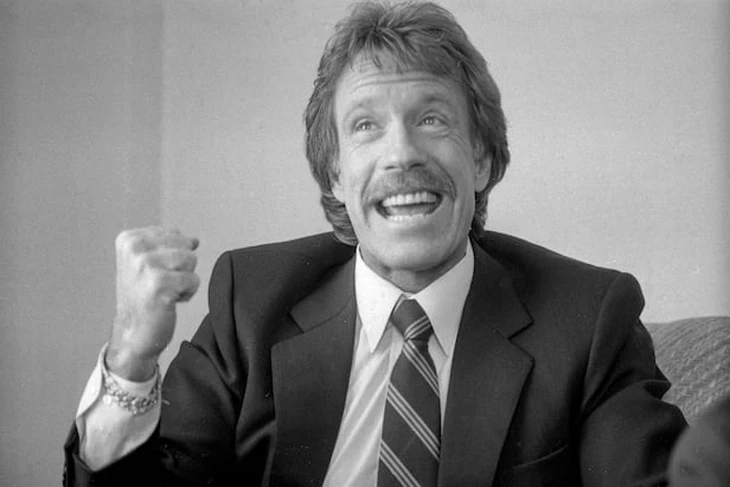
Those facts exploded across the internet in the mid-2000s, turning Norris into a meme legend: “Chuck Norris doesn’t do push-ups; he pushes the Earth down.” “When the Boogeyman goes to sleep every night, he checks his closet for Chuck Norris.” The humor stemmed from his on-screen invincibility, yet it underscored genuine admiration for his longevity and grit. Presidents, athletes, and everyday fans quoted them; Norris himself embraced the phenomenon with good-natured humor, even referencing them in appearances.
In his later years, Norris remained active. He starred in “The Expendables 2” (2012), delivering the memorable line “I’m all out of bubblegum” in a cameo that thrilled fans. He continued writing columns for WorldNetDaily, promoting conservative viewpoints, fitness, and faith. Married twice—first to Dianne Holechek (1963–1988), with whom he had two sons, Mike and Eric, and later to Gena O’Kelley (since 1998), with whom he had twins Dakota and Danilee—he spoke often of family as his greatest achievement. Gena’s health battles in the 2010s, involving complications from contrast dye used in MRI scans, led Norris to become an advocate for medical reform and alternative treatments.
Tributes poured in following his death. Fellow action stars like Sylvester Stallone and Arnold Schwarzenegger remembered him as a pioneer. “Chuck was the real deal—a champion in the ring and on screen,” Stallone posted. The martial arts world mourned a grandmaster whose schools and teachings influenced generations. Fans flooded social media with memes, clips from “Walker,” and personal stories of how his films inspired discipline or simply provided escapist thrills.
Critics often dismissed Norris’s films as formulaic, but that missed the point. His work resonated because it delivered straightforward heroism in an increasingly cynical world. He played men who stood for right, fought hard, and never backed down—qualities that mirrored his own life story from humble beginnings to global icon.
Chuck Norris’s passing marks the end of an era in American pop culture, where one man could embody strength, faith, and sheer willpower so completely that even death seemed reluctant to claim him. Yet in the hearts of millions, his roundhouse kicks still echo, his stoic gaze still inspires, and his legend endures—unbreakable, eternal, and forever kicking ass.