A heartwarming tale of resilience and unexpected friendship has swept across the internet from a modest zoo in Japan, where a once-lonely baby Japanese macaque named Punch has captured millions of hearts worldwide. Born in July 2025 at Ichikawa City Zoo in Chiba Prefecture, just outside Tokyo, Punch entered the world under heartbreaking circumstances: his mother rejected him shortly after birth, refusing to nurse or provide the essential care a newborn primate needs to thrive. Without immediate human intervention, the tiny macaque would not have survived. Zoo staff stepped in to hand-rear him, bottle-feeding and monitoring his fragile development around the clock.

To ease his isolation and mimic the comfort of maternal warmth, caretakers introduced a large, soft stuffed orangutan toy—an orange plush companion that quickly became Punch’s lifeline. Videos from early February 2026 showed the seven-month-old dragging the oversized toy everywhere he went: clutching it tightly during quiet moments, resting his head against its fuzzy body, even curling up with it for naps in his enclosure. The images struck a universal chord—viewers saw not just an animal, but a symbol of vulnerability, abandonment, and the instinctive search for security. Social media exploded: clips amassed tens of millions of views on platforms like Instagram, X, and YouTube, with hashtags like #PunchTheMonkey and #SavePunch trending globally. Fans from every corner of the planet flooded comments with encouragement, tears, and pledges of support.
The zoo’s macaque enclosure, a naturalistic habitat designed to encourage natural behaviors, initially proved challenging for Punch. Reintroduced to the troop in mid-January 2026 after hand-rearing, he faced the harsh realities of primate social dynamics. Adult macaques, establishing hierarchy and boundaries, sometimes pushed him away, grabbed him roughly, or swung him around in what zoo officials described as typical “disciplinary” or socialization behaviors. One viral clip showed Punch fleeing back to his stuffed orangutan for refuge after such an interaction, tugging at heartstrings and sparking debates online about whether the troop was “bullying” the newcomer. Some animal lovers called for his relocation; even controversial figures like Andrew Tate publicly offered large sums to “buy” him from the zoo. Officials responded firmly: these interactions, though tough to watch, were part of normal integration. They urged supporters to trust the process and celebrate Punch’s gradual progress rather than pity his setbacks.
Amid the challenges, a quiet hero emerged: an older macaque named Momiage, whose name evokes his distinctive fluffy sideburn-like cheek fur. Described by staff as calm, confident, and socially adept, Momiage did not compete with or ignore the anxious youngster. Instead, he positioned himself as a steady presence—staying close, offering physical proximity, and displaying protective gestures that signaled safety to Punch. In primate societies, such alliances are crucial: grooming, huddling, and gentle contact build trust, reduce stress hormones, and reinforce group cohesion. Momiage’s consistent attention began to work its magic.
Recent footage, shared widely in late February 2026, captured the pivotal shift. In a serene corner of the enclosure, Punch sits beside Momiage. The beloved stuffed orangutan lies nearby on the ground—untouched for the first time in months. No longer gripped desperately in tiny paws, it rests forgotten as Punch leans in, pressing his small body against the larger macaque’s side. Momiage responds with what appears to be a tender embrace: an arm draped protectively, a gentle pull closer. The moment lasts only seconds—no dramatic gestures, no loud calls—but its simplicity amplifies its power. Punch looks visibly relaxed, shoulders loosened, eyes half-closed in contentment. Subsequent clips show him grooming Momiage in return, riding on his back playfully, and exploring further without glancing back for the toy.
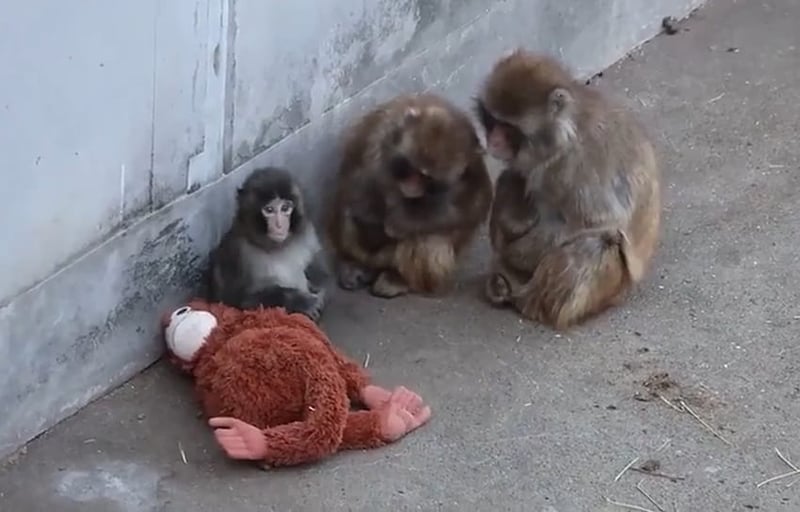
Zoo representatives have emphasized that this bond reflects authentic macaque behavior. Japanese macaques (Macaca fuscata), native to Japan’s forests and mountains, live in matrilineal troops with complex hierarchies. Youngsters rely on allies—often older siblings, aunts, or tolerant adults—for protection during integration. Physical touch, including hugging and allogrooming, releases oxytocin and lowers cortisol, mirroring attachment processes in many mammals, including humans. Experts note that primates exhibit forms of empathy, consolation, and alliance-building; Punch’s transition from inanimate comfort to living companionship underscores how social enrichment can heal emotional wounds far more effectively than objects alone.
Since forming this connection, Punch’s transformation has been remarkable. Staff report increased confidence: he ventures deeper into the enclosure, initiates play with peers, and engages more openly in group activities. The stuffed toy remains available—placed thoughtfully in his space—but it no longer dominates his world. Visitors, drawn by the viral fame, now line up at Ichikawa City Zoo for glimpses of the pair. The zoo has seen a surge in attendance, with fans snapping photos of Punch hitching rides on Momiage or nestling close during rest periods. Officials have used the attention to educate: they post updates explaining primate socialization, warn against scams exploiting Punch’s popularity (including fake donation drives), and highlight the value of careful introductions in captive settings.
The story resonates beyond cuteness. Punch’s journey mirrors human experiences of loss, adaptation, and healing through connection. Abandoned at the start of life, he found solace in a substitute mother—a plush stand-in that bridged the gap until real bonds could form. When Momiage stepped in, offering protection and acceptance, Punch no longer needed the crutch. Viewers project their own stories onto the footage: overcoming trauma, finding unexpected guardians, learning to trust again. Comments overflow with phrases like “He doesn’t need the toy anymore—he has a friend,” “This healed something in me,” and “Protect Punch at all costs.”

Animal welfare advocates praise the zoo’s approach. Hand-rearing followed by gradual troop integration, combined with environmental enrichment and close monitoring, exemplifies best practices. The stuffed toy provided transitional comfort without hindering social development; Momiage’s role demonstrated the irreplaceable power of conspecific companionship. Specialists stress that while toys aid orphaned or rejected young, true emotional security comes from peers and group dynamics.
As March 2026 begins, Punch continues to thrive under Momiage’s watchful eye. The viral videos keep circulating, reminding a global audience that empathy exists across species boundaries. In a world often divided, the quiet image of a baby macaque leaning into an older one’s embrace offers a simple, profound truth: sometimes the most powerful comfort comes not from what we hold, but from who holds us.
At Ichikawa City Zoo, caretakers watch the pair with quiet pride, knowing their story—born of hardship yet blooming into hope—has touched millions. Punch, once defined by loneliness, now embodies resilience and the healing magic of friendship. And somewhere in the enclosure, the orange stuffed orangutan sits patiently, no longer needed, a silent witness to one little monkey’s courageous step forward.
News
Justice for Austin Metcalf? One Year Later, His 17-Year-Old Killer Graduates, Goes to College… While Austin Never Will 😢
Exactly one year ago today, on a rainy April morning in 2025, 17-year-old Austin Metcalf stood under a team tent at David Kuykendall Stadium in Frisco, Texas, waiting for a…
🔥 “How Euphoria Season 3 Completely Changed Menswear: Jacob Elordi’s New Looks Are Pure Fire! 😱 What’s Behind the Costumes?
Natasha Newman-Thomas knew from the very first conversation with Sam Levinson that dressing the characters of Euphoria Season 3 would mean tearing up the rulebook. After two seasons of iconic…
Harry Potter Fans Spot Major Clue: Owen Cooper Could Be the Next Tom Riddle in Chamber of Secrets Season 2! 👀📖
A wave of excitement is sweeping through the Wizarding World as fresh casting rumors point to a breakout young British talent stepping into one of the most iconic and chilling…
Sydney Sweeney Turns Heads in Her Own $269 SYRN Corset on Euphoria – What Happened with Jacob Elordi? 😲”
Sydney Sweeney has done it again. In the explosive premiere of Euphoria Season 3, which dropped on April 12, 2026, the 28-year-old actress stepped back into the chaotic world of…
💥 The Wait is OVER! Anne Hathaway Just Confirmed The Princess Diaries 3 – Summer 2027 Release & Filming This Year?! You Need to See This 👑
The Long-Awaited Return to Genovia Feels Closer Than Ever as The Princess Diaries 3 Gears Up for a Royal Comeback Miracles really do happen. After more than two decades of…

🔥 Cal vs Liam Explodes in Sullivan’s Crossing! Chad Michael Murray Calls Out Maggie’s Ex for Breaking Her Heart… The Mystery Phone Call Will Shock You 😱😭
The Explosive Showdown in Sullivan’s Crossing Season 4: Chad Michael Murray’s Cal Finally Calls Out Liam for Shattering Maggie’s Heart – And the Fallout Is Just Beginning In the rugged,…
End of content
No more pages to load