The first thing I noticed on the dimly lit laptop screen was my own signature.
The first thing I noticed on the dimly lit laptop screen was my own signature.
It was not my name neatly typed into a standard form, nor was it a place marked with a yellow sticky tab where I was expected to sign later.
It was my signature. Scanned. Duplicated. Embedded neatly beneath formal legal jargon that categorized me as emotionally unstable, severely paranoid, cognitively deteriorating, and a immediate threat to my own physical safety.
For several suffocating minutes, I sat completely paralyzed at my kitchen table while the cold November dawn gradually turned the high-rise apartment windows a dull, ash-gray.
Julian was fast asleep in the master bedroom behind me.
Julian Vance. My fiancé. The man I was scheduled to marry in exactly three weeks. The man whose elegant mother had been quietly plotting to confine me within a private, high-security psychiatric facility in upstate New York the moment I legally surrendered enough of my personal estate to enrich them both.
I swallowed hard, my throat bone-dry, and stared at the file name displayed in the administrator directory once more:
SIENNA_COMMITMENT_PLAN.PDF
I double-clicked the file and opened the first page.
The document was thirty-seven pages in total. It began with a draft sworn affidavit signed by Julian, asserting under penalty of perjury that I had endured “escalating episodes of irrational terror, violent outbursts, and severe memory loss” following the tragic death of my parents in a car accident eighteen months ago. It detailed severe panic attacks I had never experienced, vivid hallucinations I had never suffered, and frantic threats of self-harm I had never once uttered.
There were empty underline spaces for dates. Empty spaces for medical witnesses. And right beneath them were handwritten side-notes in Victoria Vance’s precise, razor-sharp cursive handwriting: Establish consistent behavioral pattern before formal intervention.
My stomach churned violently. I kept scrolling.
Page nine contained a formal intake letter addressed to a private, luxury psychiatric residential center outside Albany. Page fourteen held a fabricated medical history compiled by a paid private practitioner. Page nineteen featured a sweeping financial power-of-attorney authorization form.
Page twenty-three contained an emergency deed amendment, transferring full sole ownership of my $1.8 million historic Manhattan apartment to Julian immediately following our legal marriage ceremony.
And page twenty-eight featured the signature.
Mine. Almost.
Whoever had forged it had studied my handwriting with terrifying accuracy. The long, sweeping curve of the S. The narrow, compressed loop in the i. Even the peculiar, sharp upward flick I made at the very end of Hayes.
But the forgery had overlooked one crucial, microscopic detail.
My father had taught me how to sign my legal name when I was twelve years old. He used to laugh and joke that if I ever became a successful professional, I should make my official autograph nearly impossible for dishonest people to replicate. So I had adopted a subtle habit: I always pressed the pen tip down twice at the very end of the final stroke, leaving a faint, microscopic double-dot beneath the paper’s surface.
This scanned signature flowed straight through in one continuous line.
It was a complete, calculated fake.
I leaned back into the cold leather chair, my hands shaking against my knees. Three weeks ago, if I had found this, I would have broken down into hysterical tears. Three hours ago, I would have been paralyzed by suffocating horror.
Now? Now something cold, sharp, and lethal crystallized inside my chest. I didn’t want to scream. I wanted to discover exactly how deep this monstrosity went.
I pulled an encrypted flash drive from my work bag, plugged it into the USB port, and copied the entire thirty-seven-page file along with its metadata timestamps. Then I took high-resolution photographs of the laptop screen using my phone, capturing the file path, the creation dates, and the internal IP address logs.
The folder had been created four months ago.
Four months.
That meant Julian had kissed me on Christmas morning while this commitment plan was sitting on his hard drive. He had dropped to one knee and proposed to me in January while this legal document was being drafted. He had sat across from me at my favorite Italian bistro, holding my trembling hands and telling me how much my late parents would have adored him, while this trap was actively being built.
A cold, unbreakable wall rose inside my mind. My grief evaporated, replaced by absolute, surgical focus.
Then I noticed another encrypted folder sitting directly adjacent to it: VANCE_HOLDINGS_LEGAL.
I clicked it.
Spreadsheet after spreadsheet appeared across the screen. Private loans. Unpaid tax liens. Offshore bank transfers. Corporate bankruptcy filings.
Victoria Vance had spent the last three years telling everyone in New York social circles that she lived off the substantial investment yields of her late husband’s estate. But these internal ledgers painted a drastically different picture. She was drowning in crippling debt.
One primary shell company owed nearly $600,000 in defaulted bridge loans. Another had received emergency wire transfers pulled directly from investment accounts linked to three elderly, vulnerable clients she managed as a private wealth adviser.
My professional training kicked in instantly. I stopped being a grieving bride. I became a Senior Forensic Accountant for the City Fraud Division.
At 7:02 a.m., the bedroom door opened. Julian walked into the sunlit kitchen wearing grey sweatpants, rubbing his eyes, his dark hair messy.
I snapped the laptop lid shut half a second before he reached the island counter.
“Morning, sweetheart,” he murmured, his voice warm, low, and perfectly normal. He bent down and pressed a gentle kiss against the crown of my head.
Every muscle in my neck locked tight, but I forced my lips to form a soft, relaxed smile as I looked up. “Morning.”
He opened the refrigerator, pulling out a carton of orange juice. “Are you okay? You look exhausted. Did you sleep at all?”
“Just wedding nerves, I think,” I replied smoothly.
Julian let out a soft laugh, pouring himself a glass. “Don’t start panicking on me now, Sienna. We’re almost at the finish line.”
The word panicking hit me differently than it would have yesterday. It sounded far too deliberate. Too rehearsed.
I looked directly into his blue eyes. “Do I panic a lot, Julian?”
He paused with the juice glass halfway to his mouth. Just for a fraction of a second, his eyes shifted.
Then he shrugged, offering an easy, charming grin. “Everybody panics sometimes, babe.”
“Have I?” I pressed softly.
His gaze locked onto mine. There it was—a subtle, calculating flicker in his irises as he evaluated my reaction. Then he smiled again, stepping closer to pat my shoulder.
“Babe, you cried when that dog died in the movie we watched last Friday,” he said softly.
“That isn’t panic, Julian.”
“I know,” he whispered, leaning down to kiss my forehead again. “I’m just teasing you. God, Sienna, you are so tense lately.”
I forced a light, airy laugh. “Three weeks until the wedding, Julian.”
“Exactly,” he lifted his glass in a silent toast, his smile widening. “Then everything gets much easier.”
Everything gets easier. I wondered if he realized how chilling those three words sounded now.
At one o’clock that afternoon, I walked into the City Fraud Division downtown and locked myself inside a windowless interview room on the fourth floor.
I didn’t use my official department computer—not yet. If Victoria Vance’s financial paper trail touched federal crime jurisdictions, I needed to gather independent evidence through clean, verified public databases first.
I pulled up corporate property filings, UCC liens, civil court judgments, and state registry deeds. By 4:30 p.m., the complete financial picture had emerged.
Victoria Vance had spent the last eight years maintaining an elaborate facade of aristocratic wealth while her actual accounts crumbled beneath her feet. Failed real estate developments in New Jersey, defaulted personal guarantees, and massive private debts.
And the shell company I had seen on Julian’s laptop? Three years ago, Victoria had acted as the financial manager for a seventy-eight-year-old widow named Evelyn Montgomery. Evelyn had transferred $240,000 into an “exclusive investment fund.” Two months later, Evelyn’s family filed a lawsuit alleging financial elder abuse. The case had suddenly vanished following a sealed, confidential settlement.
I stared at the screen, my heart pounding against my ribs.
The door opened, and my colleague Arthur Vance walked in carrying two hot paper cups of coffee. Arthur was forty-four, divorced, relentlessly sharp, and one of the most brilliant forensic investigators in our unit.
He set a coffee down in front of me. “You’ve been locked in this interview room for six hours, Sienna.”
“I’m working, Arthur.”
“You’re wearing your engagement ring while pulling deep corporate registries on your future mother-in-law,” Arthur noted quietly, leaning against the doorframe.
I glanced down at the sparkling three-carat diamond on my left hand. Suddenly, the ring felt less like a symbol of love and more like piece of physical evidence.
Arthur closed the door firmly and sat down across from me. “Sienna. Look at me. What’s going on?”
I trusted Arthur professionally, but trust had suddenly become a dangerous luxury. So I shared only a precise, clinical fraction of the truth. “I found irregularities in Victoria Vance’s private holding accounts. Potential grand fraud.”
“Does Julian know you’re investigating his mother?”
“No.”
Arthur studied my face for a long, silent moment. His expression shifted from professional curiosity to deep, grave concern. “Keep it that way, Sienna.”
I looked up. “Why?”
Arthur hesitated, and that hesitation terrified me more than the documents had.
“Two weeks ago,” Arthur said softly, “a man came downstairs to the main security desk asking if you still worked in this unit.”
My muscles went rigid. “What man?”
“Mid-fifties. Gray suit. No appointment,” Arthur explained. “He claimed he was verifying your employment details for a home mortgage application.”
“I haven’t applied for a mortgage, Arthur.”
“I figured,” Arthur nodded. “He left the moment I stepped over to ask for his private credentials. I thought he was a pushy debt collector or some wedding vendor checking your background.”
“Did security get his face on camera?”
“Yes,” Arthur stood up immediately. “I pulled the footage this morning. He’s a private investigator named Robert Hayes. He specializes exclusively in adult guardianship petitions and involuntary psychiatric commitment proceedings.”
The room seemed to drop ten degrees. The pieces of the machine were moving with terrifying speed. They weren’t just planning to commitment me after the wedding; they were establishing the legal framework to have me declared mentally incompetent before I could ever touch my inheritance.
“Arthur,” I whispered, my voice trembling slightly. “They’re going to try to take me away.”
“Not on my watch,” Arthur said, his eyes turning to liquid steel. “We build the criminal case tonight.”
That evening at 7:30 p.m., Julian invited me to a private, quiet dinner at an upscale French restaurant near Central Park.
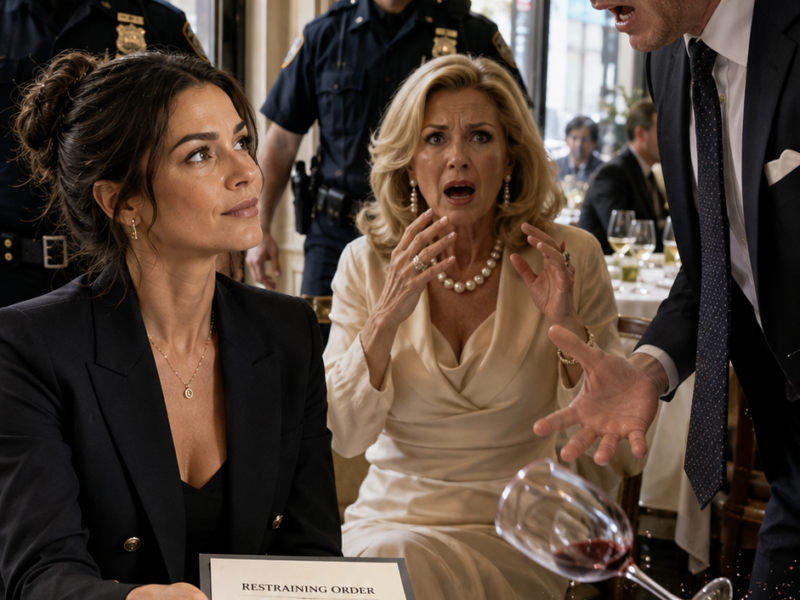
When I arrived, I realized it was not a romantic dinner for two. Sitting at the corner velvet booth, wearing an exquisite cream silk dress and her signature pearl necklace, was Victoria Vance. Beside her sat a tall, sharp-featured man in a dark suit holding a leather briefcase—Dr. Harrison Sterling, the chief medical director of the private Albany psychiatric facility listed on page nine of the commitment plan.
Julian smiled warmly as I approached the table, standing up to kiss my cheek. “Sienna, sweetheart! My mother brought a family friend to join us tonight.”
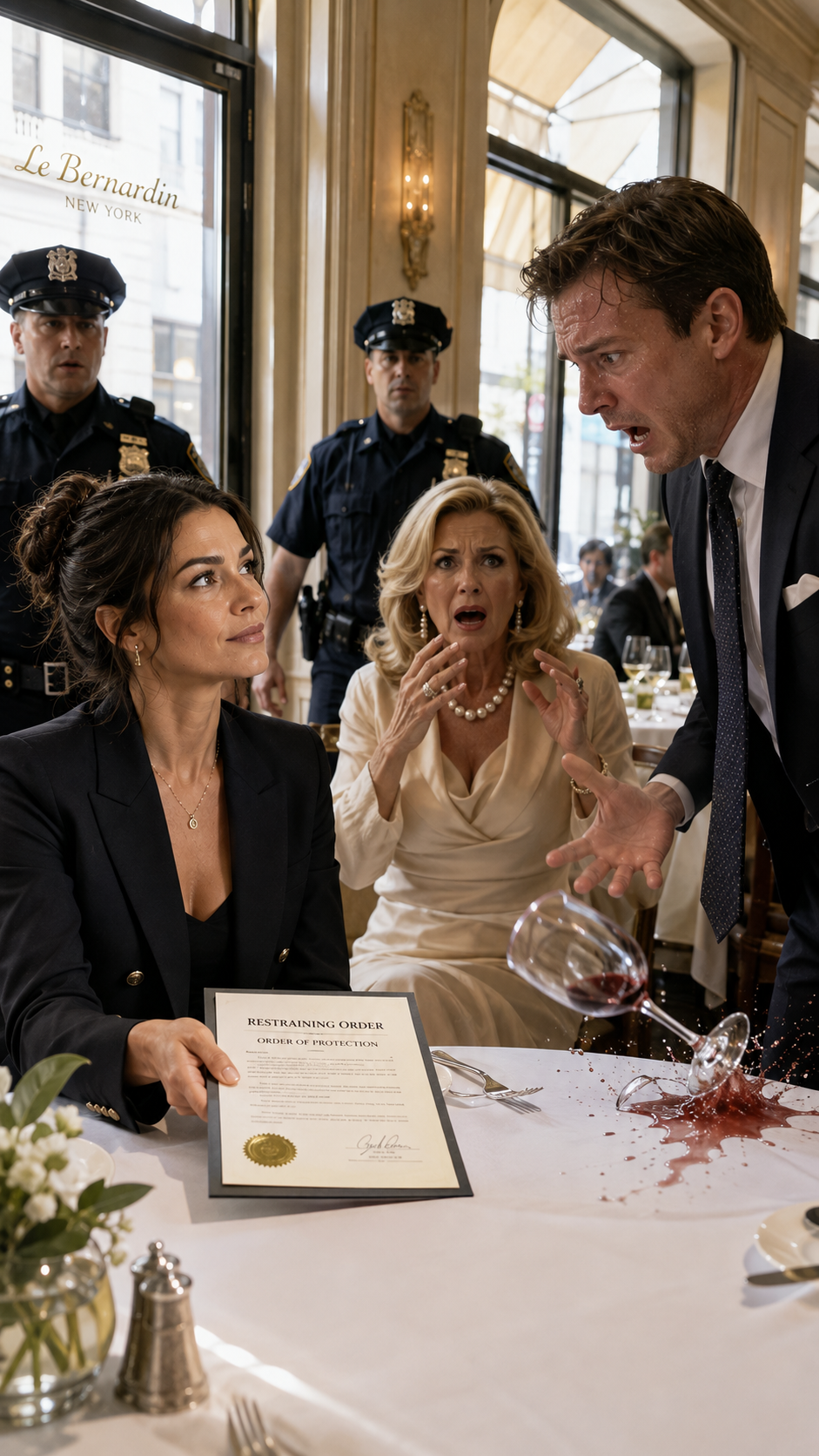
I sat down smoothly on the velvet bench, holding my leather handbag tightly in my lap, feeling the hidden digital voice recorder humming quietly inside my purse.
“Sienna, my dear,” Victoria smiled sweetly, her eyes cold as ice as she reached across the table to squeeze my hand. “We were just discussing your upcoming wedding. You’ve been looking so tired and stressed lately… Julian and I feel you need a dedicated period of rest and medical care before taking on the burdens of marriage.”
Dr. Sterling opened his briefcase, pulling out a familiar white legal folder, and laid it directly on the white tablecloth in front of my plate.
“Mrs. Hayes,” Dr. Sterling said smoothly, offering a practiced, sympathetic smile. “Your fiancé and mother-in-law have expressed deep concern regarding your recent emotional instability and memory blackouts. We have an executive private suite prepared for you tonight at our facility in Albany for a voluntary thirty-day evaluation. A medical transport vehicle is waiting right outside the restaurant.”
Julian reached over, placing his hand over mine, his eyes filled with fake, rehearsed compassion. “It’s for your own good, Sienna. Sign the voluntary intake papers, and let us take care of everything.”
I looked down at the white intake papers on the table, then up into the faces of the three monsters sitting around me.
My heart was beating with a slow, powerful rhythm. I looked Julian dead in the eye, offering a cold, calm, and utterly fearless smile.
“I won’t be signing those papers, Julian,” I said softly, my voice echoing clearly over the quiet restaurant. “Because my colleagues from the City Fraud Division and the NYPD are standing right behind you.”
Julian’s rehearsed smile instantly shattered. His jaw went slack, and the color drained from his face with terrifying speed.
Victoria’s manicured fingers tightened so hard around her wine glass that I thought the stem would snap. “Sienna… what kind of ridiculous game is this?!”
Before Victoria could stand up, Arthur Reed stepped out from the main foyer of the restaurant, accompanied by two uniformed officers from the NYPD Financial Crimes Division and an investigator from the District Attorney’s office.
Arthur placed a heavy, gold-sealed federal warrant directly on top of Dr. Sterling’s medical intake folder.
“Dr. Harrison Sterling?” Arthur announced calmly, his voice ringing across the silent dining room. “You are ordered to step away from the table. The New York State Medical Board has just issued an emergency suspension of your license, and federal agents are currently executing a search warrant at your Albany facility for healthcare fraud and illegal involuntary confinement schemes.”
Dr. Sterling’s face went ghastly white. He snapped his briefcase shut, stood up frantically, and tried to back away toward the kitchen doors, but two officers immediately stepped into his path, blocking his exit.
“Julian!” Victoria shrieked, panic breaking through her pristine socialite facade as she grabbed her son’s arm. “Do something! Tell them who we are!”
Julian stood up, his chair scraping violently against the floorboards, sweat pouring down his forehead. “Sienna! What did you do?! We were trying to help you! You’re sick! You’re out of your mind!”
I stood up slowly from the velvet booth, pulled my laptop from my leather bag, and set it flat on the table, illuminating the screen.
Displayed in high-definition digital clarity were the thirty-seven pages of SIENNA_COMMITMENT_PLAN.PDF, complete with the forensic handwriting analysis report proving Julian had forged my signature using a high-resolution digital scanner.
Beside it were the complete bank ledgers showing Victoria’s $600,000 in defaulted bridge loans and the illegal wire transfers she had pulled from Evelyn Montgomery’s trust account.
“I’m not sick, Julian,” I said, looking him dead in the eye, my voice as sharp as a razor blade. “I’m a forensic accountant. And you left your encrypted hard drive logged in on our kitchen counter four days ago.”
Several high-society restaurant patrons turned in their seats, whispering loudly as they recognized Victoria Vance.
Arthur pulled a second set of documents from his coat. “Victoria Vance, you are under arrest for grand larceny, identity theft, financial elder abuse, and corporate bank fraud.”
“No! This is a lie! This is a conspiracy!” Victoria screamed hysterically, her pearl necklace bouncing against her chest as the female NYPD officer stepped forward and clicked steel handcuffs around her wrists. “Julian! Call our attorney! Call him right now!”
Julian stumbled backward, staring at his mother in absolute horror as she was escorted through the restaurant dining room in handcuffs, past dozens of staring, filming patrons.
He turned back to me, his eyes wide with wild, pathetic desperation, reaching his hands out toward me. “Sienna… babe… please! Listen to me! It was my mother’s idea! She forced me to do it! She said we were going to lose everything if I didn’t get your apartment deed! I love you, Sienna! I swear I love you!”
I looked down at his shaking, desperate hands, then looked up into his eyes with complete, unadulterated coldness.
I unclasped the three-carat diamond engagement ring from my left finger and dropped it straight into his half-empty glass of red wine.
“Our wedding is canceled, Julian,” I whispered. “And so is your life.”
The downfall of Victoria and Julian Vance was swift, absolute, and mercilessly documented across every major news outlet in New York City.
Faced with overwhelming forensic evidence provided by my department, Victoria’s legal defense team completely collapsed within forty-eight hours. She pled guilty to three counts of felony grand larceny, financial elder abuse, and identity theft. The court ordered the complete liquidation of her remaining personal assets to pay full restitution to Evelyn Montgomery and her other elderly victims, and she was sentenced to twelve years in a state correctional facility.
Julian Vance fared no better. Forensic analysis of his laptop revealed he had actively participated in forging my signature, drafting the fraudulent commitment affidavits, and attempting to illegally transfer my real estate assets. He was convicted of forgery, conspiracy to commit unlawful imprisonment, and attempted grand larceny, receiving a six-year prison sentence.
Three weeks after that night at the restaurant—on the exact date that was supposed to be my wedding day—the sun broke bright and clear over Manhattan.
I stood in the center of my sunlit living room, looking out the floor-to-ceiling windows at the city skyline. The air smelled of fresh-cut lilies, clean ocean air, and absolute freedom.
The front door opened, and Arthur Vance walked in, carrying a cup of fresh coffee and a thick leather folder.
“The final property release papers arrived from the county clerk this morning, Sienna,” Arthur smiled warmly, handing me the document. “Your apartment deed is 100% clean, the forged transfer forms have been legally expunged, and the restraining orders against Julian’s family are permanent.”
I took the paper, looking down at my own real, genuine signature written cleanly across the bottom line—complete with the subtle, double-dot stroke my father had taught me years ago.
“Thank you, Arthur,” I said softly.
“What are you going to do now, Sienna?” Arthur asked, leaning against the kitchen counter. “You took two weeks of administrative leave.”
I looked out at the bright, open sky over Manhattan, feeling an unshakeable wave of strength and peace wash over my soul.
“I’m going to pack my bags, Arthur,” I smiled, taking a slow sip of my coffee. “I’m taking a three-week vacation to Paris. And when I come back… I’m going to keep catching monsters.”
I walked over to the kitchen table, closed my laptop, and stepped out onto my private balcony into the warm morning sun, holding my head high, finally free to live the life that was rightfully mine.