At 5:12 on a freezing November morning, I walked into my kitchen and found another woman barefoot in my husband’s sweatshirt, drinking coffee from my wedding china.
When she reached for the sugar bowl without looking and located it instantly on the second shelf, I understood something far worse than a clumsy one-night mistake. She knew my kitchen because she had walked through it before while I was away.
Julian Vance stood beside the Italian marble island in yesterday’s black dress shirt. His collar was open, his sleeves rolled back to his forearms, exposing the dark ink of his family crest. At forty-four, Julian was the kind of man whose name made hardened New York prosecutors reconsider filing charges and made rival business moguls lower their voices in private dining rooms. But that morning, for the first time in nine years of marriage, he looked caught.
“Sienna.” His voice was low, carrying a rare, dangerous hesitation.
The woman turned toward me. She was younger, blonde, and undeniably beautiful, her slender frame lost inside the faded dark-green Columbia sweatshirt I had slept in during our first winter together in a drafty Brooklyn apartment. Her expression cycled rapidly through guilt, fear, and defensive arrogance while I stared silently at the gold-rimmed porcelain mug in her hands.
It was a wedding gift from my mother. It was meant for celebratory mornings, not secret sunrises.
Then I shifted my gaze to Julian.
“I’m leaving.”
Two words. Clean, flat, and absolute.
His expression barely changed—he had spent two decades mastering the art of the unreadable poker face—but I knew him too well to miss the microscopic tightening around his eyes.
“Sienna, wait,” he said, taking a step around the marble counter.
The girl took a quick, nervous sip of her coffee, her hands trembling against the warm porcelain. “Julian, you need to tell her,” she whispered, looking between us like a child waiting for an authority figure to clean up a spill.
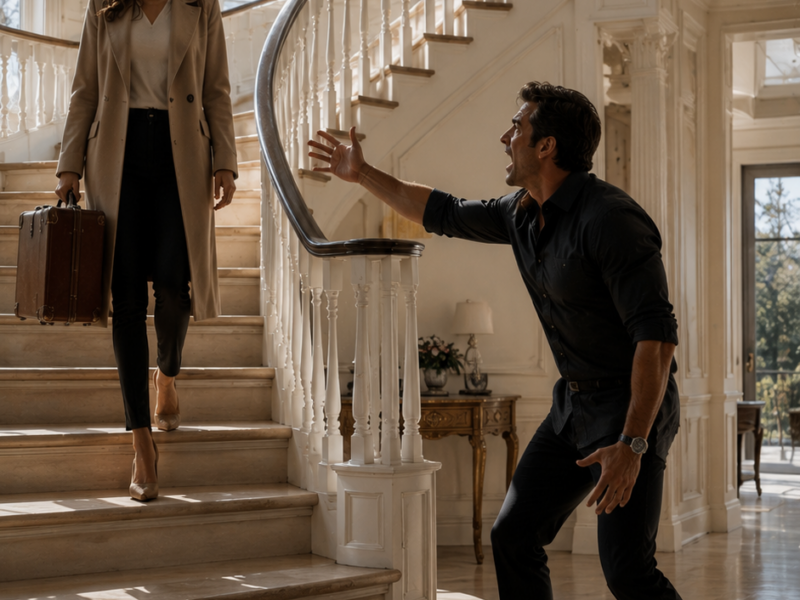
I didn’t stay to hear his explanation. I turned on my heel and walked up the grand spiral staircase, my soft leather slippers making no sound against the white oak steps.
It took me exactly thirty-seven minutes to pack nine years of my life.
I didn’t reach for the designer trunks in the walk-in closet. I pulled down a simple, durable leather suitcase I had bought during my second year of college. I packed two weeks of sensible clothes, my laptop, my address book filled with old professional contacts from my former career as an art conservator, and my grandmother’s simple gold hoop earrings.
I left every piece of diamond jewelry Julian had ever bought me sitting on the dark mahogany vanity.
The three-carat Paris cuff bracelet.
The diamond solitaire necklace from our fifth anniversary.
The tear-drop emerald earrings he had sent upstairs with his driver after disappearing for three straight days without answering his phone.
Those glittering trinkets belonged to a version of Sienna Vance who had accepted expensive, silent apologies because asking direct questions hurt too much.
Finally, I reached for my left hand. I twisted the platinum band set with small baguette diamonds and slid it off my knuckle. The strip of skin beneath it was shockingly pale, soft, and unweathered compared to the rest of my hand—a stark reminder of how long I had been shielded beneath Julian’s shadow.
I placed the ring beside Julian’s custom silver watch and waited for tears to come.
None came.
I had already wept enough over the past twelve months—in hot showers with the water running loud, in parked cars three blocks from our gates, and once inside a locked powder room while eighty guests drank vintage champagne downstairs to celebrate Julian’s latest corporate acquisition.
Grief had been the unbearable period of uncertainty. This moment was simply a decision.
When I reached the top of the staircase with my suitcase in my right hand, Julian was waiting at the landing below. The blonde girl was gone, her lingering scent of sweet floral perfume the only evidence she had ever existed in our home.
Julian’s dark eyes immediately dropped to my left hand.
“Where is your ring, Sienna?”
“Upstairs. On your nightstand.”
Something cracked through his formidable control—a sudden, sharp flash of genuine panic.
“Sienna, please.”
I paused on the third step from the bottom. Julian Vance did not say please. Powerful politicians begged Julian for campaign funding. Men in expensive suits begged Julian for mercy when their debts came due.
“Is she your employee?” I asked, keeping my voice entirely devoid of emotion.
“Yes,” he admitted quietly. “She works in the legal department at the firm.”
“Have you slept with her in this house?”
Silence filled the grand foyer, heavy and suffocating. That silence answered the question far more accurately than any fabricated lie could have.
“How long, Julian?”
He shifted his weight, looking past me toward the floor-to-ceiling glass windows overlooking the frozen garden. “It’s complicated.”
I let out a soft, dry laugh. “No. Mathematics is complicated. Tax law is complicated. That question requires a single number.”
He looked back at me, his jaw clenching tightly.
“Eight months?” I pressed, watching his eyes carefully.
A subtle flicker in his irises gave him away. My stomach turned sickeningly, but I kept my posture rigid. I had guessed correctly.
“Eight months,” I repeated. “You brought her here while I was visiting my sister in Boston.”
“You knew?” Julian’s voice dropped an octave, incredulous. “For how long?”
“I suspected for almost a year,” I said softly.
“Then why didn’t you say anything?” he demanded, taking an urgent step toward the stairs. “Why didn’t you confront me months ago if you knew?”
“Because somewhere along the way, Julian, I became terrified of confirming what I already felt in my gut,” I said, looking down at him. “Because every late-night board meeting, every sudden weekend trip to Miami, every phone flipped face-down on the dinner table slowly trained me to accept a lie just to keep the peace.”
I lifted my suitcase slightly, adjusting my grip on the worn leather handle.
“Because today is the first morning I finally stopped needing your explanation.”
I stepped down onto the marble floor. Julian moved aggressively to block my path to the heavy front doors, his large frame towering over me.
And for the first time in nine years, the most feared man in New York looked utterly terrified that I was about to walk through a door he had no power to lock.
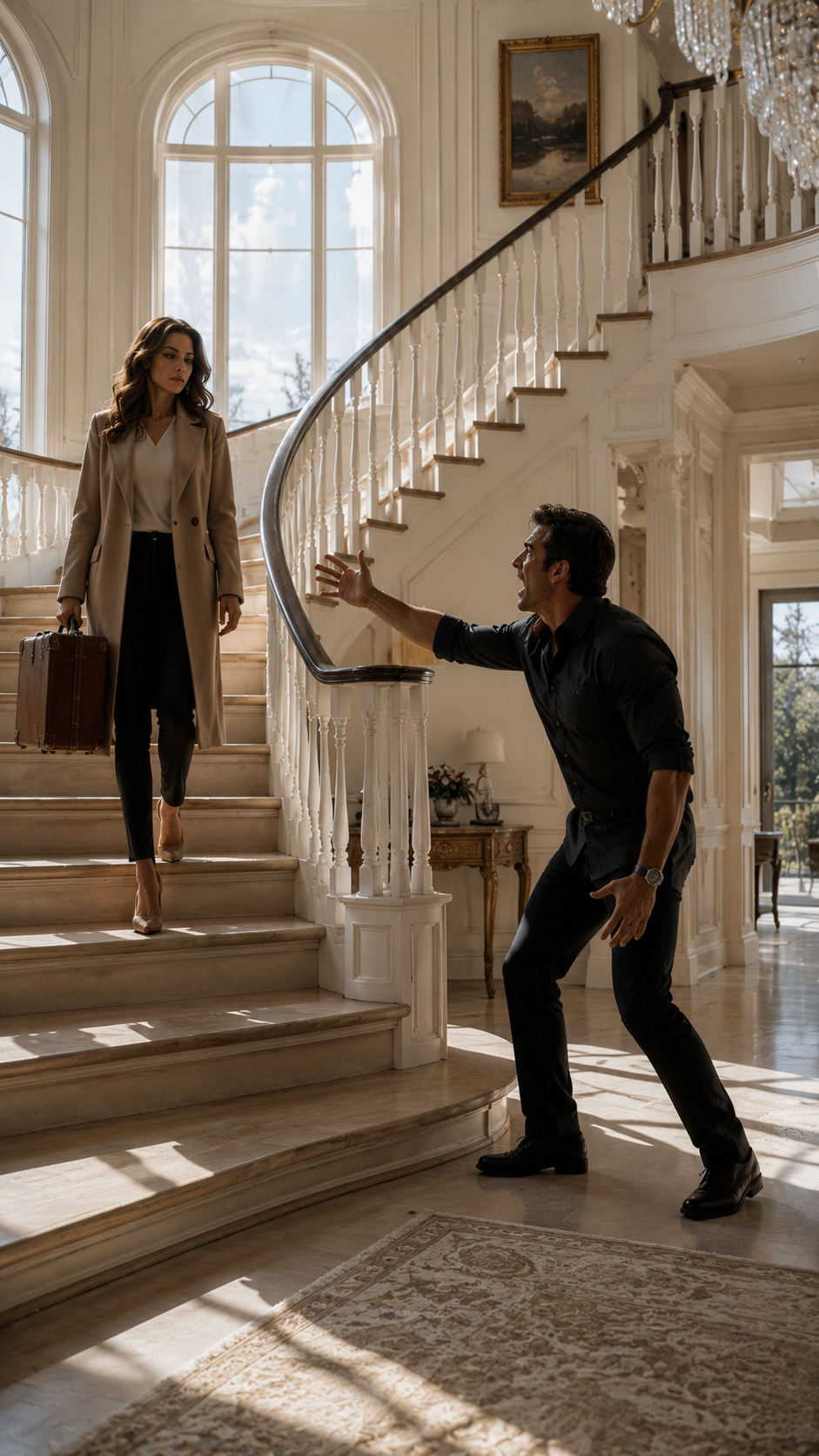
Julian’s hand shot out, catching the edge of my coat sleeve, but his grip was surprisingly gentle—as if he were afraid that applying too much force would break the fragile reality standing between us.
“You aren’t walking out of this house at six in the morning in a freezing rainstorm, Sienna,” he said, his voice dropping into the authoritative tone he used in boardrooms. “We will talk about this like adults. I will fire her today. She will be out of the state by noon.”
I looked down at his fingers on my sleeve until he slowly released his grip.
“You still don’t understand, do you?” I said, looking directly into his eyes. “This isn’t about her, Julian. She is just a symptom of what you’ve become. You built an empire where everyone obeys you, everyone fears you, and everyone can be bought off with a wire transfer or a piece of jewelry. You tried to manage our marriage like one of your subsidiaries.”
“I protected you!” he snapped, his control finally fracturing. “I kept you safe from everything ugly in my world!”
“You isolated me,” I corrected gently. “There’s a difference.”
Without another word, I brushed past him, opened the heavy mahogany front door, and stepped out into the crisp, biting November air. The driver, Arthur, was standing near the idling black sedan, looking thoroughly miserable. When he saw me carrying my own luggage, he hurried forward, his eyes wide with confusion.
“Mrs. Vance, let me take that for you—”
“No thank you, Arthur,” I said kindly. “I’ve called a yellow cab. It’s waiting at the front gate.”
“Sienna!” Julian’s voice echoed off the grand stone driveway as he stepped out onto the porch, unmindful of the freezing drizzle soaking his dark hair. “If you walk through those gates, I will freeze every credit card in your name by eight AM. You won’t have a dime.”
I turned back to look at him one last time, standing on his grand portico like an angry king atop a barren mountain.
“I brought four hundred dollars in cash and my grandmother’s savings account card, Julian,” I called back. “I survived on far less before I met you. Keep your money.”
I walked down the long, winding brick driveway, leaving the iron gates of the Vance estate behind me.
By noon, I was sitting in a tiny, sunlit studio apartment in Park Slope, Brooklyn—a property registered under my maiden name that I had kept secretly maintained for six years. It was modest, furnished with secondhand oak chairs and a small sofa, but as I opened the double windows to let in the cool city air, it smelled entirely of freedom.
My peace, however, was short-lived. By three o’clock that afternoon, two black SUVs with tinted windows pulled up to the curb outside my building.
My doorbell rang three times in rapid succession.
I opened the door to find Marcus, Julian’s chief security officer, standing in the hallway. Marcus was a broad-shouldered man with a scarred jaw who had served as Julian’s right hand for a decade. He looked deeply uncomfortable standing in the narrow hallway of a Brooklyn brownstone.
“Mrs. Vance,” Marcus said respectfully, dipping his head. “Mr. Vance sent me to ensure you are safe. He requests that you return to the estate to discuss the terms of your… separation.”
“Hello, Marcus,” I said calmly, leaning against the doorframe. “You can tell Julian that if he wants to communicate with me, he can do so through my attorney, Eleanor Vance-Roth.”
Marcus winced slightly at the name. Eleanor was Julian’s estranged older sister—a ruthless high-stakes divorce attorney who had spent the last decade tearing apart corporate prenuptials in Manhattan supreme courts.
“Mrs. Vance, please,” Marcus urged quietly. “Mr. Vance hasn’t touched his desk all day. He canceled the merger meeting with the European group. He’s tore up his office. He isn’t acting like himself. He just wants to talk to you.”
“Tell him I’ve already said everything I had to say, Marcus,” I replied softly. “And please don’t park your men outside my building. It upsets the neighbors.”
I closed the door firmly and engaged the deadbolt.
That night, as the city lights flickered across my studio ceiling, my phone lit up on the nightstand. It was a text message from a private number.
I don’t care about the money, Sienna. I don’t care about the firm. Come home. Please.
I stared at the glowing screen for a long time, watching the blinking cursor. For nine years, I would have dropped everything to answer that call. But as I looked at my bare left ring finger, I realized that the woman who loved Julian Vance had died somewhere between 5:12 AM and the moment I stepped onto the subway.
I turned the phone off and went to sleep.
Three months later, the high-ceilinged conference room on the forty-fifth floor of a Midtown skyscraper was suffocatingly quiet.
Winter sunlight poured through the floor-to-ceiling glass windows, illuminating the long mahogany table where eight lawyers in dark suits sat arranged like chess pieces. At the head of the table sat Julian Vance, looking leaner and paler than I had ever seen him. The sharp, immaculate edge he usually projected was dulled; his navy suit hung slightly loose on his shoulders, and dark circles shadowed his piercing eyes.
I sat opposite him, wearing a sharp cream-colored tailored suit, flanked by Eleanor Roth.
“We have reviewed the proposed settlement,” Eleanor said, her voice smooth as polished marble as she slid a thick legal folder across the table. “Mr. Vance’s legal team has offered my client a thirty-million-dollar lump-sum settlement, the penthouse on 5th Avenue, and a fifty-percent equity stake in the Hampton estate.”
Julian didn’t look at his lawyers. His eyes remained fixed entirely on my face.
“It’s a generous offer, Sienna,” Julian said, his voice raspy. “It ensures you will never have to work a day in your life. You can build whatever art foundation you want.”
I looked down at the documents, then pushed them back across the table toward him without opening the binder.
“I’m rejecting the settlement, Julian.”
The lawyers on Julian’s side of the table rustled their papers in sudden surprise. His lead attorney cleared his throat nervously. “Mrs. Vance, with all due respect, this offer exceeds what any court would award you under the terms of your original prenuptial agreement—”
“I don’t want thirty million dollars,” I interrupted, keeping my tone crisp and even. “I don’t want the penthouse, and I certainly don’t want the house in the Hamptons.”
Julian leaned forward, resting his forearms on the table. “Then what do you want, Sienna? Name it. A blank check? The art collection? Tell me what it takes to make this right.”
“You still think every transaction has a price tag,” I said softly, feeling a sudden wave of genuine pity for the man sitting across from me. “I don’t want your blood money, Julian. I don’t want assets built on late-night bribes, corporate intimidation, and compromised ethics.”
I reached into my handbag and pulled out a single sheet of paper, sliding it into the center of the table.
“This is my counter-proposal,” I stated. “I am requesting the release of my original art restoration firm’s intellectual property, three hundred thousand dollars from my own pre-marital inheritance account that was merged into your holding firm, and an immediate, uncontested decree of divorce.”
Silence gripped the room. Julian’s lead attorney stared at the single sheet of paper as if it were written in a foreign language.
“You’re walking away from forty million dollars?” Julian whispered, his voice cracking slightly. “Why?”
“Because as long as I take your money, Julian, I am tied to your ledger,” I answered, looking him dead in the eye. “As long as I live in your houses and spend your wealth, you will always believe that you bought my silence and my forgiveness. I want to own my life again. Completely.”
Julian stared at me, the harsh fluorescent lights highlighting the deep lines of regret etched into his face. For years, he had operated under the belief that everything in this world—loyalty, silence, power, love—could be negotiated, audited, and purchased if the offer was high enough.
Standing before him was the one thing his vast empire could never buy back: a woman who needed nothing he owned.
Slowly, with his hands visibly trembling, Julian picked up his heavy gold fountain pen. His lawyers made subtle motions to stop him, but he waved them off with a single, sharp gesture.
He signed his name on the bottom line of the single-page agreement, the wet black ink soaking into the parchment.
“Is that everything?” he asked, his voice barely audible.
“That’s everything,” I replied.
I stood up, buttoned my blazer, and gathered my coat. I didn’t linger for dramatic goodbyes or lingering glances. I walked out of the conference room, down the marble corridor, and stepped into the glass elevator.
As the elevator descended forty-five floors toward the bustling Manhattan street below, I looked at my reflection in the polished brass doors. The pale line on my ring finger had finally faded under the sun, replaced by healthy, warm skin.
I stepped out through the revolving glass doors into the bright, crisp afternoon sunlight of New York City. The air was cold, clean, and full of endless possibilities. I adjusted my scarf, turned the corner toward my new studio, and began to walk.