She Wrote Seven Words on a Billionaire’s Menu—Then the “Dead” Woman in the Yellow Dress Made Him Drop His Glass.
The fourth time the woman in the yellow dress appeared at Mercer & Stone, Nora Bennett knew something was wrong.
Not unusual. Not inconvenient. Wrong.
The kind of wrong that made the back of her neck prickle before her mind could explain why.
It was 7:18 on a rain-soaked Thursday evening in downtown Chicago, and nearly every table inside the glass-walled restaurant was occupied. Crystal chandeliers threw warm gold across white linen. Silverware gleamed beneath soft lights. Outside, headlights smeared across wet pavement while the Chicago River reflected the city in broken streaks of blue and amber. Inside, people were spending more on dinner than Nora sometimes earned in a week.
And at table twelve, Julian Mercer sat alone. Again.
Thirty-nine years old. Founder of Mercer Capital. Owner of hotels, commercial towers, investment firms, and enough downtown real estate that financial magazines liked to joke he could walk through Chicago without stepping onto property he did not somehow control.
Nora had served him eleven times over the past three months. He was polite. Always. But never warm. He ordered sparkling water without lemon. Steak medium rare. No sauce. Coffee after dinner. Black. He tipped generously without looking at the receipt. And he watched the windows more than he watched people.
There was something unsettling about a man surrounded by so much luxury who seemed permanently prepared for everyone to leave.
That evening, Nora had just placed his water beside him when she noticed security moving toward the entrance. Her hand stopped.
The woman was back.
Soft yellow dress. Old gray coat folded over one arm. Scuffed brown shoes. A small purse clutched against her stomach. Silver hair pinned neatly behind her ears. And that same expression Nora had seen three times before.
Fear. Hope. And something much deeper. Something that looked like grief after it had learned how to survive without making noise.
“Ma’am.”
Derek, the evening security supervisor, stepped directly into her path. The woman stopped.
“I only need a minute.”
Nora heard her voice even from twenty feet away.
Derek shook his head. “You’ve been told not to come back.”
“I know.”
“Then you understand why I’m asking you to leave.”
The woman looked past him. Straight toward Julian. Julian was reading something on his phone. He never looked up.
The woman’s fingers tightened around her purse. “Please.”
Derek’s expression hardened. “Ma’am.”
“I’m not asking him for money.”
Several nearby diners were beginning to notice. The woman realized it too. Her cheeks flushed. “I don’t want anything from him.”
“Then there’s no reason for you to be here.”
Nora’s jaw tightened. That sentence bothered her. Because she had heard versions of it her entire life. People with less money were always assumed to want something from people with more. Attention. Charity. Access. A favor. A handout. It apparently never occurred to anyone that sometimes a frightened person approached a wealthy person because the wealthy person was simply the one they needed to speak to.
The woman swallowed. “My name is Evelyn.”
“I remember.”
“I came Tuesday.”
“And Monday.”
“And Saturday,” Derek said. His voice lowered. “This is the fourth time.”
Evelyn nodded. “I know.” She looked at Julian again. “I just need him to see me.”
Derek stepped farther into her line of sight. “No.”
One word. Flat. Final.
Something inside Nora twisted. Three previous nights flashed through her memory. The first time, Evelyn had stood in the lobby for less than a minute before security escorted her outside. The second time, she had carried an envelope. The third time, she had gotten close enough to the dining room to whisper Julian’s name. Each time she had left quietly. No shouting. No threats. No attempt to force her way inside. Just those trembling hands. And those eyes.
Nora had spent enough years working restaurants to recognize scammers, aggressive customers, desperate opportunists, and people searching for wealthy targets. Evelyn did not behave like any of them. She behaved like someone gathering courage for a conversation that terrified her.
At table twelve, Julian finally looked up. Not toward the entrance. Toward Nora.
“Everything all right?”
Nora realized she had been standing motionless with his menu still under her arm. “Yes, sir.” Her answer came automatically. But her attention returned to the lobby.
Derek was reaching for Evelyn’s elbow. Not violently. But firmly. Evelyn recoiled anyway. “No, please.” Her voice cracked.
That did it.
Nora moved. Her manager saw her immediately. “Nora.”
She stopped. Victor Lang stood beside the service station, expensive suit fitted perfectly around a body that had never carried trays for ten consecutive hours. At forty-six, Victor was general manager of Mercer & Stone and treated the restaurant less like a workplace than his personal kingdom. He monitored servers through cameras. Timed bathroom breaks. Docked premium sections from anyone who questioned him. Reminded staff every week that hundreds of people would “kill for these jobs.” And whenever an important guest arrived, Victor became a different man. Smiling. Bowing. Laughing too loudly. To employees, however, his kindness had strict economic limits.
“What are you doing?” he whispered.
Nora glanced toward Evelyn. “She’s back.”
“I have eyes.”
“She says she only wants to speak to Mr. Mercer.”
“And she has been told no.”
“Maybe someone should ask why.”
Victor’s stare sharpened. “That isn’t your job.”
Nora said nothing.
He leaned closer. “Your job is table twelve.”
“I know.”
“Then do it.”
Nora looked down at the menu beneath her arm. Then toward Evelyn. Derek had turned her toward the doors. Rain streaked the glass beyond them. Evelyn looked so small beneath the enormous marble archway. For one second, her gaze met Nora’s. There was no demand in it. Only resignation. As though this woman had spent most of her life being told that whatever truth she carried could wait.
Nora remembered her mother. Not because Evelyn looked like her. She didn’t. Nora’s mother had been younger, louder, stubborn enough to argue with thunderstorms. But there had been one night, fourteen years earlier, when Nora was sitting in a hospital waiting room in Ohio. Her mother had stood beside a pay phone, clutching a folder of insurance documents while a hospital administrator explained that a procedure would require approval. Nora still remembered her mother’s hand shaking. Not from fear. From humiliation. The administrator had barely looked at her. One human being begging another human being to listen. And the other person already deciding the conversation was inconvenient.
Nora had hated that helplessness. She hated it now.
Victor snapped his fingers softly. “Nora.”
She looked at him. “Table twelve.” Then he walked away.
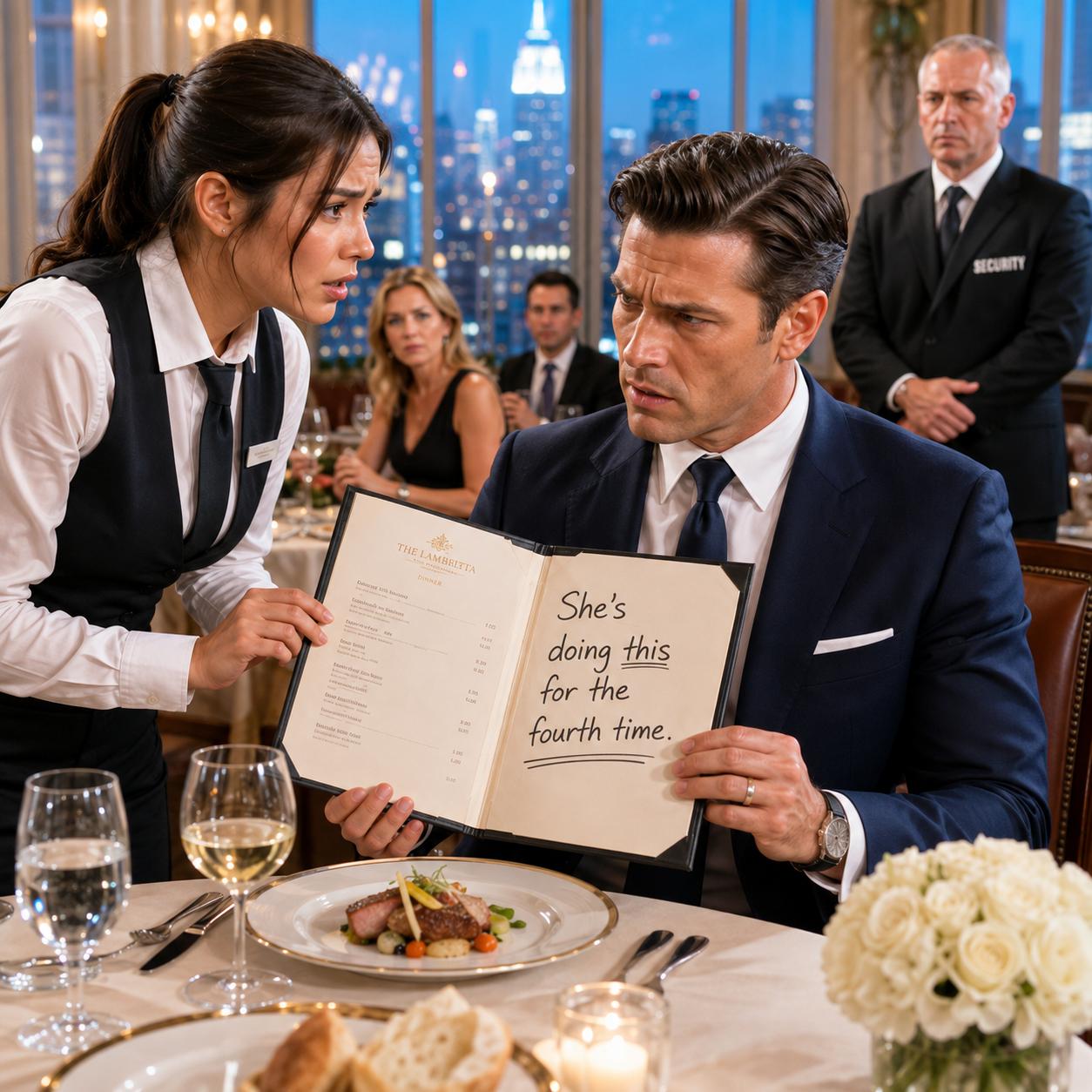
Nora returned to Julian. He was looking at his phone again. She placed the menu in front of him. “Dessert selections, Mr. Mercer.”
“Thank you.”
Her fingers remained on the leather cover. One second. Two. Julian noticed. His eyes lifted. “Something else?”
Nora’s heart pounded. She could hear Victor somewhere behind her. She imagined being called into the office. Losing the Friday dinner section. Losing hours. Losing the job entirely. She was twenty-eight years old. Her rent was due in nine days. Her student loan payment was overdue. Her car had started making a grinding sound every time she turned left. She had exactly $1,842 in savings, and most of it was supposed to cover tuition for the community college classes she had postponed twice already.
Being brave was expensive when you were poor. That was something inspirational speeches rarely mentioned.
Nora withdrew her hand. Julian opened the menu. Then stopped.
Across the blank inside cover, beneath the restaurant’s embossed gold logo, Nora had written seven words in blue ink.
WARNING. SHE’S DOING THIS FOR THE FOURTH TIME.
Julian stared at the sentence. His face changed. Not dramatically. A man like Julian Mercer had spent decades learning how to keep reactions away from witnesses. But Nora saw it. His lips parted slightly. His shoulders went rigid. His thumb froze against the edge of the leather. Then he looked toward the entrance.
Derek had just opened the door. Evelyn stepped toward the rain.
“Wait.”
Julian did not shout. He didn’t need to. Something in his voice traveled through the room with enough force to stop three separate conversations.
Derek turned. Victor turned. Evelyn turned. Julian stood. The chair legs scraped softly across the floor. For the first time since Nora had known him, he looked completely unguarded. He was staring at Evelyn. Not like a millionaire examining a stranger. Like a man staring at a ghost.
Evelyn’s hand rose to her throat. And that was when Julian saw the necklace. A small silver oval rested against her yellow dress. Old. Scratched. Almost ordinary. But Julian’s eyes locked onto it. His water glass slipped from his fingers. It hit the table. Water spilled across the white linen. Nora instinctively grabbed a napkin. Julian didn’t move.
“Nora.” Victor was suddenly beside her. His voice was barely audible. “What did you write?”
She ignored him.
Julian walked forward. Slowly. Every step seemed difficult. Evelyn did not move. Neither did Derek. Julian stopped perhaps six feet away from her. His voice came out rough. “Where did you get that?”
Evelyn looked down at the necklace. Her hand closed around it. “I’ve had it for thirty-one years.”
Julian’s face went white. “No.”
Evelyn’s eyes filled. “Julian.”
He took one step backward. “You don’t know me.”
“I do.”
“No.”
“You have a scar.” He froze. Evelyn’s breath trembled. “Inside your left wrist. When you were six, you fell through the glass door behind our apartment. You needed eleven stitches. You cried because you thought the doctor was going to cut your whole hand off.”
Nora saw Julian’s left hand instinctively close over his wrist. Evelyn’s tears spilled. “And you made me promise you could have chocolate pudding afterward.”
The restaurant disappeared around them. At least that was how it felt. The murmuring stopped. Forks stopped. Even Victor’s face had gone slack.
Julian whispered, “Who are you?”
Evelyn’s mouth opened. Nothing came out. She tried again. “I’m your mother.”
Julian stared at her. Then he laughed. One short, empty sound. “No.”
Evelyn flinched. “You died.”
“I didn’t.”
“You died in St. Louis.”
“I was told you did.”
“You died in the fire.”
“No.”
“I have a death certificate.”
“I know.”
“You’re lying.”
Evelyn closed her eyes. Those words hit her harder than Nora expected. But she did not defend herself. She only reached slowly inside her purse.
What she pulled out was not money. Not a demand letter. Not a photograph for blackmail. It was a small, faded Polaroid, edges soft from years of handling. She held it out with both hands, as if the paper itself might break.
Julian did not take it at first. His breathing had gone shallow. Nora watched the pulse jump in his throat. Then, almost against his will, he reached forward and took the photograph.
Nora could see it from where she stood. A little boy with dark hair and solemn eyes, sitting on a woman’s lap on a cheap floral sofa. The woman wore the same silver oval necklace. The boy’s left wrist was wrapped in white gauze. Chocolate pudding smeared the corner of his mouth. Someone had written on the back in careful blue ink: Julian, age 6. After the stitches. Still my brave boy.
Julian’s hand began to shake. The Polaroid trembled between his fingers. “This… this isn’t possible.”
Evelyn’s voice was barely above a whisper. “They told you I died in the apartment fire in St. Louis. They told me you died in the same fire. The social worker who took you said there were no living relatives. She said the records were sealed. I looked for you for eleven years before they told me to stop. I never stopped.”
Julian’s eyes stayed locked on the photograph. “The fire… the death certificate…”
“Was forged,” Evelyn said. “By the people who wanted you. Your father’s family. They had money. I had nothing. After the divorce they decided a waitress from the South Side was not fit to raise their grandson. The fire was real. The bodies they claimed were us were not. They paid someone to rewrite the paperwork. They paid someone else to make sure I never found you.”
The silence in the dining room felt heavy enough to crush glass. Nora realized she was still holding the wet napkin. Victor had gone completely still. Derek’s hand had dropped from Evelyn’s arm.
Julian finally looked up. His face was the color of the linen tablecloth. “Why now? Why after all this time?”
Evelyn’s fingers twisted the strap of her purse. “Because three months ago I saw your face on the cover of a magazine in a doctor’s waiting room. ‘Chicago’s Quiet Billionaire.’ I almost dropped the magazine. I sat there for an hour just staring. Then I started coming here. I was afraid if I called or wrote a letter they would make me disappear again. I needed you to see me with your own eyes. I needed you to see the necklace.”
Julian’s gaze dropped once more to the silver oval against the yellow fabric. His voice cracked. “I used to fall asleep holding that necklace when I was little. After they told me you were gone. I thought it was the only thing left of you.”
Evelyn’s tears fell freely now. “It was. Until tonight.”
Julian took one more step forward. Then another. The distance between them shrank until only a few feet remained. He did not reach for her. Not yet. Instead he held out the Polaroid with both hands, as if returning something sacred.
“I need to know everything,” he said. “Every name. Every person who lied. Every paper they forged. I need to know who stole thirty-one years from us.”
Evelyn nodded. Her shoulders shook with the effort of remaining upright. “I have the original social worker’s notes. I have letters I wrote that were never delivered. I have the name of the man your father’s family paid. It’s all in a safe-deposit box. I can take you there tonight.”
Julian’s eyes flicked toward Nora for the first time since he had stood. Something unspoken passed between them—gratitude, sharp and sudden. Then he looked back at Evelyn.
“You’re not leaving this restaurant alone,” he said. “Not in the rain. Not ever again if I can help it.”
Victor finally found his voice. “Mr. Mercer, perhaps we should move this conversation somewhere more private—”
Julian’s head turned slowly. The look he gave Victor was the same look Nora imagined he used in boardrooms when someone tried to waste his time. “Victor. Call my driver. Clear the private dining room upstairs. And make sure this woman is treated as my personal guest from this moment forward. Anyone who interferes will answer to me directly.”
Victor swallowed. “Of course, sir.”
Julian turned back to Evelyn. For a long second neither of them spoke. Then he opened his arms—awkwardly, carefully, like a man who had forgotten how the gesture worked. Evelyn stepped into them as if the intervening decades had never existed. Her gray coat slipped from her arm and fell to the polished floor. The silver necklace pressed between them.
Nora stood frozen at table twelve, the wet napkin still clenched in her fist, the menu with her handwritten warning lying open on the white linen. Around them the restaurant slowly began to breathe again. Conversations restarted in careful whispers. Silverware resumed its soft clink. Outside, rain continued to streak the glass.
But something irreversible had shifted inside the room.
Julian pulled back just enough to look at Evelyn’s face. “I’m taking you home with me tonight. We’ll talk. We’ll sort every lie they told. And tomorrow we start making them answer for it.”
Evelyn’s voice was thick. “I don’t want your money, Julian. I never did.”
“I know,” he said. “That’s why you’re getting it anyway. And a lawyer. And whatever else it takes to make sure no one ever erases you again.”
He glanced once more at Nora. This time the gratitude was clear. “Whatever shift you’re working, it’s over. You’re joining us upstairs. I want a full statement of every time this woman was turned away. Names. Dates. Camera footage if it exists. And Nora—” He paused. “Thank you for writing on the menu. Most people would have looked away.”
Nora felt heat rise in her cheeks. “I almost did.”
“But you didn’t.” Julian’s expression softened by a fraction. “That matters more than you know.”
Victor hovered nearby, already calculating the political cost of everything that had just happened. Derek stood by the doors looking like a man who wished the floor would open. The other diners pretended not to stare while staring with every available sense.
Evelyn wiped her eyes with the back of one hand. The silver necklace caught the chandelier light and threw a small, stubborn gleam across the floor. Julian kept one arm around her shoulders as he guided her toward the private elevator that led to the upper dining room. Nora followed a few steps behind, heart still hammering, the menu tucked under her arm like evidence of a crime she was suddenly proud to have committed.
Halfway to the elevator Evelyn stopped. She turned to Nora, took her free hand, and squeezed once—hard. “You didn’t have to help me. Most people never do.”
Nora swallowed. “I know what it looks like when no one listens.”
Evelyn’s eyes shone. “Then you already understand more than most.”
The elevator doors opened. Julian, Evelyn, and Nora stepped inside. As the doors closed, Nora caught one last glimpse of the dining room: the spilled water still darkening the linen at table twelve, the abandoned Polaroid resting beside Julian’s empty glass, and Victor already on his phone, voice low and urgent.
Upstairs, the private dining room was quiet, the city glittering beyond the windows. Julian ordered tea for Evelyn and coffee for himself. He pulled out a chair for her with the careful formality of a man who had just discovered the most important person in his life had been standing in the rain for four nights while he ate steak alone.
Evelyn set her purse on the table and began to speak. Slowly at first. Then faster. Names. Dates. The social worker who had taken the bribe. The uncle who had signed the forged papers. The private investigator she had hired with money scraped from double shifts. The years of searching that had led nowhere until a magazine cover in a doctor’s office changed everything.
Julian listened without interrupting. His left hand stayed closed over the scar on his wrist. Every so often his eyes dropped to the silver necklace as if to confirm it was still real.
Nora sat slightly apart, taking notes on the back of an order pad because Julian had asked her to. She wrote down every detail Evelyn offered. She wrote down the exact times Evelyn had been turned away. She wrote down Victor’s words and Derek’s. She wrote until her hand cramped.
When Evelyn finally fell silent, Julian reached across the table and took both of her hands in his. His voice was low, steady, and absolute.
“They took thirty-one years,” he said. “I’m going to take everything else they care about. Starting tomorrow morning.”
Evelyn’s fingers tightened around his. “You’re not angry that I came here looking like this? That I couldn’t afford nicer clothes or a better story?”
Julian’s laugh was short and broken. “I’m angry at every person who made you believe you needed a better story just to be heard. Including myself, for sitting at that table eleven times and never looking up soon enough.”
Outside, thunder rolled across the Chicago River. Rain hammered the glass. Inside the private dining room, a mother and son who had been told the other was dead began the long, careful work of becoming real to each other again.
Nora finished the last line on her order pad and set the pen down. For the first time in months the grinding noise in her car and the overdue student loan felt distant. She had written seven words on a menu. Those seven words had opened a door that thirty-one years of silence had tried to keep sealed.
She looked at the silver necklace catching the light between them and felt something settle in her chest that was not quite hope and not quite fear.
It was the quiet knowledge that sometimes the smallest act of attention—seeing what others refused to see—was enough to change the shape of an entire life.
And that the fourth time a woman in a yellow dress was almost thrown out into the rain, someone finally refused to look away.