The $100,000 “I Do”: How I Bankrupted My Ex-Husband’s Dream Wedding.
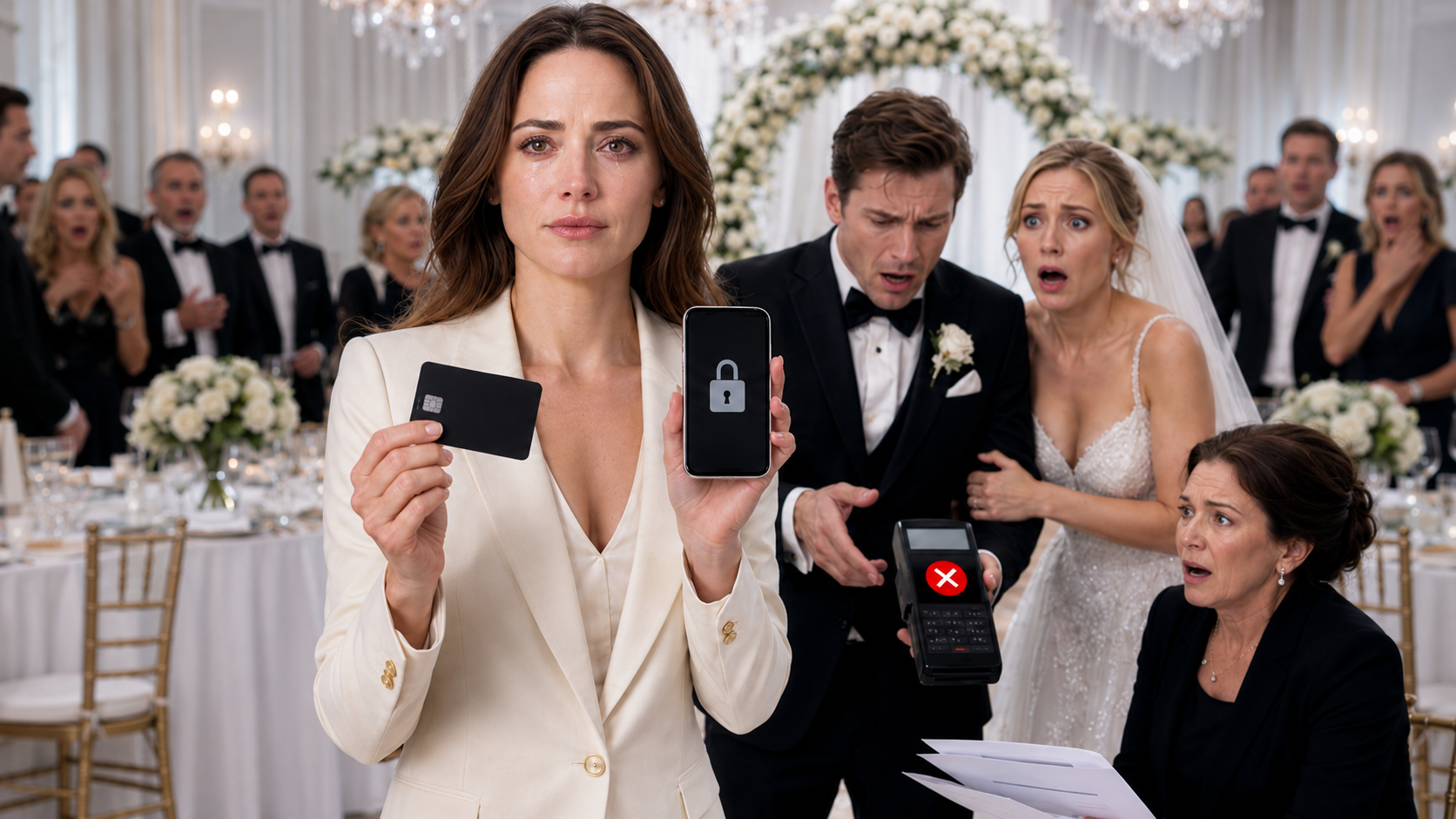
The Grand Aurelia Hotel’s ballroom was a cathedral of manufactured perfection. Three hundred guests sat under crystal chandeliers that dripped with the light of a thousand dreams, most of which were bought on credit. White roses, imported from across the globe, formed a wall around the stage, masking the scent of the decay I knew lay beneath.
My name is Elena. For six years, I was the architect of my ex-husband Julian’s success—and the silent guardian of his failures. Today, I wasn’t a guest. I was the ghost in the machine.
Julian stood beside a seven-tier cake that cost more than a year’s rent in my early days. Beside him stood Maya, a woman who had once borrowed my clothes, cried on my shoulder, and called my mother “Mom” as a joke. She looked radiant in a gown that shimmered with enough diamonds to fund a small revolution. They were the image of a power couple, a love story written in gold ink.
Then, the music stopped. The ballroom manager didn’t shout; he didn’t have to. “Mr. Sterling,” he said, his voice as dry as a desert wind. “The card on file has been declined.”
Julian’s laughter, initially warm, curdled. “There’s a mistake. Run it again. It’s a black card. No limit.”
The manager looked down at his tablet, his expression devoid of empathy. “The account has been permanently closed, sir. It is not an issue with the credit limit. The line of credit no longer exists.”
The silence that followed was heavy, tangible—the sound of a social structure collapsing in real-time. Maya, still clutching the silver cake knife, looked at Julian, her face draining of all color. The panic in her eyes was the most honest thing I had ever seen from her.
Julian scanned the room, his eyes frantic, desperate for a savior. They found me.
I sat at Table 29, tucked away near the back, my dress a sharp, uncompromising black—a funeral attire for a marriage that had died long before the wedding papers were signed. I held a glass of sparkling water, my hands perfectly steady.
Julian pushed through the tables, his face twisting into a mask of fury. He stopped before me, his voice a dangerous hiss. “What did you do, Elena?”
“I didn’t do anything, Julian,” I said, my voice cutting through the growing murmur of the crowd. “We’ve been divorced for three months. Did you truly believe I would keep paying for your life indefinitely?”
Maya rushed over, her dress rustling like dry leaves. “Elena, today is our wedding! How can you be so cruel?”
I stood up, my heels clicking like gunfire against the marble. “Cruel? You’re standing in a $200,000 ceremony, wearing a $20,000 gown, funded by a man who used his ex-wife’s credit card to pay for his new life. The cruelty didn’t start with me, Maya. It started when you walked into my bedroom while I was in New York.”
The ballroom erupted. The whispers became an avalanche.
Julian tried to grab my arm, but I stepped back, my gaze locking onto his. “Don’t touch me. You aren’t just broke tonight, Julian. You’re under investigation.”
The true plot twist wasn’t the bill. It was the fraud. Six months ago, I had hired a forensic accountant. He discovered that Julian and Maya had been using my digital signature and my firm’s letterhead to legitimize her shell company, V-Strategic, effectively laundering $412,000 from the Northgate contract—a deal I had secured for him.
I pulled an envelope from my purse and tossed it onto the table. It wasn’t a wedding gift. It was a formal legal preservation notice from Northgate’s legal department.
Julian’s father, who had been sitting at the head table, walked over, his face unreadable. He looked at the document, then back at his son. “Is this true?”
Julian started to stutter, but his phone, which he had put on speaker to call his finance director, told the truth for him. A cold voice from the other end of the line echoed through the ballroom: “The Northgate audit has begun. We have restricted all non-essential transfers. There is no money for your wedding bill, Julian. And there is no money for payroll.”
The ballroom became a scene of chaotic exodus. Guests began standing up, embarrassed, clutching their coats as if trying to shield themselves from the contagion of Julian’s ruin. The band stopped entirely. The premium bar was locked. The dream was being dismantled, piece by piece, invoice by invoice.
“You’re trying to destroy me!” Julian screamed at me, the facade of the charming entrepreneur finally shattering into a thousand jagged pieces.
“No,” I said, picking up my purse. “I just stopped saving you. There’s a difference.”
I didn’t stay to watch the final act. I walked toward the exit, the weight of six years of “damage control” falling off my shoulders with every step. I didn’t care about the money he lost, the reputation he tarnished, or the woman who had traded my friendship for his shallow affection.
As I pushed through the heavy doors and into the crisp night air of the city, my phone began to chime—a relentless stream of messages from Julian, from his lawyer, from people who suddenly realized I held the keys to their future.
I reached into my pocket, pulled out my phone, and for the first time in my life, I chose the power of “Off.”
The silence that followed was the greatest luxury I had ever owned.