Chilling Thermal Video: Frontier A321 Hits Trespasser on Denver Runway, Triggers Engine Fire and Full Evacuation.
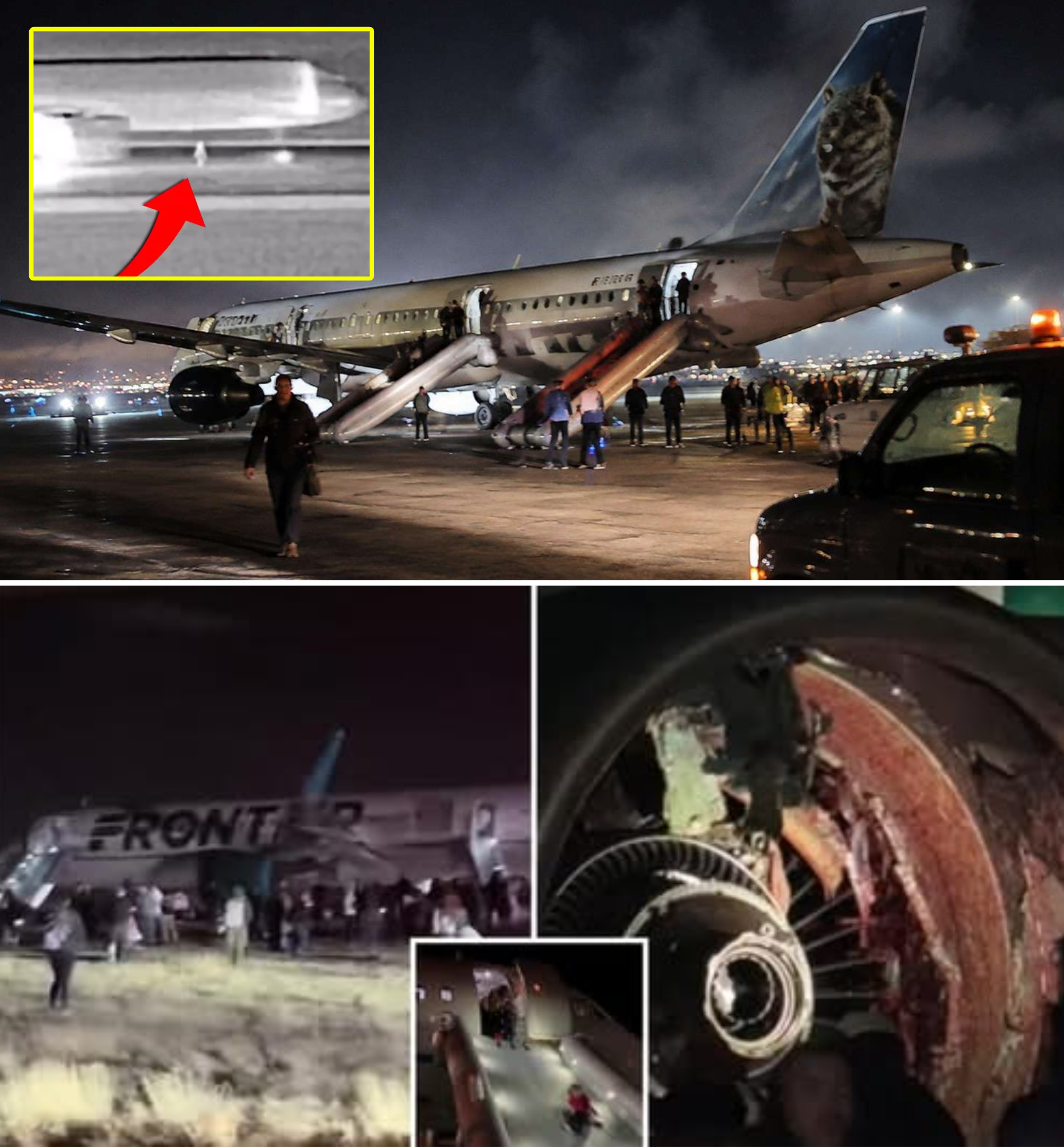
In a terrifying incident that has sent shockwaves through the aviation world, thermal imaging cameras at Denver International Airport captured the dramatic moment a trespasser was struck by a Frontier Airlines Airbus A321 during its takeoff roll on May 8, 2026. The collision on Runway 17L caused a major engine fire, smoke pouring into the passenger cabin, and the rapid emergency evacuation of all 224 passengers and 7 crew members.
The event occurred shortly before 11:20 p.m. MDT as Flight 4345, bound for Los Angeles, was accelerating down the runway. Airport thermal surveillance cameras, designed primarily for perimeter security and wildlife monitoring, recorded the entire sequence in stark infrared. The footage shows a single human figure, glowing faintly against the cold pavement, moving across the wide runway surface. Seconds later, the intense white-hot thermal signature of the Airbus A321’s engines fills the frame as the jet reaches takeoff speed. A sudden bright flare marks the impact near the right engine.
The trespasser, who had scaled the airport’s perimeter fence just minutes earlier, was killed instantly. Airport officials confirmed the individual died at the scene. The identity has not been released pending family notification. How the person managed to breach the fencing at one of America’s largest and most heavily monitored airports remains a critical focus of the ongoing investigation.
Pilots aboard Frontier 4345 reacted swiftly. After the collision, they immediately initiated a rejected takeoff, bringing the heavily fueled aircraft to a halt on the runway. Smoke quickly filled the cabin, forcing the crew to declare an emergency and order a full evacuation. Within moments, emergency slides deployed from all doors. Passengers, many still in shock from the impact and explosion, slid down onto the active runway surrounded by flashing lights from emergency vehicles. Denver Fire crews arrived within minutes and successfully extinguished the right engine fire.
Twelve passengers received treatment for minor injuries sustained during the evacuation, primarily bumps and strains from the slides. Remarkably, no one on board suffered life-threatening harm. The professionalism of the flight crew has drawn widespread praise from aviation experts and passengers alike. One survivor posted on social media: “We heard a loud bang, then smoke everywhere. The crew got us out so fast — true heroes.”
Air traffic control recordings reveal the intensity of the moment. The captain calmly reported the collision and engine fire while working to stop the aircraft safely. The NTSB and FAA launched an immediate investigation, closing Runway 17L for several hours as the damaged Airbus A321 (registration N646FR) was towed away for detailed inspection. The Pratt & Whitney PW1133G engine sustained catastrophic damage from ingesting human remains and debris.
The release of the thermal footage on May 10 and 11 has fueled intense public interest. In the infrared video, the human form appears ghost-like against the dark runway, while the jet’s engines burn with blinding intensity. The moment of impact lasts less than a second but leaves a lasting impression. Aviation safety analysts say this is one of the clearest examples of how thermal cameras can document runway incursions in low-light conditions.
Denver International Airport spans more than 52 square miles with extensive fencing and security systems. Officials have launched a comprehensive review of perimeter protocols, including potential upgrades to AI-powered detection, ground sensors, and rapid-response patrols. Transportation authorities are treating the trespass as deliberate, warning that entering active runways at speed is almost always fatal.
For the 231 people on Flight 4345, what should have been a routine late-night flight turned into a nightmare. Many described the sudden jolt, the smell of smoke, and the rush to evacuate as the scariest moments of their lives. Buses eventually transported passengers back to the terminal, where Frontier arranged alternative flights. The airline expressed deep sorrow for the loss of life while commending its crew and emergency responders.
This incident underscores persistent challenges in airport security despite billions spent on technology and personnel. Runway incursions remain a top concern for global aviation regulators. While most involve aircraft or vehicles, pedestrian breaches like this are rare but extremely dangerous, especially during the critical takeoff phase when stopping distances are long and options are limited.
Experts are now calling for enhanced integration of thermal and radar systems around major airports. Denver, already a leader in airfield technology, may become a testing ground for next-generation perimeter defenses following this event. The successful evacuation also highlights major improvements in aircraft design and crew training since earlier high-profile incidents.
As the NTSB continues its work, questions linger about the trespasser’s motivations. Was it a suicide attempt, a protest, a mental health episode, or something else? Investigators are combing through security logs, nearby camera footage, and any digital trail the individual may have left.
The thermal video has become required viewing in aviation safety circles. It serves as both a haunting record of tragedy and a powerful training tool for pilots, controllers, and security teams. For the traveling public, it is a sobering reminder that even the most routine flight can be disrupted by factors far beyond the cockpit.
Denver International Airport and Frontier Airlines continue to cooperate fully with federal investigators. In the meantime, the aviation community mourns the loss of life while celebrating the fact that 231 people walked away from a high-speed collision that could easily have ended far worse.
This event will likely influence security policy for years to come. The thermal camera footage from Runway 17L stands as a stark visual warning: the layered defenses protecting our skies are only as strong as their weakest link — and sometimes that link is a single fence crossed at the wrong moment.