BEYOND THE BEST FRIEND ZONE: A FORGOTTEN LETTER, AN UNINTENTIONAL CONFESSION, AND A LOVE DECADE IN THE MAKING.
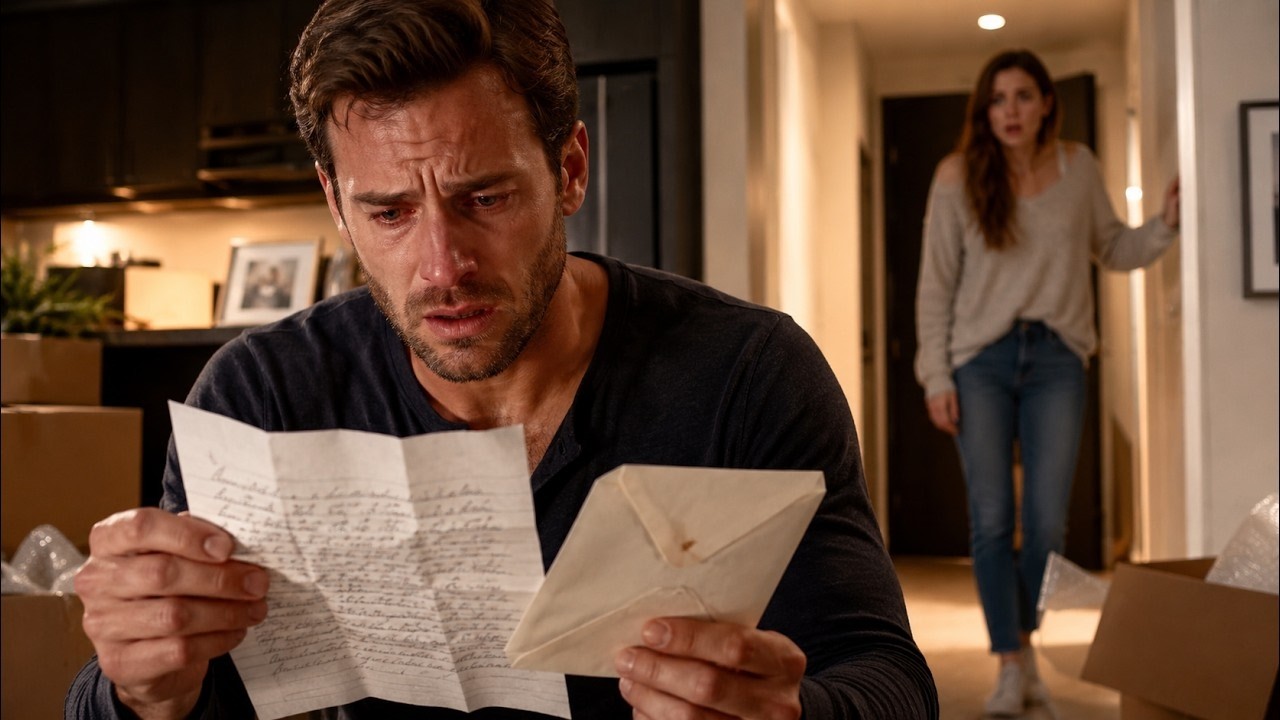
The air in the apartment smelled of cardboard dust, packing tape, and the distinct, melancholy fragrance of an ending. For eight years, I, Julian, had played the most comfortable role of my life: the devoted, reliable, platonic anchor in Sarah’s orbit. I was the man who knew which brand of coffee she hated, the one who held her hair back after a disastrous first date with a man who couldn’t remember her middle name, and the permanent fixture on her living room couch during every Sunday thunderstorm.
We were the “unbreakable pair.” At least, that is what we told everyone who asked why two people in their late twenties spent every holiday together without ever sharing a bed. Everyone assumed we were just too stubborn, too chaotic, or simply too good as friends to ever risk ruining it.
Until the afternoon I started dismantling the bottom of her life.
Sarah was moving to Munich in forty-eight hours to take over as creative director at a massive design firm—the very job she had spent a decade dreaming of. I was kneeling on the scarred hardwood floor of her living room, surrounded by half-packed stacks of thick architectural books, tangled charging cables, and enough bubble wrap to insulate a small aircraft. Sarah was in the kitchen, arguing with a stubborn customer service representative from a national moving van rental company, her voice tight with stress.
I reached out to grab a stack of hardcovers wedged beside a narrow gap near the baseboard. My fingertips brushed against something stiff and flat. Pulling it free, I turned it over in the dim light of the afternoon sun filtering through the windowpanes.
It was a cream-colored envelope. No postmark, no return address. Just my name written in Sarah’s sharp, precise handwriting: Julian.
At first, a warm, reflexive smile tugged at my lips. Sarah was famous for leaving me snarky little post-its around the apartment—Your coffee tastes like burnt engine oil, Buy toothpaste, You owe me seventeen euros for emotional damages. I assumed this was just another parting jab, a humorous note to find after she was gone.
I slipped my thumb under the flap. The adhesive had long since dried and given way; the envelope wasn’t even sealed. A single piece of heavy stationery slid halfway out. Before my brain could process the boundaries of privacy, my eyes caught the opening line:
“Julian, if you’re reading this, then I am likely gone, and I didn’t have the courage to hand it to you myself.”
The room went entirely dead. The chatter from the kitchen radio, the distant hum of traffic on the Hamburg street, the rustle of plastic wrap—everything vanished into a vacuum.
I swallowed hard, my heart hammering against my ribs with the force of a sledgehammer. Just one more line, I lied to myself. The oldest, most destructive lie in the world.
“I tried to stay. I tried to convince myself that being your best friend was enough, that watching you build a life with other women while sitting three feet away from you was a normal price to pay. But I couldn’t stay in Hamburg and keep loving you like this.”
My breath hitched. The paper felt suddenly hot, like a live coal in my palm.
“Julian?“
I snapped my head up. Sarah was standing in the doorway between the kitchen and the living room. Her phone was still clutched in her hand, the screen dark. Her face had drained of every drop of color, leaving her skin stark white against her dark hair. Her eyes darted from my face down to the cream-colored envelope trembling in my hand, and back up again.
Several agonizing seconds ticked by. Neither of us breathed.
“You weren’t supposed to find that,” she whispered, her voice cracking with a terrifying, raw vulnerability.
The Anatomy of an 8-Year Lie
“My name is Julian Vance,” I said aloud, though the words felt like they belonged to a stranger. “And Sarah Hoffmann was my best friend for eight years. Not my girlfriend. Not my ex. Not a near-miss. My best friend. At least, that’s the fairy tale I built a house on.“
We had met when we were twenty-four, colliding in the most cinematic and humiliating way possible in a crowded, rain-drenched café. I had stood up too fast, my heavy leather backpack snagging the corner of her table, sending a ceramic mug of hot black coffee cascading directly across her pristine, open laptop keyboard.
I froze, bracing myself for a volcanic eruption, mentally calculating how many months of freelance work it would take to pay for the damage.
Sarah had stared at the smoking machine, then down at me, and finally back at the screen. She took a slow, deep breath, her eyes narrowing slightly. “Well.“
“Well?” I choked out, my voice squeaking.
“I was looking for an excuse to quit my job and buy a new machine anyway.“
That was the moment. We spent the next three hours drinking bad tea in the rain, and within a month, we were inseparable. Within a year, my mother was asking why we weren’t sharing an apartment. Whenever someone brought it up, Sarah was always the first to step in with a sharp laugh. “No way,” she would say, her eyes flashing with a playful warning. “Julian and I would kill each other within forty-eight hours. He has no patience, and I have zero tolerance for idiots.”
I would always nod along. It was safe. It kept the machinery of our friendship well-oiled and predictable.
We navigated the turbulence of our twenties side by side: bad dates, corporate promotions, terrible apartment move-ins, Sunday morning recovery brunches, and late-night emergency runs. When her father passed away, I stayed in her apartment for nine consecutive days, sleeping on a folding chair and making sure she ate. When I tore my meniscus hiking in the Harz Mountains, she drove three hours each way to pick me up, spending the entire return journey yelling at me about what an absolute fool I was.
And then came the job offer in Munich.
When she called me at midnight three weeks ago to tell me she had landed the creative director position—the pinnacle of her career—my stomach had dropped into a bottomless pit. I had told her she was brilliant, that she would be crazy not to take it. I thought I was being the ultimate, supportive best friend.
Now, kneeling on the floor of her half-empty apartment with her secret confession in my hand, I realized I had just handed her a ticket out of my life, assuming she would never ask me to give her a reason to stay.
“You wrote this,” I said, my voice dangerously low. “When?”
Sarah didn’t look away. She didn’t try to snatch the paper back. She just let her arms fall limply to her sides. “Six months ago. During that winter when you were dating Laura.”
The name hit the air like a splash of ice water. Laura. A brilliant corporate lawyer I had dated for nearly three years, a woman who had come dangerously close to becoming my wife.
“Laura,” I repeated, feeling sick. “What does Laura have to do with this?”
“Everything,” Sarah said bitterly, stepping closer into the center of the room. “She knew, Julian. Everyone who ever spent more than ten minutes around us knew. Except you. You were too busy playing the oblivious, protective big brother to ever look at what was right in front of your face.”
“That’s not fair,” I argued, standing up slowly, towering over her by a head. “You never gave me a hint! You never once said—”
“I gave you a hundred hints!” she interrupted, her voice finally breaking, the tears spilling over her lashes. “Do you remember last Christmas Eve?”
My mind raced backward. “Of course. You spent it with my family.”
“My mother asked if I was seeing anyone special,” Sarah said, her voice trembling. “I told her no. She looked right at you, and then at me, and asked why. I told her I hadn’t found the right person. I was looking right into your eyes when I said it, Julian, and you smiled, clinked your glass of wine, and asked if anyone wanted more roast potatoes!”
The memory struck me with the force of a physical blow. The festive lights, the laughter of my parents, the warm glow of the fireplace—and Sarah, sitting across from me, holding a secret she had carried like a glowing ember.
“And New Year’s?” she continued, pressing her advantage, her voice rising with a desperate, pent-up fury. “When everyone left at one in the morning and I stayed until four? We were sitting on the floor by the sofa. I asked you if you ever thought about getting married. Do you remember what you said?”
My throat tightened. The scene materialized in high-definition clarity.
“Yeah, probably someday,” I had replied, staring into the flickering embers.
“What would she be like?” Sarah had asked, her knees pulled up to her chest.
“Uncomplicated,” I had answered with a smug, youthful arrogance. “Someone easy. Someone who doesn’t come with a manual, where everything just fits without forcing it.”
Sarah had gone completely silent after that. I had thought she was just tired.
“You called me uncomplicated,” Sarah whispered, her eyes shining with unsheethed pain. “You wanted someone easy. And all this time, I was the one who knew every single broken piece of you, every dark mood, every stupid habit—and you wanted a stranger because a stranger wouldn’t make you work for it.”
The Baltic Sea and the Fireplace
“And the Baltic Sea,” I rasped, the words forcing their way past the block in my throat.
Sarah stopped pacing. Her breath caught.
Three months before Laura and I had finally broken up, Sarah and I had rented a tiny, isolated wooden cabin on the coast of Timmendorfer Strand for a long weekend. It had rained for forty-eight hours straight. On the second night, a fierce coastal storm had knocked out the power. We sat in front of the stone fireplace wrapped in woolen blankets, drinking cheap red wine by the light of a dozen melting candles.
Eventually, exhausted by hours of laughing and talking, Sarah had fallen asleep leaning heavily against my shoulder, her cheek pressed against my collarbone.
I remembered sitting there in the dark for more than an hour, too terrified to move a muscle. My arm had gone completely numb, pins and needles biting into my skin, but I refused to shift. I had stared down at her face, illuminated by the orange flicker of the flames, thinking about how natural it felt to hold her. I had thought about leaning down, sliding my hand into her dark hair, and kissing her lips.
Instead, I had paralyzed myself with fear. I told myself I was protecting our friendship. When morning came, I had jumped up, brewed coffee, and pretended I hadn’t spent half the night wondering what my life would look like if I crossed the line.
“You were awake,” I whispered, the realization dawning on me like a sudden sunrise.
Sarah looked down at the floor, a bittersweet, agonizing smile touching her lips. “I woke up about two minutes before you decided to pull away. I kept my eyes closed, waiting for you to do the one thing we both pretended was impossible.”
“Why didn’t you say anything?”
“Because you didn’t kiss me, Julian!” she yelled, the tears finally breaking free, streaming down her cheeks unchecked. “When a man looks at you like that and then turns away, you don’t chase him. You put on your armor, pack your bags, and you accept that you’re just the girl who helps him move his couch!”
The argument hung in the air, heavy and electrified. The apartment felt suffocating. I crossed the remaining distance between us in two long strides, grabbing her by the shoulders. She flinched, but I didn’t let go.
“Laura knew,” I said, my voice dropping to a rough, desperate whisper. “That’s why she left me, isn’t it? On the night we broke up, she told me I had already given my heart to someone else, even if I was too cowardly to admit her name.”
“She told you the truth,” Sarah sobbed against my grip. “And you spent six months hating me for it, thinking I had poisoned your relationship.”
“I didn’t hate you,” I corrected her, my thumb gently brushing a tear from her cheek. “I was terrified of you. Because loving you meant admitting that everything else I had built—every safe relationship, every cautious career move, every wall I put up to keep life clean and predictable—was just a pathetic substitute for the real thing.”
Sarah looked up at me, her chest heaving. “You’re saying this now because I’m leaving. In forty-eight hours, I’ll be three hundred miles south in a city where I don’t know a soul, starting over.”
“Then don’t go.”
“Don’t be ridiculous, Julian,” she snapped, trying to pull away. “I worked my entire life for that position. You told me yourself I’d be crazy to turn it down!”
“I told you that as your best friend!” I shouted back, the frustration bubbling over into absolute desperation. “I didn’t know I was talking to the woman I can’t live without! Let me be something else. Let me be the man who doesn’t let you walk out of this door.”
The silence returned, but this time it wasn’t cold. It was thick with the weight of eight years of unvoiced truths colliding at terminal velocity.
I didn’t give her a chance to form an objection. I slid my hands from her shoulders down to her waist, pulling her flush against my chest. Her breath hitched. For a fraction of a second, her hands hovered against my chest as if to push me away—and then her fingers curled hard into the fabric of my shirt.
When our lips met, it wasn’t a gentle, hesitant exploration. It was a collision. It was messy, desperate, and laden with the unbearable gravity of a decade of near-misses. It felt like breaking through a glass wall I had spent my entire adult life polishing.
Her lips parted, and a soft, broken sound escaped her throat—part sigh, part surrender. My hands tangled in her hair, pulling her closer, tilting her head to deepen the kiss, as if by sheer physical force I could rewrite the last eight years of our cowardice.
When we finally tore apart for air, we were both trembling, our foreheads pressed together, our breaths mingling in the dusty, cardboard-filled room.
The Airport and the Final Envelope
“Well,” Sarah whispered softly, a weak, tear-streaked laugh escaping her lips. “That certainly complicates the moving schedule.”
“I’ve always been terrible at planning,” I murmured, resting my chin against the top of her head. “So, what happens now? You have a flight in two days. A lease signed in Munich.”
“I do,” she agreed, her voice quiet.
“I’m coming with you.”
She pulled back slightly, her dark eyes widening with alarm. “Julian, you can’t just drop your entire life—your clients, your apartment—because of a panic-induced confession on a Tuesday afternoon.”
“I’m not panicking,” I said, my voice steady, the absolute clarity of my decision settling deep into my bones. “For the first time in my life, I know exactly what I’m doing. I’m not asking you to throw away your job, Sarah. Take the position. Be the brilliant creative director you were born to be. But you aren’t going alone. I’ll take a leave of absence, I’ll find work down there, I’ll sleep on a blow-up mattress in your new apartment if I have to. But I am not letting you board that plane thinking you’re leaving me behind.”
Sarah stared at me for a long, searching moment, looking for any sign of hesitation, any trace of the old coward who always chose the safe path. Finding none, a slow, radiant smile broke through the remnants of her tears.
“You’re an absolute idiot, Julian Vance,” she whispered, her voice thick with emotion.
“I know,” I smiled, leaning down to press a soft, lingering kiss to her lips. “But I’m your idiot. Starting right now.”
Two days later, the scene at the Munich terminal of the airport was a chaotic blur of rushing travelers, crying children, and echoing loudspeaker announcements. We stood near the security checkpoint, the weight of our new reality hanging heavily between us.
Sarah adjusted the strap of her carry-on bag, looking up at me with a mixture of nervous excitement and deep affection. “My train leaves for the downtown office in an hour. You’re actually doing this? You rented a temporary sublet?”
“Three blocks away from your new building,” I confirmed, tapping my phone. “And my remote work transfer was approved this morning. I officially start my Munich branch duties on Monday.”
She let out a long, shuddering breath, her eyes sparkling. “You’re insane.”
“Insane is spending eight years sitting on a couch pretending not to love you,” I replied, stepping closer and wrapping my arms around her waist.
Before she could answer, she reached into the front pocket of her jacket, pulled out a small, folded piece of cream-colored stationery, and held it out to me.
“What’s this?” I asked, frowning.
“The rest of the letter,” she said, her cheeks tinting with a faint pink blush. “You only read the first page, Julian. There was more.”
“What did it say?” I asked, a grin tugging at the corners of my mouth.
Sarah smiled, slipping the letter back into her pocket and stepping backward toward the security line. “You’ll have to find it when you unpack my boxes on Saturday. Consider it your punishment for being late to the party.”
“Hey!” I protested, laughing as she turned on her heel, flashed a dazzling, confident smile, and disappeared into the crowd of passengers.
I stood there for a moment, watching the space where she had vanished, feeling an overwhelming sense of lightness settle into my chest. For eight years, I had believed that love had to be simple, predictable, and uncomplicated—a neatly drawn blueprint with no rough edges.
As I turned toward the exit to head to my new temporary home, I realized how wrong I had been. The best things in life aren’t the ones that come easy. They are the ones worth tearing down every wall to finally build together.