COLLISION AT THE CROSSROADS: A NINE-YEAR BETRAYAL ENDS IN THE UNLIKELIEST OF PLACES.
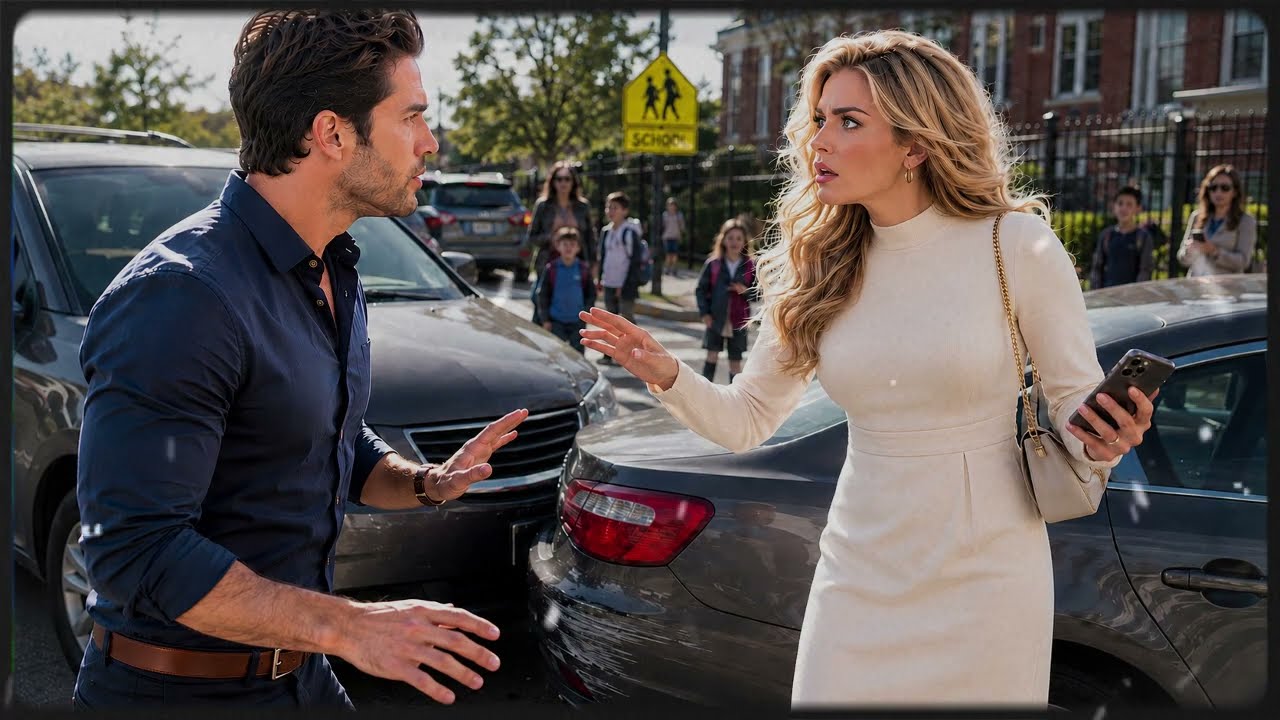
The school pickup line in Millhaven was a ritual, a slow-moving, serpentine dance of minivans and SUVs that defined the pulse of our quiet Michigan town. I, Elias, hated it. I was a high-powered architect from Chicago, a man used to designing skylines and orchestrating million-dollar projects. But here I was, trapped in my sister’s clunky minivan, juggling inhalers and lunch boxes because she was recovering from an emergency surgery.
My life had been a series of strategic maneuvers, efficient and cold. I had left Millhaven nine years ago, leaving behind a fiancée and a life I deemed “too small” for my ambition. I had walked out on Sarah—my Sarah—with nothing but a four-sentence breakup in her parents’ kitchen and a promise of a future that didn’t include her.
I was thinking about Chicago, about the partner-track promotion I was courting, when the minivan lurched forward. I pressed the gas too hard. THUD.
A soft, humiliating bump against the sedan in front of me.
The driver’s door of the sedan flew open. A woman stepped out, her posture rigid, her jaw clenched with the exhaustion of a thousand daily burdens. I rolled down my window, ready to offer a quick insurance apology, when she turned.
Time didn’t just slow down; it stopped. The air in the parking lot curdled.
“Elias?” she whispered. The name hit me like a physical blow. It was Sarah.
Nine years had etched lines of exhaustion around her eyes, but the recognition was electric, immediate, and terrifying. She stood frozen, a ghost from the life I had discarded.
“You’re… you’re driving Miriam’s minivan?” she asked, her voice a hollow echo of the past.
“Temporarily,” I stammered, my hands gripping the steering wheel so hard my knuckles turned white. “My sister… she had an emergency.”
A small boy with Sarah’s eyes and an open backpack scrambled out of the school, looking at our dented bumpers with morbid curiosity. “Did someone die?” he asked solemnly.
Sarah didn’t look at him. She looked at me, a storm of suppressed history raging in her eyes. “We should move the cars, Elias. We’re blocking the line.”
The following weeks were a slow-motion car crash of a different kind. Forced encounters in the pickup line, shared moments of tense, stilted conversation in the repair shop, and the realization that our children—Sarah’s son, Ben, and my niece, Leni—had become inseparable best friends.
Sarah had built a life. She had been married, divorced, and was raising a son who looked for a father figure in every shadow. I was still chasing the “greatness” I thought I was owed.
One afternoon, standing near the school fence, Sarah cornered me. “I need you to think, Elias. Ben is looking for a man he can rely on. He doesn’t need another person in his life who has a return date circled on his calendar.”
“I don’t have a return date,” I lied. The truth was, my return date was exactly six weeks away.
She looked at me, not with anger, but with a crushing, absolute clarity. “Then you’re a bigger liar than I thought.”
The climax hit when the offer came from Boston. A Director position. Everything I had worked ten years to build. A salary that would make Millhaven feel like a distant, insignificant memory. I stood in my sister’s kitchen, the laptop glowing in the dark, the “Accept” button inches from my cursor.
I told Sarah the news in her driveway. She didn’t scream. She didn’t cry. She just went still, the way people do when they are bracing for a final blow.
“Wirst du diesmal mit jemandem darüber reden?” she asked, her voice cutting through the humid evening air. “Or will you decide alone again, like you did nine years ago? You’re very good at that, Elias. You’re efficient.”
“It’s not the same,” I argued, but my voice lacked conviction.
“It is exactly the same,” she said, her eyes glistening. “You didn’t hurt me by leaving. You hurt me by deciding I wasn’t worth the conversation. I would have waited. I would have gone with you. But you didn’t give me the chance.”
I returned to my sister’s house, the house I was supposed to leave in two days. I looked at the blueprints on my desk—designs for a reading nook I had offered to build for the school, a project I’d poured my heart into instead of just my intellect. I realized then that I had been building for the wrong reasons for a decade. I was trying to prove myself to a father who valued salaries over people, and to an ambition that left me empty.
The day before my departure, I called Boston and declined the position. Then, I called Chicago and resigned. It wasn’t a strategic move; it was an act of surrender.
I found Sarah at the pickup line the next day. The lot was nearly empty. I walked up to her, feeling lighter than I had in nearly a decade. I reached into my pocket and pulled out a crumpled receipt from the supermarket. On the back, I had sketched a new house. It was grounded, sturdy, and real.
“I know you kept the napkin,” I said, my voice quiet. “I’m not asking for that plan back. I’m asking to draw a new one. Slower, this time. With you in the room.”
Sarah looked at the drawing, then at me. She didn’t hand it back. She folded it with agonizing care and tucked it into her own jacket pocket, right next to her heart.
“Draw slower,” she whispered, her voice finally losing its defensive edge. “I’m not in a hurry either.”
I realized then that the bump in the parking lot wasn’t an accident. It was an intervention. I had spent nine years being efficient with my life, only to find that the only things worth building are the ones that require you to stay.