The search for Chris Palmer, the 39-year-old Arkansas man who disappeared while hiking with his German Shepherd Zoey along North Carolina’s Outer Banks, has taken a darker turn. National Park Service rangers and volunteer teams recovered a water bottle and backpack confirmed to belong to Palmer, found discarded along a remote coastal trail near where his truck was located. The items’ position—close to the waterline on a stretch of unstable sand and dunes—has dramatically shifted the tone of the operation from cautious optimism to grim determination as rescuers race against an incoming ice storm.
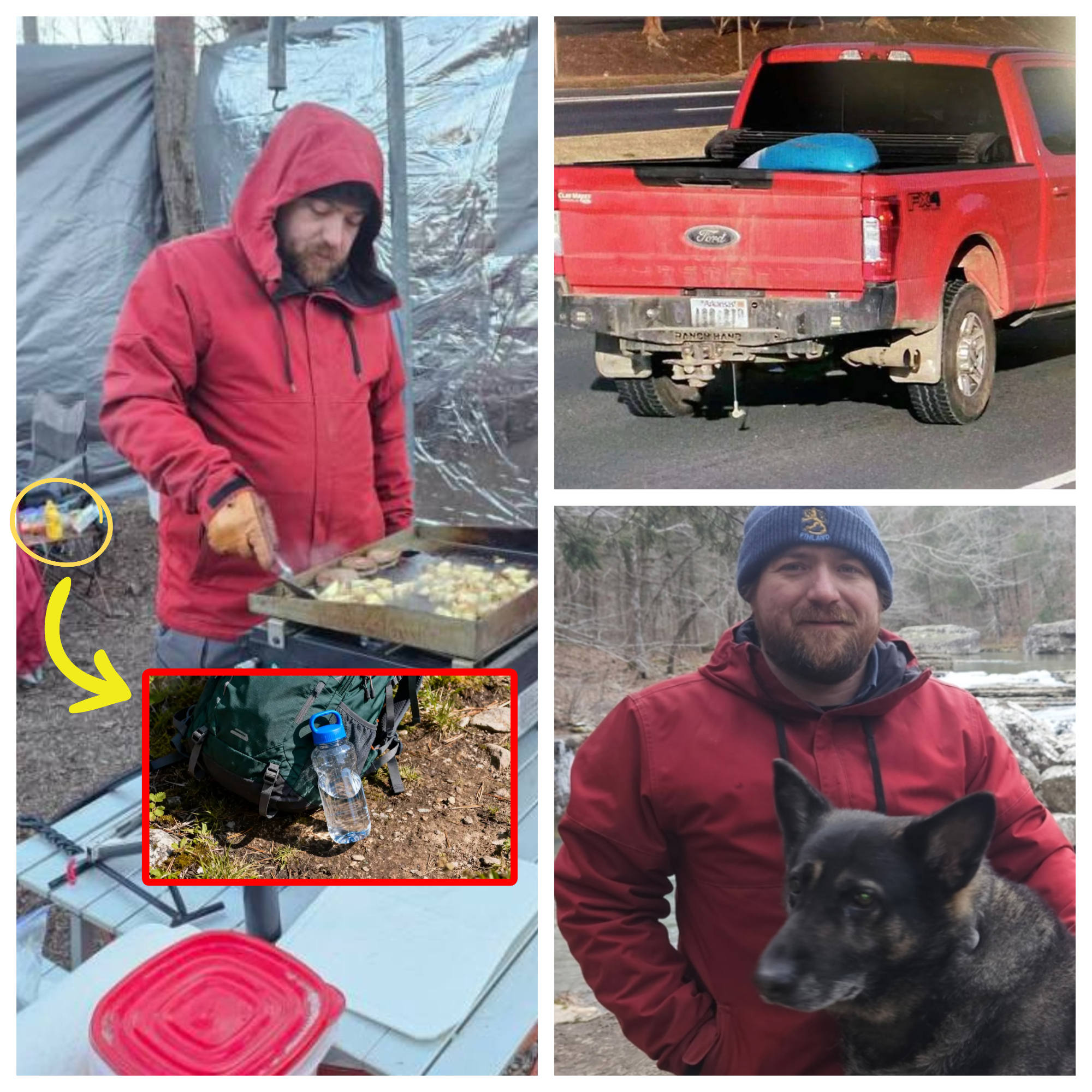
Palmer vanished sometime after January 9, 2026, when he last texted family members that he was enjoying the solitude of his multi-park hiking adventure. His red Ford F-250 was discovered stuck in deep sand on a Buxton beach within Cape Hatteras National Seashore on January 12. Inside were his shotgun, keys, camping equipment, and other belongings, but no sign of Palmer, Zoey, or any immediate evidence of struggle. The truck’s location suggested he may have attempted to drive onto the beach—perhaps to access a more secluded camping spot—only to become immobilized.
Initial searches focused on the possibility that Palmer had ventured inland toward nearby trails or tried to reach a different part of the seashore. Helicopters flew low over marshes and inlets, while ground teams with dogs scoured dunes and scrubland. The United Cajun Navy, alongside dozens of local volunteers, set up command posts and coordinated daily sweeps. Early hopes centered on Zoey: if the dog remained alive and mobile, she could potentially lead searchers to her owner or at least provide a directional clue.
The discovery of the water bottle and backpack changed the equation. Found partially buried in sand just off a narrow footpath that runs parallel to the surf, the items were spotted by a volunteer who noticed the distinctive blue bottle cap protruding from the ground. Rangers quickly secured the scene. The backpack contained a few personal effects—snack wrappers, a small first-aid kit, and a folded map—but no phone, wallet, or identification beyond what matched Palmer’s description. The water bottle was nearly empty, cap loosened as if set down in a hurry.
The location itself has become the focal point of growing concern. The trail ends abruptly at a series of low bluffs overlooking the Atlantic, where strong rip currents and sudden drop-offs make the water extremely dangerous, especially in winter. Search coordinators noted that the backpack appeared to have been deliberately placed rather than scattered by wind or animals. This has led investigators to consider several scenarios: Palmer may have attempted to enter the ocean—perhaps to swim for help after realizing his truck was stuck—or he could have become disoriented, left his pack to lighten his load, and wandered into a hazardous area. Hypothermia remains a leading theory given the sub-freezing overnight temperatures and Palmer’s prolonged exposure.
The timing could not be worse. A powerful ice storm is forecast to move through the Mid-Atlantic and Southeast over the next 48 hours, bringing freezing rain, sleet, and wind gusts up to 50 mph. Forecasters warn that coastal areas could see ice accumulation on roads, power lines, and vegetation, making travel and search operations hazardous or impossible. Teams have accelerated efforts, calling for experienced volunteers with four-wheel-drive vehicles, cold-weather gear, and knowledge of the local tides. Additional drone flights and boat patrols along the shoreline have been requested before visibility and access deteriorate.
Palmer’s family has remained active on social media, sharing updates and pleading for information. His aunt posted a photo of the recovered items with the caption: “These are Chris’s. He wouldn’t leave them behind unless he had no choice. Please keep looking.” The family has emphasized Zoey’s importance—describing her as fiercely loyal and protective—and asked anyone who might spot a German Shepherd wandering alone to report it immediately. Posters and flyers have been distributed across Dare County, from gas stations to bait shops.
The Outer Banks community continues to show extraordinary solidarity. Local businesses have donated fuel, food, and lodging for searchers. Churches have opened their doors as warming stations and coordination hubs. Social media groups have grown to thousands of members, with live streams from search briefings and crowdsourced maps of checked areas. One volunteer shared drone footage showing the exact spot where the backpack was found, sparking intense discussion about possible paths Palmer might have taken from there.
Officials have stressed that the investigation remains open. No evidence of foul play has surfaced—no footprints indicating a struggle, no signs of violence on the items recovered. The case is still treated as a missing endangered person rather than a criminal matter. Yet the absence of any further trace after nearly two weeks weighs heavily. Survival experts point out that without shelter, adequate clothing for prolonged cold, and access to fresh water, the odds diminish rapidly after the first 72 hours, let alone two weeks.
As the storm approaches, the search window narrows. Teams plan round-the-clock shifts until conditions force a stand-down. If Palmer and Zoey are still out there, the next few hours could be decisive. If not, the recovered items may represent the last tangible link to what happened on that lonely stretch of beach.
The water bottle and backpack—ordinary objects in any other context—have become symbols of a heartbreaking mystery. They sit now in evidence storage, photographed, cataloged, and studied for any clue they might still hold. For the family, volunteers, and an entire community holding its breath, those items are both a painful reminder and a faint thread of hope. The plea remains the same: keep looking, keep sharing, keep believing—just a little longer.