“We Tried Everything… But the Tide Came In Too Fast”: Paramedic’s Heartbreaking Testimony at Inquest into Mum-of-Six Saffron Cole-Nottage’s Tragic Death
In a desperate race against the merciless North Sea, emergency crews fought valiantly to save a trapped young mother — only for the rising tide to claim her life in a horrifying tragedy that has left Britain reeling. Saffron Cole-Nottage, a devoted 32-year-old mum-of-six, slipped and fell head-first between massive sea defence rocks on Lowestoft’s Esplanade while walking her dog with her daughter. What should have been a routine evening stroll turned into a nightmare of screaming panic, rising water, and agonising delays that no family should ever endure.
Now, at Suffolk Coroner’s Court, a frontline paramedic has delivered gut-wrenching evidence: the 999 teams gave everything they had, but the tide surged faster than anyone anticipated — and they simply could not reach her in time.
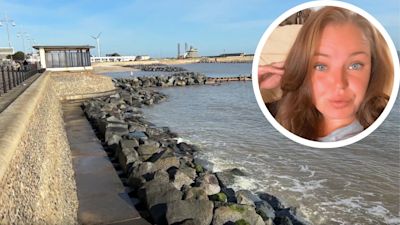
Saffron Cole-Nottage died on February 2, 2025, in the coastal town of Lowestoft, Suffolk. She had been out with her young daughter and their beloved dog along the seafront near The Esplanade. Witnesses described a freak accident: Saffron slipped on the narrow path at the base of the seawall, tumbling head-first into a gap between two enormous boulders. She became wedged tight, upside down, with only her legs visible, screaming in terror as the cold seawater began to lap around her.
Bystanders rushed to help. Two men grabbed her legs and pulled desperately, trying to free her as the tide crept higher. Her daughter watched in horror. Passers-by dialled 999 at around 7:52pm. But what unfolded next has sparked painful questions about emergency response times, communication breakdowns, and whether more could have been done to snatch Saffron from the jaws of the sea.
The initial 999 call handler categorised the incident as an entrapment, dispatching an ambulance but not immediately mobilising the fire service, whose specialist rescue gear and expertise were critical for extricating someone trapped in rocks. It took a critical 18 minutes — some reports suggest up to 30 minutes — before firefighters were finally called. By the time full crews arrived on scene around 8:22pm, precious time had been lost.
Members of the public battled on, ignoring instructions from the operator not to attempt a full rescue themselves. They worked frantically as the tide rose relentlessly. One witness later recalled the moment they realised Saffron had become unresponsive — the sea had claimed its victim while rescuers were still en route.
When firefighters finally reached her, they acted with lightning speed. It took just 20 seconds to free Saffron from the rocks. Paramedics immediately began CPR. But it was too late. She was pronounced dead at the scene. The official cause of death: drowning.
At the inquest, a paramedic involved in the response laid bare the raw frustration and heartbreak of that night. The team “tried everything,” he told the coroner. They improvised, adapted, and pushed themselves to the limit in chaotic conditions. But no one had fully anticipated how quickly the tide would surge in that particular spot beneath the Esplanade. “The water came in faster than expected,” his testimony revealed. Despite their best efforts, the conditions overwhelmed them.
Another emergency worker described the operation as “disjointed” — crews essentially “winged it” amid confusion over exactly what resources were needed. Call handlers later admitted the response was “muddled.” One senior ambulance call leader told the court that, had he taken the initial call, he would have requested the fire service immediately upon learning a person was trapped near water. When asked why that hadn’t happened, he could only reply: “I don’t have an answer for that.”
Saffron’s family has been left devastated. In a moving pen portrait read to the court, her loved ones described her as a “beautiful,” “fun,” and “full of life” mother who was completely devoted to her six children. Her partner, Michael Wheeler, spoke of the indescribable void her death has left. She was a loving mum who had come home earlier that day after a meal, before heading out for what should have been a simple dog walk.
Post-mortem results added another layer of tragedy. Saffron had alcohol in her system at levels that “significantly impaired her cognitive abilities.” While this may have contributed to the initial slip, it does nothing to ease the pain for her children, who must now grow up without their mother.
Lowestoft’s sea defences, designed to protect the town, became the scene of unimaginable horror that night. The boulders beneath the promenade, while effective against erosion, created deadly traps when combined with a rising tide. Signs warn people to stay away from the lower areas, but families and dog walkers still use the paths.
The inquest has shone a harsh light on gaps in the 999 system. Delays in mobilising specialist teams. Confusion over the exact nature of the emergency. A failure to recognise the imminent danger from the tide. Coroner Darren Stewart is examining whether better coordination between ambulance, fire, and coastguard services could have changed the outcome.
Public reaction has been one of shock and sorrow mixed with anger. Many have questioned why it took so long for the right resources to arrive. Others point to the bravery of ordinary people who risked their own safety trying to pull Saffron free while the professionals were still en route. Tributes have poured in across social media, with friends and neighbours remembering a warm, caring woman who lived for her kids.
This is not the first time a tragedy on the UK coastline has exposed weaknesses in emergency response. Rising sea levels and unpredictable tides make incidents like this more dangerous than ever. Yet for Saffron’s family, statistics offer no comfort — only the haunting knowledge that their loved one slipped away while help was just minutes too late.
As the inquest continues, the focus remains on learning lessons that might prevent another family suffering the same fate. Fire services, ambulance trusts, and police are all under scrutiny. Calls are growing for improved training on coastal incidents, faster inter-service communication, and public awareness campaigns about the dangers of sea walls and tides.
Saffron Cole-Nottage was just 32 — a young mum with her whole life ahead. Instead, she became another heartbreaking statistic in Britain’s coastal towns. Her daughter witnessed the horror. Her other children lost their mother in the cruellest way imaginable. And emergency workers, who dedicate their lives to saving others, were left powerless against the unstoppable force of the incoming tide.
The paramedic’s words echo with quiet devastation: they tried everything. They gave their all. But sometimes, even the bravest efforts are no match for nature’s deadly speed.
Lowestoft’s promenade continues to welcome visitors. The sea rolls in and out twice daily, indifferent to the tragedy it caused. But for one family, the waves will forever carry the memory of a devoted mum who never made it home from a simple evening walk.
The coroner’s conclusion is still to come. Whatever the verdict, nothing can bring Saffron back. Her six children will grow up knowing their mother fought until the end — trapped, terrified, but surrounded by strangers who refused to give up on her.
In the end, it wasn’t a lack of courage or compassion that failed Saffron Cole-Nottage. It was the cruel arithmetic of time, tide, and a response system that, on that fateful February evening, simply couldn’t keep up.