PETER BECOMES A MONSTER: The Shocking Mutation Twist in Spider-Man: Brand New Day That Changes Everything
Four years after the heartbreaking events of Spider-Man: No Way Home, Peter Parker thought he had made the ultimate sacrifice. By asking Doctor Strange to cast a spell that erased his identity from the minds of everyone he loved, Peter chose isolation over connection, becoming a ghost in his own city. Now, in Spider-Man: Brand New Day, the consequences of that decision run far deeper than loneliness or forgotten friendships. What begins as the story of a young hero fighting crime alone in a world that no longer knows his name quickly spirals into something far more terrifying: Peter’s own body is turning against him. The spider bite that granted him power years ago is no longer content to lie dormant. It is evolving — and the mutation threatens to transform the friendly neighborhood Spider-Man into something monstrous.
The official trailer for Spider-Man: Brand New Day, released in March 2026, dropped one bombshell after another. Set for theatrical release on July 31, 2026, the film picks up with an adult Peter (Tom Holland) living a solitary life, fully committed to his role as Spider-Man. Without the support network of Aunt May, MJ, Ned, or any of his former allies, he throws himself into protecting New York with relentless intensity. But the pressure of constant vigilance, combined with the lingering effects of Strange’s reality-altering spell, appears to have destabilized something fundamental inside him. Peter begins experiencing blackouts, heightened senses that overwhelm him, and involuntary physical changes that suggest his DNA is rewriting itself.
One of the trailer’s most chilling sequences shows Peter collapsing in his rundown apartment, only to wake up naked and disoriented in an alley, cocooned in thick layers of webbing. The webs are not from his mechanical shooters — they are organic, produced by his own body. This single visual confirms what comic fans have long speculated about: the spider that bit Peter didn’t just give him abilities. It fundamentally altered his genetic code, and now that code is pushing forward into a new, dangerous phase. Bruce Banner (Mark Ruffalo), appearing as a university professor, delivers the grim diagnosis: “If DNA is mutating, that would be enormously dangerous.” Banner, no stranger to unwanted transformations himself, warns that spiders undergo multiple life cycles, leaving them vulnerable during transition — and Peter is caught right in the middle of one.
The mutation is not portrayed as a simple power upgrade. Trailers and early reports describe it as a forced evolution that amplifies Peter’s spider traits at the expense of his humanity. He develops stronger organic webbing, retractable stingers in some descriptions, dramatically enhanced senses that cause painful overloads, and increasingly primal instincts. His human mind struggles to process the flood of new information and urges, leading to moments where he loses control. In one teased sequence, a feral, partially transformed Peter appears to lash out uncontrollably, raising fears that he could become a threat to the very city he protects. Fans immediately drew comparisons to the classic “Man-Spider” storyline from the 1990s animated series, where Peter fully mutates into a grotesque, multi-limbed spider creature driven by pure instinct.
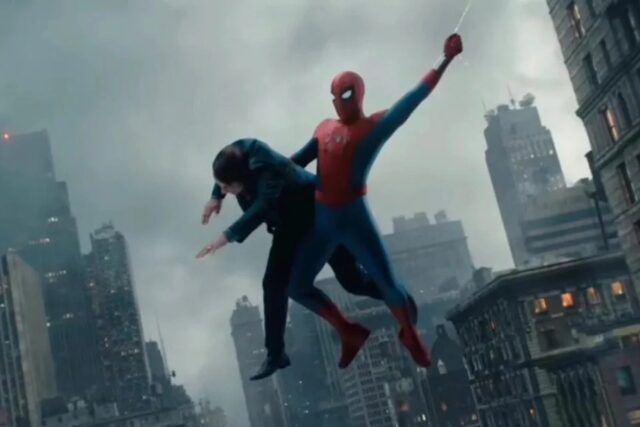
This darker turn makes perfect sense within the context of No Way Home. Doctor Strange’s spell did more than wipe memories — it fractured reality around Peter in ways no one could have predicted. Some theories suggest the magical backlash interacted with his already unstable radioactive spider DNA, accelerating a latent mutation that might have remained dormant for years. The isolation and relentless stress of his solo vigilante life act as the final trigger. Without friends or family to ground him, Peter’s body responds to the overload by pushing his spider side to dominance. It is a brutal reminder that even the most well-intentioned choices can have devastating, unforeseen consequences.
As Peter races to understand and reverse what is happening to him, he seeks help from the one person who might comprehend radical genetic change: Bruce Banner. Their interaction carries heavy emotional weight. Banner, who has no memory of Peter thanks to the spell, treats the desperate young man as just another student at first. Yet the scientist in him cannot ignore the terrifying data. Their collaboration becomes a race against time to stabilize Peter’s DNA before the transformation becomes irreversible. Along the way, Peter crosses paths with Jon Bernthal’s Punisher, who may initially view the increasingly erratic wall-crawler as just another monster to put down. This street-level tension adds grit and moral complexity to what could have been a purely sci-fi horror story.
The mutation plot also sets up larger stakes for the MCU. Brand New Day reportedly leads directly into the events of Avengers: Doomsday and Avengers: Secret Wars. Whatever “cure” or stabilization Peter receives — possibly involving Stark Industries technology or experimental science — is expected to leave lasting physical or psychological aftermath. Fans speculate that this experience could make Peter more powerful but also more vulnerable heading into the multiversal chaos ahead. The trauma of nearly losing himself might deepen his sense of responsibility or push him toward riskier decisions when facing cosmic threats like Doctor Doom.
Director and writers have crafted a story that balances high-stakes action with intimate horror. Peter’s transformation is not just physical — it is deeply psychological. He must confront the fear of becoming the very thing he fights: a creature ruled by instinct rather than conscience. Scenes of sensory overload, where everyday sounds and sensations become unbearable, highlight his growing alienation. The cocoon moments, in particular, evoke body horror and rebirth simultaneously, suggesting that even if Peter survives this ordeal, he will emerge changed forever.
Early reactions to the trailer have been electric, with fans split between excitement and unease. Many praise the boldness of taking Peter in such a visceral direction after years of lighter, more quippy adventures. Others worry about how dark the story might get, but most agree it feels like a natural evolution for a hero who has already lost so much. The visual effects teams appear to have outdone themselves, blending practical and CGI elements to make Peter’s changes feel disturbingly real.
Ultimately, Spider-Man: Brand New Day promises to deliver what fans have come to expect from the MCU’s wall-crawler: heartfelt emotion wrapped in spectacular set pieces. But this time, the greatest enemy may not wear a flamboyant costume or wield advanced technology. It lives inside Peter himself. As he fights to hold onto his humanity while his body demands something far more primal, audiences will be reminded why Spider-Man has always been the most relatable superhero. Great power has always come with great responsibility — but what happens when that power begins to consume the person holding it?
With Tom Holland delivering what many are calling his most committed and layered performance yet, and strong supporting turns from Ruffalo, Bernthal, and a roster of new and returning faces, Brand New Day looks set to redefine Peter Parker for the next era of the MCU. The mutation may be temporary, but its impact will echo through Doomsday and Secret Wars. Peter’s journey from lonely hero to something almost unrecognizable, and back again, could prove to be the most compelling chapter in his story yet.
Get ready for a Spider-Man adventure unlike any before — one where the real monster lurking in the shadows might just be the hero himself.