In the aftermath of one of Australia’s most devastating terrorist attacks in decades, a 43-year-old Syrian-born fruit shop owner has emerged as a symbol of extraordinary bravery. Ahmed al-Ahmed, a father of two living in Sydney’s Sutherland Shire, woke up in St George Hospital this week after sustaining two gunshot wounds while single-handedly disarming one of the gunmen during the deadly mass shooting at Bondi Beach on December 14, 2025.
The attack, which claimed 15 lives and injured dozens more during a Hanukkah celebration attended by members of Sydney’s Jewish community, has shaken the nation. Yet amid the grief, al-Ahmed’s actions—captured on multiple bystander videos that quickly went viral—have inspired millions around the world. Now, for the first time since the incident, al-Ahmed has begun sharing his story from his hospital bed, revealing the deeply human impulse that drove him to run toward danger when others fled.
Al-Ahmed, who had simply stepped out for a coffee with a friend on that warm summer evening, described how the peaceful scene at Bondi Beach shattered in an instant. Gunfire erupted from a footbridge overlooking the Bondi Pavilion, where families and revelers had gathered for the Jewish festival of lights. Two gunmen, later identified as a father-and-son duo allegedly inspired by Islamic State ideology, opened fire on the crowd below.
“I was just trying to enjoy a quiet moment,” al-Ahmed reportedly told visitors through his family and lawyer, his voice still weak from surgery. “Then I heard the shots. People screaming, running. I looked and saw bodies on the ground—women, children, blood everywhere. I couldn’t just stand there.”
What followed was a moment of raw courage that likely saved countless lives. Video footage shows al-Ahmed crouching behind parked cars in a nearby lot, using them as cover as he edged closer to one of the shooters. When the gunman appeared to pause—possibly to reload or adjust his weapon—al-Ahmed seized the opportunity. He charged forward, tackling the armed man from behind in a desperate struggle.
In the chaotic wrestle, al-Ahmed managed to wrench the rifle from the attacker’s grasp. He briefly turned the weapon back on the gunman, forcing him to retreat before raising one hand in surrender to approaching police, making clear he was not a threat. Moments later, shots rang out again as the disarmed attacker retrieved another weapon, but al-Ahmed’s intervention had disrupted the assault at a critical juncture.
Eyewitnesses and authorities believe his actions prevented an even greater massacre. One of the gunmen was later killed in the exchange of fire with police, while the other was hospitalized. But al-Ahmed paid a heavy price: he was shot twice, once in the torso and once in a limb, collapsing as emergency responders rushed to the scene.
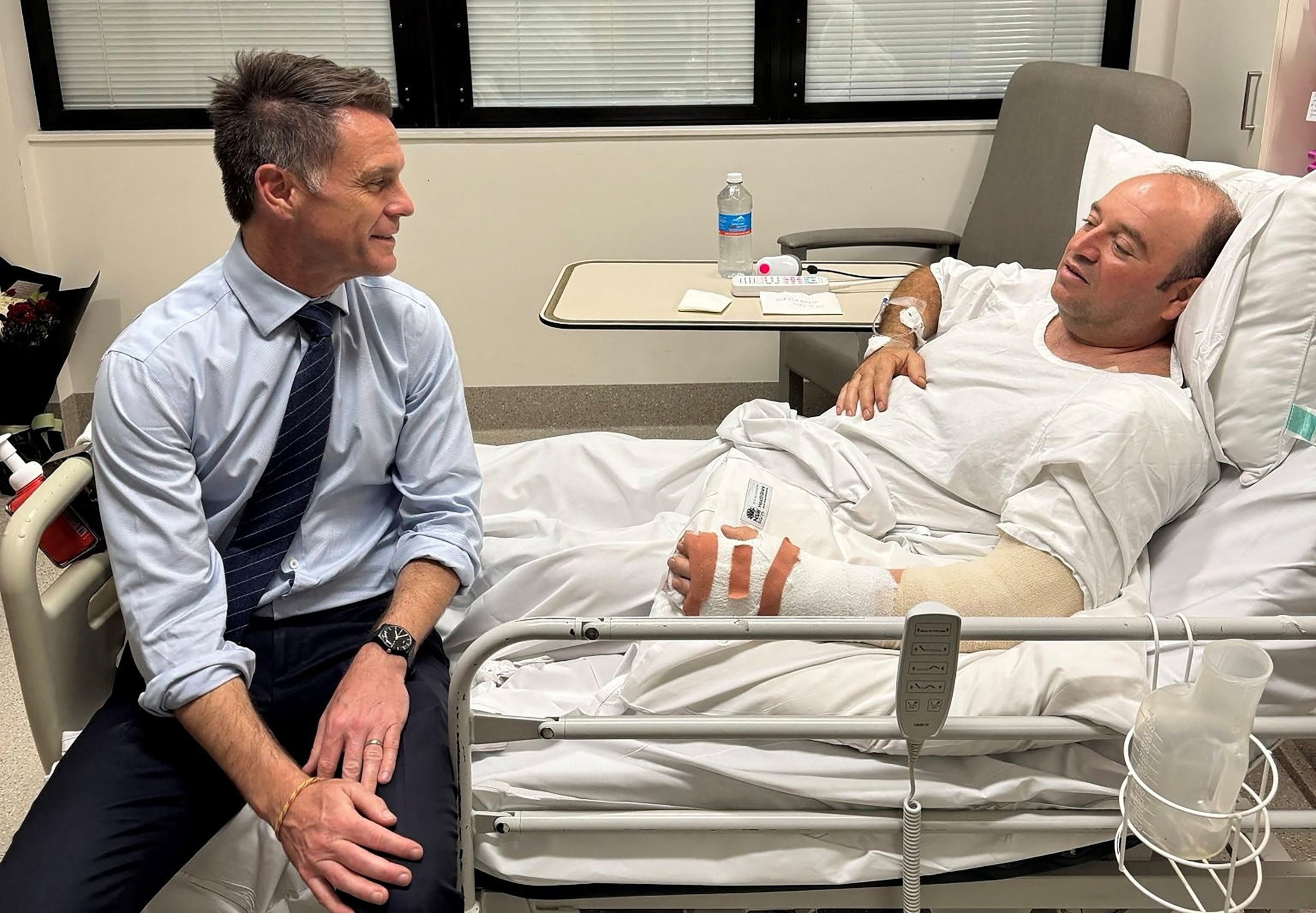
Rushed to St George Hospital in critical condition, al-Ahmed underwent emergency surgery that night and additional procedures in the days that followed. Doctors described his survival as remarkable, given the severity of his injuries. After days in intensive care, he finally regained full consciousness earlier this week, surrounded by his devastated but proud family.
Speaking through intermediaries as he recovers, al-Ahmed has emphasized that his decision was not born of heroism in the moment but of an unbearable sense of conscience. “I saw helpless people lying there, families torn apart,” he shared. “Women and children who had done nothing wrong. I thought, if I do nothing, more will die. It was a matter of conscience—I couldn’t bear to watch innocent lives end while I stood by.”
His cousin, speaking to media outside the hospital, elaborated on the family’s understanding of his mindset. “Ahmed doesn’t discriminate. He would have done the same for anyone—Muslim, Jewish, Christian, anyone. He always says life is sacred. In that moment, he just acted on what he believes: you protect the vulnerable, no matter the cost.”

Al-Ahmed’s background adds layers of poignancy to his story. Born in Idlib, Syria, he fled the war-torn region nearly two decades ago, arriving in Australia seeking a better life. He built a modest existence running a fruit and vegetable shop in Sutherland, becoming a devoted father to his two young daughters and eventually gaining Australian citizenship after a protracted legal battle. His parents, still living in Syria, have expressed overwhelming pride mixed with anguish, telling reporters their son has become a “source of pride for our entire village.”
News of his bravery has resonated far beyond Australia’s shores. In his hometown in Syria, locals have celebrated him as a beacon of humanity amid ongoing conflict. Fundraising efforts exploded almost immediately, with a GoFundMe campaign surpassing $2 million in donations within days. Notably, many contributions came from Jewish donors and organizations, who praised al-Ahmed’s “selfless and instinctive” actions in protecting their community during an attack targeting Jewish celebrants.
Australian Prime Minister Anthony Albanese visited al-Ahmed in hospital shortly after he awoke, clasping his hand and calling him “an Australian hero” whose courage “is an inspiration for all Australians.” Albanese highlighted how al-Ahmed’s intervention embodied the nation’s values of unity and mateship. “He put himself at risk to save others, running toward danger while others ran away,” the Prime Minister said. “This is the best of our country.”
International leaders echoed the sentiment. At a White House event, U.S. President Donald Trump expressed “great respect” for al-Ahmed’s bravery. Britain’s King Charles sent personal thanks, and figures from across the political and religious spectrum lauded him as a counterpoint to the hatred that fueled the attack.
For al-Ahmed himself, the outpouring has been overwhelming. From his hospital bed, surrounded by cards, flowers, and messages of support, he has expressed humility and gratitude. “I am not a hero,” he insisted weakly. “I did what any decent person would do. If it happened again, I would do the same.”
His family, however, knows the road ahead will be long. Doctors have warned of months of rehabilitation, further surgeries, and psychological recovery from the trauma. Yet relatives say al-Ahmed remains resolute, focused on returning to his daughters and his simple life selling fresh produce.
“He’d do it again in a heartbeat,” his father told reporters from Syria. “That’s who he is—he sees suffering and acts.”
In a nation grappling with grief, rising concerns about extremism, and debates over gun control and community safety, al-Ahmed’s story stands out as a powerful reminder of individual courage. A Muslim immigrant risking his life to protect a Jewish gathering from Islamist-inspired violence—this act of defiance against division has united Australians in admiration.
As flowers pile up outside his shuttered shop and tributes adorn the Bondi Pavilion memorial, al-Ahmed’s quiet words from his hospital bed cut through the noise: humanity, at its core, triumphs over hate when ordinary people choose extraordinary action.
The attack may have exposed deep fractures, but al-Ahmed’s awakening—and his unflinching account of why he charged forward—has offered a glimpse of healing. In his survival and his story, many see hope: proof that bravery and compassion can still prevail, even on the darkest days.