These 4 British Royal Tiaras Were Branded “Cursed” for Generations — The Chilling Reasons Finally Explained
Four glittering pieces from the British royal collection have long carried whispers of misfortune. Over decades, patterns of tragedy, flight, and superstition have attached themselves to these headpieces, turning them into objects of fascination and caution. Here is the story behind each one, drawn from historical records.
The most infamous is the Hesse Strawberry Leaf Tiara. Designed by Prince Albert in 1861 as a wedding gift for his daughter Princess Alice, the diamond diadem features delicate foliage and strawberry leaves. Albert never saw her wear it. He died of typhoid fever on December 14, 1861. Alice herself later lost two young children — one from a fall, another to diphtheria — before dying of the same disease on the exact anniversary of her father’s death in 1878, aged just 35.
:max_bytes(150000):strip_icc():focal(745x362:747x364):format(webp)/maria-pavlovna-queen-elizabeth-II-040226-533bd717d278414d8f2e6aaea6070288.jpg)
The tiara passed to her son Ernest. His first marriage ended in divorce after the death of their only child. Years later, in 1937, his daughter-in-law Princess Cecilie of Greece wore the piece to the coronation of King George VI. Shortly afterward, while traveling by plane with family members including Ernest’s second wife, the aircraft crashed. Everyone on board was killed. The tiara was recovered from the wreckage and is now held by the Foundation of the House of Hesse. It has not been worn by the British royal family since.
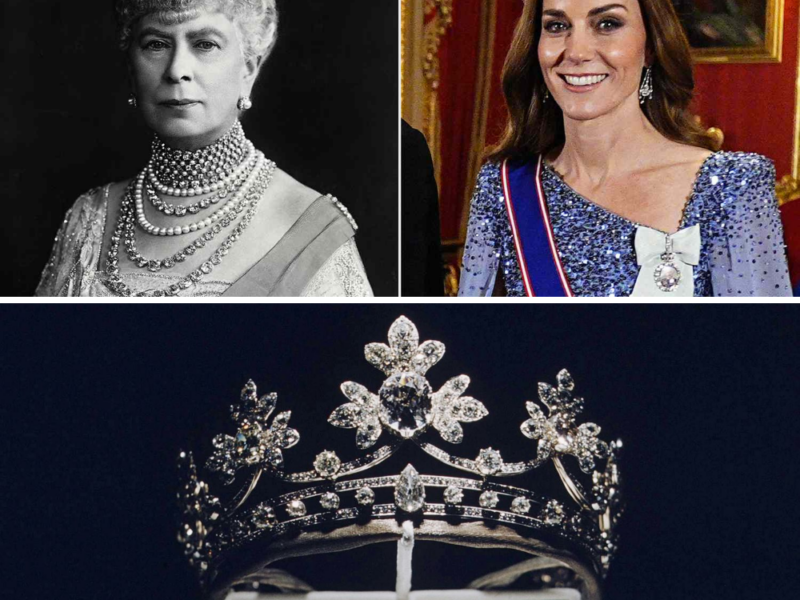
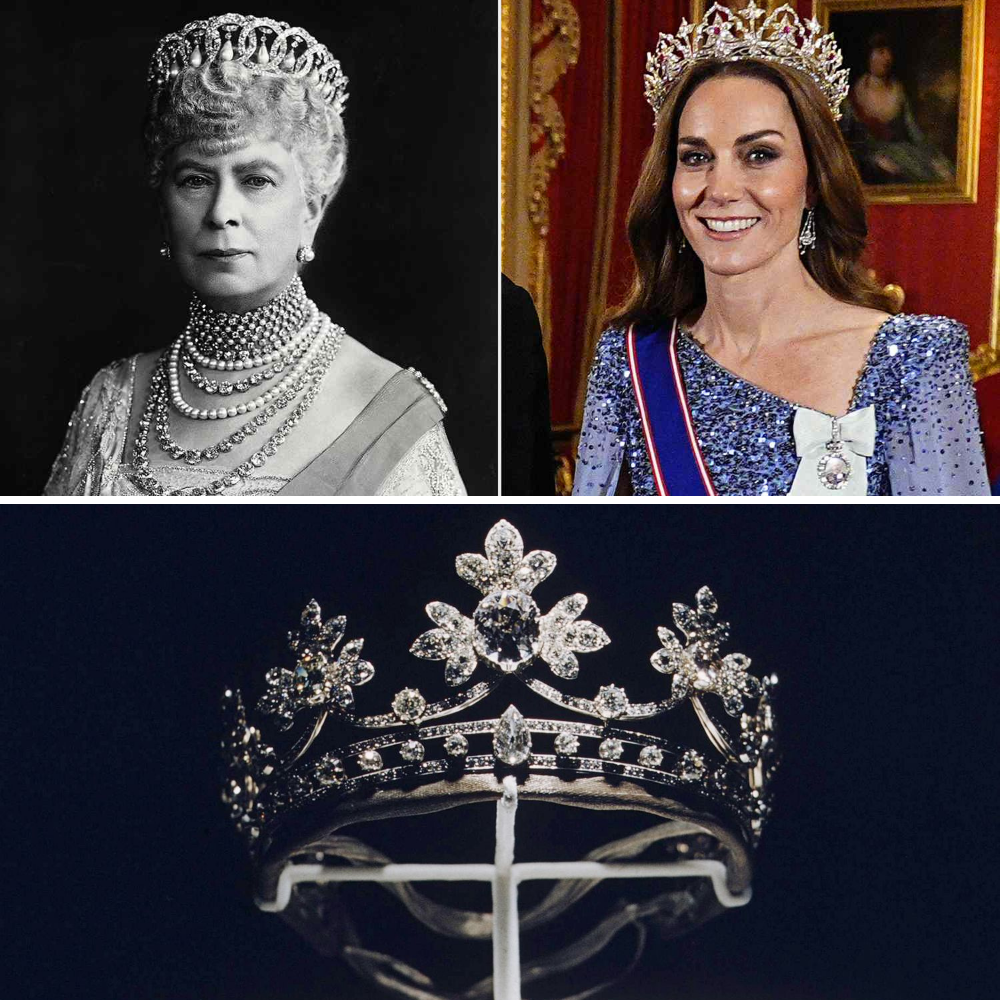
Next is the Oriental Circlet Tiara. Commissioned by Prince Albert for Queen Victoria in 1853, the large piece originally combined thousands of diamonds with opals set in a Mughal-inspired design of lotus flowers and arches. After Victoria’s death, her daughter-in-law Queen Alexandra ordered a major redesign in 1902. The opals were removed and replaced with Burmese rubies. At the time, opals had gained a reputation in fashionable circles for bringing bad luck. The arches were also reduced to make the tiara smaller and more wearable. Victoria’s will stipulated that the circlet should be reserved for queens and future queens. It later belonged to the Queen Mother and then Queen Elizabeth II. Catherine, Princess of Wales, wore the redesigned version at a state banquet in December 2025.
The Grand Duchess Vladimir Tiara carries a different kind of sorrow. Created for Grand Duchess Maria Pavlovna of Russia to celebrate her marriage, the diamond-and-pearl design became a symbol of a collapsing world. After the Russian Revolution and the assassination of Tsar Nicholas II, Maria fled her palace, leaving the tiara behind. Her son later recovered it through a daring retrieval. Maria never saw the piece again. She died in exile in 1920. Her daughter eventually sold it to the British royal family. Queen Elizabeth II made the Vladimir Tiara one of her most frequently worn jewels, even adapting it so the pearls could be swapped for emeralds. It was the last tiara she wore publicly before her death in 2022.
:max_bytes(150000):strip_icc():focal(753x405:755x407):format(webp)/queen-mary-crown-the-queen-mother-040226-ac48602b2f9d422abe5de836f2405d8b.jpg)
Finally, the Koh-i-Noor diamond sits in the crown made for the Queen Mother’s 1937 coronation. The 105-carat stone has a centuries-long history across Indian, Persian, Afghan and Sikh rulers. A persistent legend claims that any man who wears it meets a “grisly” end, while women are said to be protected. Queen Victoria received it in 1849. It was later set into the Queen Mother’s crown, which she wore again at her daughter’s coronation in 1953. The diamond was deliberately left out of Queen Camilla’s coronation crown amid competing claims from India, Iran and Afghanistan. It remains on display with the Crown Jewels in the Tower of London.
None of these pieces are treated as literally cursed by the royal household or serious historians. Yet the repeated association with early deaths, revolution, forced redesigns and dark legends has kept their reputations intact. In a collection famous for beauty and continuity, these four stand out for the shadows they cast.