In the crimson-hued corridors of a theocracy where hope is heresy and every whisper carries the weight of whips, Hulu has cracked open the door to its most anticipated dystopian descent yet: The Testaments. Dropped like a forbidden pamphlet amid the embers of The Handmaid’s Tale‘s sixth and final season, the first-look images from the spin-off—unveiled at CCXP25 in Brazil on December 6, 2025—have ignited a firestorm of fervor among fans. This isn’t a mere sequel; it’s a seismic shift, plunging deeper into Margaret Atwood’s nightmarish Gilead with a coming-of-age ferocity that promises to eclipse the original’s gut-wrenching grip. Set against the regime’s unyielding grip, years after June Osborne’s defiant exodus, The Testaments reframes the apocalypse through the eyes of a new generation of young women—daughters of the damned, raised in red robes and rigid rites, who dare to dream of a world beyond the Wall. With Ann Dowd’s Aunt Lydia returning as a spectral guide turned guardian, and breakout star Chase Infiniti stepping into the fraught shoes of Agnes (the grown-up Hannah, June’s stolen child), these teaser stills tease a tapestry of survival, subversion, and soul-crushing sorrow. Critics and devotees alike are already buzzing: if The Handmaid’s Tale was a scream into the void, The Testaments is the slow suffocation that follows—a masterpiece of muted menace, where every stolen glance and suppressed sob builds to a rebellion that feels both inevitable and impossible. Premiering in April 2026 on Hulu and Disney+, this 10-episode odyssey isn’t just gripping from the first frame; it’s a haunting heirloom to Atwood’s legacy, drawing you into a vortex of heartbreak you’ll never escape.
Born from the ashes of Atwood’s 2019 Booker Prize-winning sequel—co-written in clandestine collaboration with the Handmaid’s Tale TV scribes to bridge book and screen—The Testaments dares to dissect Gilead’s guts from the inside out. Where the original novel and series chronicled the brutal subjugation of fertile women as Handmaids, this chapter pivots to the daughters they’ve left behind, a cohort of teens navigating adolescence under the regime’s iron gaze. The timeline compresses Atwood’s 15-year leap into a taut four-to-five-year window post-Handmaid’s finale, ensuring Hannah/Agnes is a fiery 14-to-16-year-old, her memories of freedom flickering like contraband contrails. No longer the wide-eyed toddler ripped from June’s arms in Season 1, Agnes embodies the inherited trauma: indoctrinated in a Commander’s household, betrothed to a stranger twice her age, her spirit chafing against the pearl-white purity of her Pearl Girl training. The first-look photo of Infiniti as Agnes—poised in a high-necked gown, eyes hollow yet defiant amid a sea of somber sisters—captures this exquisite agony: a girl on the cusp, her handmaid heritage a hidden bomb ticking toward detonation.
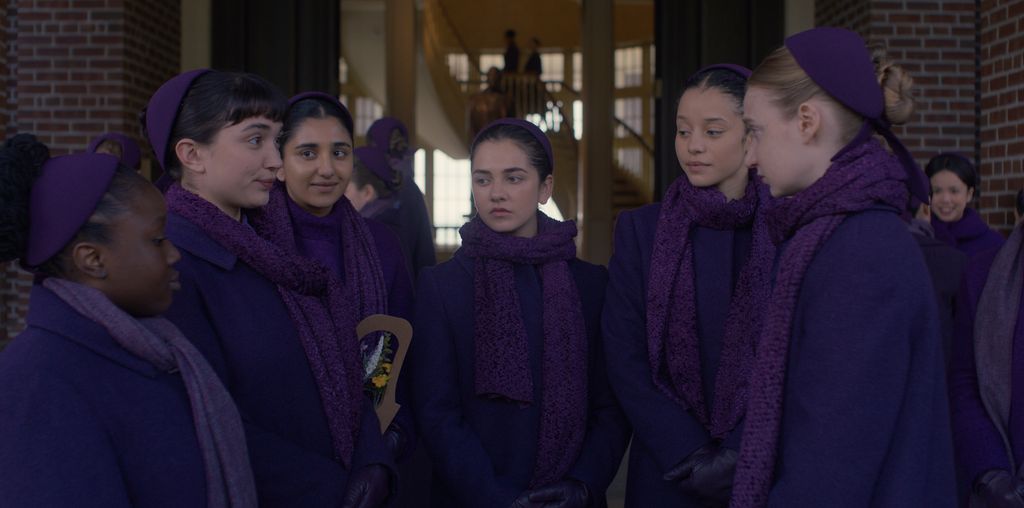
Flanking her is Daisy, portrayed by the luminous Lucy Halliday (The Jetty), a Canadian-raised innocent whose sheltered suburbia shatters when Gilead’s tendrils reach across borders. In the novel, Daisy is Nicole—June’s smuggled infant—now a teen piecing together her origins through underground networks and illicit letters. The series amplifies this exile’s edge, with Halliday’s Daisy glimpsed in the teasers huddled in a dimly lit safehouse, poring over faded polaroids that scream “Mayday.” Her arc is the spark of external rebellion: recruited by Ardua Hall’s clandestine scholars, she becomes a courier for smuggled truths, her wide-eyed wonder curdling into wary wisdom as borders blur and betrayals mount. Then there’s Aunt Lydia, the iron-fisted iconoclast whose evolution from tormentor to tormented has been Handmaid’s most riveting redemption. Ann Dowd, Emmy-hailed for her venomous virtuosity, reprises the role with a weathered ferocity in the first-look shots—her face a map of moral fissures, perched in a Pearl Girl assembly like a queen bee guarding her hive. No longer flogging Handmaids in the colonies, Lydia now shepherds these “chosen” daughters, her protective piety a thin veil over seething subversion. “She’s not rebelling outright,” Dowd confided in a post-finale interview, her voice a velvet blade. “But she’s building something—nurturing these girls like fragile flames, knowing one gust could gutter them all.” In The Testaments, Lydia’s testimonies—penned in secret ledgers—become the narrative glue, her voiceover a confessional chill threading the trio’s tales.
The ensemble blooms around these pillars like thistles in cracked concrete, each bloom a barb against the regime’s facade. Rowan Blanchard (Girl Meets World, Snowflakes) simmers as Shunammite, Agnes’s sharp-tongued confidante and fellow Pearl Girl, her knowing smirks in the teasers hinting at underground dalliances that flirt with forbidden fruit. Mattea Conforti (Power Book III: Raising Kanan) embodies Becka, the rebellious redhead whose scoff at salvation rituals echoes Offred’s early fire, her arc teasing a descent into Ardua Hall’s shadowy academia. Isolde Ardies (Wayward) brings gravitas as a grizzled Gilead matron, while Shechinah Mpumlwana (Lyla in the Loop) and Birva Pandya (The Umbrella Academy) flesh out the Pearl Girls’ ranks with multicultural menace—reminders that the regime’s rot knows no borders. Supporting shadows include Eva Foote as a Mayday operative, Mabel Li as a sly Ardua acolyte, and Amy Seimetz (Ladyworld) in a recurring role as a Canadian handler whose safehouse doubles as Daisy’s crash course in courage. Elisabeth Moss, the eternal June, lurks in the periphery—executive producer and spectral presence, her off-screen machinations seeding cameos that could shatter screens. “June’s the ghost in the machine,” showrunner Bruce Miller teased at a TCA panel. “She’s out there, fighting from the fringes, but her daughters bear the scars she couldn’t spare them.”
Plot-wise, The Testaments is a labyrinth of layered loyalties, where coming-of-age collides with collapse. Episode arcs alternate between Agnes’s cloistered chafing—forced into wifely “tutorials” that reek of ritual rape, her clandestine chats with Becka uncovering buried brutalities—and Daisy’s daring dashes across the no-man’s-land, smuggling microfilmed manifestos that map Gilead’s fractures. Lydia’s ledger entries punctuate the peril, her entries evolving from regime apologia to coded calls for coup. The first-look footage, a 30-second sizzle reel screened at CCXP, opens on a Pearl Girl procession: white-robed acolytes marching through mist-shrouded meadows, chants of “Praised be” undercut by a dissonant drone. Cut to Agnes’s private torment—a locked-room lashing where she claws at her collar, whispering “Nolite te bastardes carborundorum” like a talisman. Daisy’s vignette flashes her fumbling a dead drop in a Toronto tearoom, heart pounding as Eyes lurk in the latte foam. Twists tease tectonic shifts: a Pearl Girl schism that pits loyalty against liberty, Agnes’s betrothal unraveling into a revelation of her true parentage, and Lydia’s ledger leaking like a live wire, igniting alliances that span salvaged states. “It’s darker because it’s domestic,” Miller explained in a Variety deep-dive. “These girls aren’t fighting for survival—they’re fighting for selfhood in a world that defines them as vessels.” Devastating beats abound: a forced fertility rite that scars souls, a Mayday mole unmasked in a birthing chamber, and a climactic convergence where mother and daughters’ paths perilously entwine. Atwood’s epistolary epilogue—two scholars decoding Gilead’s fall—looms as a meta-masterstroke, framing the frenzy as folklore for future feminists.
What elevates The Testaments beyond Handmaid’s harrowing highs is its unflinching focus on the next wave: girls groomed for the grind, their rebellions not born of battle-hardened bitterness but the bewilderment of inherited hell. Atwood, ever the oracle, penned the sequel amid #MeToo’s roar and rising autocracies, infusing it with “tons of hope” through testimonies that defy erasure. “Writing is an act of hope,” she affirmed in a 2019 Paris Review chat, a ethos Miller mirrors by amplifying Ardua Hall’s arachnid intrigue—the underground university where Aunts forge forbidden knowledge, from smuggled sci-fi to subversive semiotics. Visually, director Mike Barker (The Handmaid’s Tale alum) helms the pilot trio with a palette of poisoned pastels: Gilead’s greens gone gangrenous, Pearl whites weeping crimson. Production, greenlit in 2022 and firing up in Toronto’s soundstages last April, clocks a $12 million-per-episode budget that pours into practical oppressions—hand-stitched habits, horse-drawn horrors, and holographic horrors for holographic histories. Executive producers like Warren Littlefield and Sheila Hockin ensure continuity, with Moss’s shingle seeding subtle synergies: a locket from June’s last stand surfacing in Agnes’s attic, a coded quilt signaling safe passage.
The first-look frenzy has fans feral: X threads explode with “This is the gut-punch we needed—Gilead’s not dead, it’s breeding,” while Reddit’s r/HandmaidsTale swells with speculation on Shunammite’s sapphic subplots and Becka’s bookish betrayals. Critics, privy to pilots, crow of “deeper emotional dives” that dissect daughterly dread—how Agnes’s arranged nuptials echo Serena’s silenced screams, Daisy’s diaspora dilemmas mirroring Moira’s marooned rage. In a post-Roe landscape, where bodily autonomy battles ballot boxes, The Testaments lands like lit dynamite: a clarion call to the daughters disinherited, urging them to author their own amen. “If the original was about endurance,” Blanchard posted post-CCXP, “this is about eruption.”
As the teaser’s tolling bells fade—Lydia’s voice intoning, “Blessed be the meek, for they shall inherit the ruins”—The Testaments beckons like a black-market bible. Gripping, gutting, and gloriously grim, it doesn’t just extend Atwood’s empire; it excavates its entrails, unearthing the unbreakable in the broken. For those scarred by Handmaid’s finale—June’s flight a fragile flicker—this spin-off is the storm that follows: a testament to tenacity, where young women wield words as weapons, weaving wills from the wreckage. April 2026 can’t come soon enough; until then, these first-look fragments are forbidden fruit worth the fall. In Gilead’s grip, rebellion isn’t a roar—it’s the rustle of pages turning, the spark of sisters scheming. Praise be: the daughters are rising, and they’ll burn it all to inherit the dawn.