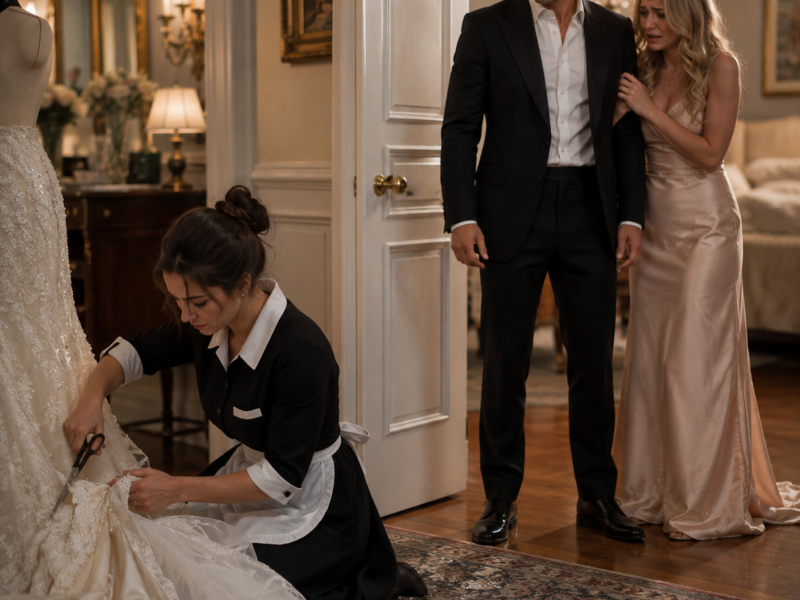
When Arthur Sterling walked into the locked memorial room and saw the new nanny holding scissors over his dead wife’s wedding dress, his first thought was not that his sons were finally crying.
When Arthur Sterling walked into the locked memorial room and saw the new nanny holding scissors over his dead wife’s wedding dress, his first thought was not that his sons were finally crying.
It was that he would destroy her life before sunset.
“What have you done?”
His voice struck the room like thunder.
Nine-year-old Mason and Miles sat on the carpet beside Nora Vance, each clutching a piece of ivory satin. Tears streamed down their identical faces. Behind them, the glass display case that had protected Elena Sterling’s wedding dress for nearly three years stood open.
The gown itself lay across Nora’s lap.
A twelve-inch cut ran through its train.
Nora slowly lowered the scissors.
“Arthur, listen to your sons.”
“I asked you what you did.”
“They asked me to help them.”
“They’re children!”
“They’re grieving children.”
Arthur crossed the room so quickly that both boys flinched.
Nora rose and stepped between them.
That movement made his anger burn hotter.
Ten nannies had come and gone from the Sterling estate in thirty-one days. Some had quit after enduring the twins’ screaming matches, broken lamps, and calculated cruelty. Others had been fired because Arthur believed they lacked patience, discipline, warmth, judgment, or some impossible combination of all four.
Nora had lasted eleven days.
Until now.
“Get away from them,” Arthur said.
“Dad, wait,” Mason pleaded.
Arthur didn’t look at him. His eyes remained fixed on the woman who had entered the one room nobody was allowed to touch.
The room had belonged to Elena.
After her death, Arthur had ordered the staff to preserve it exactly as she had left it. Her books remained arranged beside the window. Her perfume bottles stood on the vanity. Her pale blue robe hung behind the bathroom door.
At the center of the room, inside a custom-made glass case, stood the wedding gown she had worn fifteen years earlier.
It had become more sacred to Arthur than any church altar.
And Nora Vance had cut it apart.
“You’re fired,” he said.
Miles sprang to his feet. “No!”
Arthur’s jaw tightened.
“Both of you, go to your rooms.”
“We’re already in Mom’s room,” Mason said through his tears.
The words struck Arthur somewhere beneath the anger, but he refused to let them show.
Nora gathered the pieces of satin from the carpet.
“I’ll leave,” she said quietly. “But first, you need to read something.”
“I don’t need anything from you.”
“Yes, you do.”
She reached beneath the folded gown and lifted a yellowed envelope.
Arthur stopped breathing.
His name was written across the front.
Not typed.
Not printed.
Written in Elena’s hand.
For one dangerous second, the entire room disappeared around him.
Then suspicion replaced shock.
“Where did you get that?”
“It was sewn into the hem.”
“You opened it?”
“No. Mason did.”
Arthur finally looked at his son.
Mason held up a small seam ripper with a trembling hand.
“We found the lump,” he whispered. “Mom used to hide notes in our coat pockets. I thought maybe…”
His voice broke.
Arthur stared at the envelope.
Three years earlier, Elena had died after an aggressive illness turned a six-month prognosis into seven devastating weeks. Arthur had been in the hospital when she took her final breath, but he had not been holding her hand.
He had been in the hallway arguing with an executive about a merger.
He had returned to the room less than four minutes too late.
Four minutes had become the dividing line of his life.
Before those four minutes, Arthur Sterling had been a husband, a father, and the founder of a rapidly growing technology company.
Afterward, he became only the CEO.
He built Sterling Tech into a multibillion-dollar corporation. He bought competitors, expanded across continents, and appeared on magazine covers beneath headlines about vision, discipline, and ruthless intelligence.
At home, however, he became a stranger who slept beneath the same roof as his sons.
He told himself he was working for them.
The twins understood the truth better than he did.
He was working to avoid them.
Arthur snatched the envelope from Nora’s hand.
“Everyone out.”
“Arthur—”
“Now.”
Nora looked at the boys.
“Go with your father.”
“But he’s going to make you leave,” Miles said.
Nora crouched in front of him. “What happens between your father and me is not your burden.”
“Everybody leaves because of us.”
“No.” Her voice was firm. “Adults make their own choices. You are never responsible for an adult choosing to leave.”
Arthur saw both boys absorb the words.
He also saw how naturally they trusted her.
That frightened him more than the ruined dress.
“Nora,” he warned.
She stood.
The twins walked out reluctantly, turning back twice before disappearing into the hallway. Nora followed, but Arthur caught her arm as she passed.
“Did you plan this?”
She looked down at his hand until he released her.
“I planned to get them to speak honestly.”
“By desecrating my wife’s belongings?”
“Your wife was their mother. They should not need permission to remember her.”
“You know nothing about Elena.”
“I know she loved her children.”
“Don’t say her name.”
“Why? Because it hurts?”
Nora didn’t blink. Her gaze was steady, entirely devoid of the sycophantic deference Arthur was accustomed to receiving from employees, business partners, and the terrified stream of nannies who had preceded her.
“Pain is not a ghost, Arthur,” she said softly. “It’s a tenant. And you’ve locked it in a museum so it can take over the whole house.”
Before Arthur could muster a retort, she walked out, pulling the heavy oak door closed behind her.
The silence that rushed back into the room felt suffocating.
Arthur stood alone in the dim, lavender-scented light of the memorial room. His eyes fell on the glass case, then down to the ruined dress resting on the vanity where Nora had placed it. The twelve-inch gash exposed the inner lining. Sticking out from the cut was a thick seam that had clearly been unpicked.
His hands shook as he looked down at the yellowed envelope in his grasp.
Arthur.
The handwriting was unmistakably Elena’s—hasty, looping, familiar. It was a handwriting he used to see on grocery lists tucked against the refrigerator magnet, or on quick notes left on his office laptop when he stayed too late at the firm.
He tore the flap open, pulled out a folded sheet of heavy cream stationery, and unfolded it under the vanity light.
My dearest Arthur,
If you are reading this, it means the boys found it. Or perhaps the house has finally grown too quiet for you to ignore.
I know why you are building this empire. I know you think that if you accumulate enough power, enough money, enough concrete and steel, you can build a wall high enough to keep death out. You couldn’t save me from the hospital bed. I felt you out in that hallway, Arthur. I didn’t need your apology when you finally walked in. I just needed you to look at me, not at the clock.
Do not punish the boys for breaking my dress. It was just silk and lace, darling. It was a day in the past. But our sons are happening right now, in real-time, and they are drowning in the shadow of a shrine.
They don’t need a monument to a dead mother. They need a father who is actually alive.
Forgive yourself. Forgive the world. And please… stop running.
Forever yours, Elena
The paper slipped from Arthur’s fingers, drifting down to land softly among the satin shards of the wedding gown.
For three years, he had worn his grief like heavy armor. He had convinced himself that strict discipline, absolute control, and unyielding perfection were the only ways to honor his wife and protect his remaining family. Every nanny had been tested against an impossible standard—the ghost of Elena—and every single one had failed because Arthur had designed them to fail.
It was easier to fire them. It was easier to blame them. Because as long as someone else was incompetent, he didn’t have to look in the mirror and face the truth: He was the one who had abandoned his home long before Elena ever drew her last breath.
A sharp, ragged sob broke loose from his throat—a sound he hadn’t made since the night she died.
He sank down onto the edge of the velvet bench, burying his face in his hands as the years of carefully constructed walls finally fractured. The cold, unyielding CEO of Sterling Tech dissolved, leaving only a broken, exhausted man who realized he was on the verge of losing his children, too.
Downstairs, the house was eerily quiet.
Arthur walked out of the memorial room, his footsteps heavy against the polished hardwood of the corridor. He pushed open the door to the twins’ shared bedroom.
Mason and Miles were sitting on the edge of the lower bunk, huddled close together, whispering in low, frightened tones. When they saw him in the doorway, they instantly stiffened, expecting the wrath of the man they had come to view more as a warden than a father.
Arthur stopped a few feet away. He didn’t order them to stand. He didn’t raise his voice.
Instead, for the first time in three years, he knelt down to their eye level.
The boys stared at him, bewildered by the redness in his eyes and the complete absence of anger in his posture.
“I read the letter,” Arthur said, his voice raspy and barely above a whisper.
Mason swallowed hard. “Are you going to fire her?”
Arthur looked at his eldest son—who possessed Elena’s sharp brown eyes—and felt a profound wave of shame.
“No,” Arthur said softly. “No, I’m not firing her.”
Miles blinked, suspicious. “Really?”
“Really.” Arthur reached out, hesitating for a fraction of a second before placing a tentative, awkward hand on Mason’s small shoulder. The boy didn’t flinch away. “And… I’m sorry. For the way I’ve been. For the rules. For this house.”
Mason’s lower lip quivered. “We didn’t mean to ruin Mom’s dress, Dad. We just… we missed her so much. We wanted a piece of her to keep in our pockets, like she used to do for us.”
Arthur pulled both boys toward him, wrapping his arms around their small frames. The dam broke completely, and as he held his sons tightly against his chest, the heavy armor of his past finally shattered into dust.
“I know,” Arthur murmured into Mason’s hair, tears finally falling freely down his cheeks. “I missed her too. But we’re going to remember her together now. Not just locked in a room upstairs… but out here, where life is happening.”
Ten minutes later, Arthur found Nora in the expansive, modern kitchen. She was packing a small canvas duffel bag by the island counter, her movements efficient and composed.
She didn’t look up as footsteps approached.
“I’m leaving, Arthur. You don’t have to show me the door.”
“I’m not showing you the door,” Arthur said.
Nora paused, zipping the bag halfway, and finally looked at him. Her expression was guarded, ready for a fight.
Arthur stood in the center of the kitchen, his posture entirely changed—no longer stiff with defensive arrogance, but grounded, vulnerable, and real.
“I read what she wrote,” Arthur said quietly. “And she was right about everything. Especially about you.”
Nora raised an eyebrow. “Is that an apology?”
A faint, self-deprecating smile touched the corners of Arthur’s mouth.
“It’s a start. Eleven nannies in thirty-one days. Every single one of them walked away because I made this house a prison.” He took a step closer. “I don’t want you to leave, Nora. The boys need you. And God help me… I think I do too.”
Nora studied him for a long moment, searching his face for the shadow of the tyrant who had screamed at her an hour ago. What she found instead was a man who had finally woken up from a three-year nightmare.
She slowly let go of the duffel bag zipper.
“If I stay,” Nora said, her voice carrying a quiet, unshakable strength, “we throw out the rulebook. No locked doors. No shrines. And you eat dinner with your sons every single night.”
Arthur looked down the hallway toward the stairs, where two little boys were peeking around the corner, watching anxiously to see if their world was about to shatter again. He looked back at Nora, feeling a lightness in his chest he hadn’t experienced since before the hospital clock ticked past four minutes too late.
“Deal,” Arthur said.
For the first time in years, the Sterling estate wasn’t just a house.
It was a home.