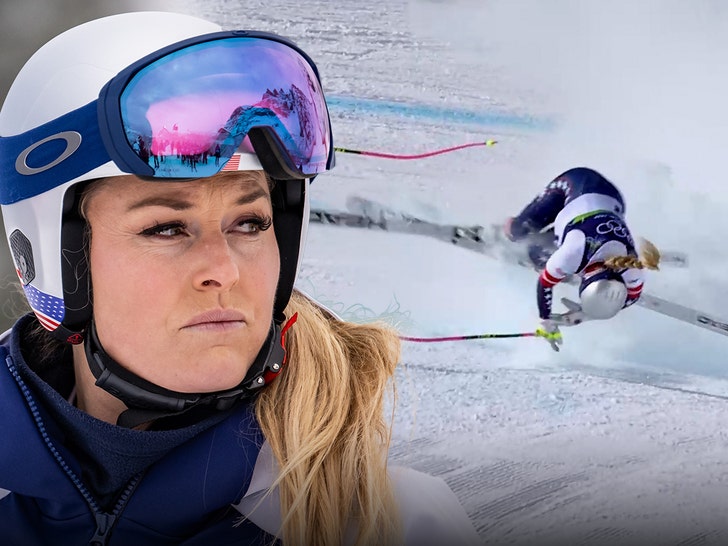
The roar of the crowd faded into a stunned hush as Lindsey Vonn, the queen of downhill skiing, launched herself from the start gate at Cortina d’Ampezzo on February 8, 2026. Under a brilliant blue sky, with the jagged Dolomite peaks standing sentinel, the 41-year-old American icon was chasing one last shot at Olympic glory in the women’s downhill at the Milan-Cortina Winter Games. But in a heartbeat, triumph turned to tragedy. Vonn clipped the fourth gate with her right arm, lost control, and hurtled off a roll on the treacherous Olympia delle Tofane course. She failed to stick the landing, her body slamming into the snow with brutal force. For agonizing minutes, she lay there in visible pain, the race grinding to a halt as medical teams rushed to her side. In a scene that gripped the world, Vonn was airlifted off the mountain by helicopter, her Olympic dreams shattered in an instant. This wasn’t just a crash—it was a heartbreaking reminder of the razor-thin line between victory and catastrophe in one of the world’s most perilous sports.
Vonn’s journey to this moment had been nothing short of legendary, a tale of resilience, dominance, and unyielding passion that captivated fans for over two decades. Born Lindsey Caroline Kildow on October 18, 1984, in Saint Paul, Minnesota, she grew up in a family that embraced the slopes. Her father, Alan, a former junior national champion skier himself, introduced her to the sport at a young age. By 15, Vonn was already turning heads, becoming the first American female to win Italy’s Trofeo Topolino, a prestigious youth competition. Her professional debut came at 16 during the 2000-01 World Cup season, and she quickly ascended the ranks, blending raw speed with technical finesse that made her a force in downhill and super-G events.

Her breakthrough arrived at the 2010 Vancouver Olympics, where she clinched gold in the downhill—America’s first in the event since Picabo Street in 1994—and bronze in the super-G. That victory solidified her as a superstar, but it came at a cost. Vonn’s career was plagued by injuries: a torn ACL and MCL in 2013 that sidelined her for the Sochi Games, another ACL tear in 2015, a fractured humerus in 2016, and more. Yet each time, she roared back, amassing 82 World Cup victories—a record for women until Mikaela Shiffrin surpassed it in 2023. Vonn retired in 2019 after a final downhill win in Åre, Sweden, but the fire never died. In 2024, she announced a comeback, driven by advancements in knee replacement technology. She had undergone partial knee surgery in 2023, installing an artificial joint that allowed her to ski pain-free for the first time in years. “I’m not done yet,” she declared in interviews, her eyes gleaming with that trademark determination. The 2026 Olympics represented her ultimate redemption arc—a 41-year-old defying age, injury, and expectations to chase gold one more time.
The Milan-Cortina Games, spread across northern Italy’s alpine wonderlands, were tailor-made for drama. Cortina d’Ampezzo, with its glamorous history as host of the 1956 Olympics and its challenging courses, set the stage for the women’s downhill on Day 2 of competition. The Olympia delle Tofane piste is infamous for its speed—racers hit velocities over 80 mph—and its technical demands: steep drops, sharp turns, and jumps that test every fiber of an athlete’s skill and nerve. Conditions on race day were near-perfect: sunny skies, firm snow, and minimal wind, allowing for blistering times. Vonn, starting in the middle of the pack, had looked sharp in training the day before, posting competitive splits that hinted at podium potential despite her age and recent setbacks.
Just a week earlier, Vonn had revealed a devastating blow: a complete rupture of her left knee’s ACL during a training run. It was a fresh injury, unrelated to her surgical history, but she downplayed it, insisting on competing. “Pain is temporary; glory is forever,” she posted on social media, echoing the mindset that had carried her through countless comebacks. As she pushed out of the gate, millions watched via NBC’s broadcast, her family—including father Alan and sister Karin—cheering from the stands. For the first few gates, she was fluid, her form a masterclass in efficiency. Then disaster struck. Sequence photos captured the horror: her right arm snagging the gate, her skis buckling, her body launching airborne before crashing down. She slid to a stop, writhing in agony, as the crowd’s cheers dissolved into gasps.
Medical personnel were on her in seconds, stabilizing her on the snow. The race paused for over 20 minutes, a tense interlude that underscored the sport’s inherent brutality. U.S. Ski & Snowboard issued a brief statement: “Lindsey Vonn crashed during the women’s downhill and is being evaluated by medical staff.” As the helicopter lifted her away, the silence was palpable, broken only by the whir of rotors. Spectators, bundled in winter gear, exchanged worried glances; commentators on air struggled to fill the void, reminiscing about Vonn’s storied career while praying for her well-being.
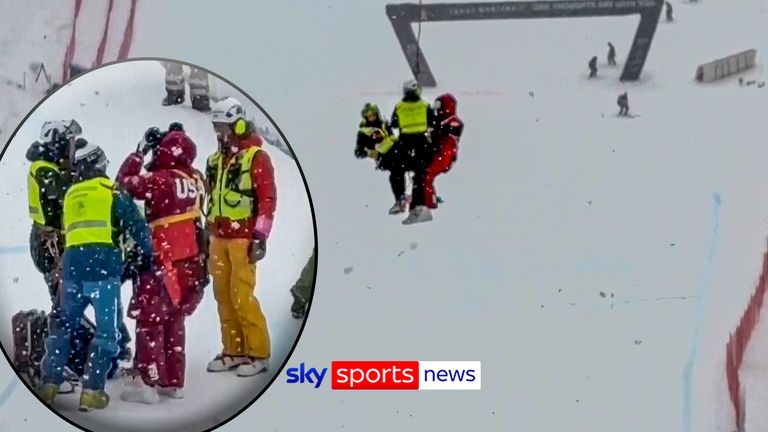
The emotional toll rippled through the alpine community. Vonn’s sister Karin, speaking to NBC amid the chaos, captured the family’s raw anguish. “That was definitely the last thing we wanted to see. It happened quick… She just dared greatly. She put it all out there. It’s really hard to see but we hope she is okay.” With tears in her eyes, she added, “I know she put her whole heart into it and sometimes things just happen. It’s a very dangerous sport.” The family, including Vonn’s four younger siblings, had traveled to Italy to support her, turning what should have been a celebratory reunion into a vigil. They planned to rush to the hospital, uncertain of what awaited. Karin admitted she had no idea about next steps but emphasized Vonn’s boldness: “She dared greatly,” a nod to Theodore Roosevelt’s famous quote about striving valiantly, even in defeat.
Teammates and rivals alike rallied with messages of support. Mikaela Shiffrin, the prodigy who inherited Vonn’s mantle as America’s skiing sweetheart, took to X (formerly Twitter) with a simple yet poignant post: “💔🙏🙏🙏 @lindseyvonn.” The broken heart and prayer emojis spoke volumes, reflecting the tight-knit bond in the U.S. team. Shiffrin, who had her own share of injuries, understood the mental and physical grind. Anouk Patty, chief of sport for U.S. Ski & Snowboard, offered a grounded perspective: “She’ll be OK, but it’s going to be a bit of a process. This sport’s brutal and people need to remember when they’re watching (that) these athletes are throwing themselves down a mountain and going really, really fast.” Her words highlighted the often-overlooked risks of alpine skiing, where crashes can end careers—or worse.
Even the race’s eventual winner, Breezy Johnson, paused her gold-medal elation to empathize with Vonn. Johnson, the defending world champion and a fellow American who had paced the field in Saturday’s training, clocked a winning time of 1:36.10 as the sixth racer down. “I don’t claim to know what she’s going through, but I do know what it is to be here, to be fighting for the Olympics, and to have this course burn you and to watch those dreams die,” she said post-race. “I can’t imagine the pain that she’s going through and it’s not the physical pain—we can deal with physical pain—but the emotional pain is something else.” Johnson’s victory marked the first U.S. gold of the 2026 Games, a bittersweet milestone overshadowed by Vonn’s fall.
The podium rounded out with Germany’s Emma Aicher taking silver in 1:36.14 and Italy’s Sofia Goggia earning bronze in 1:36.69, delighting the home crowd. American Jackie Wiles finished a heartbreaking fourth at 1:36.96, just missing the medals. The race resumed with heightened tension, each subsequent run a reminder of the sport’s unforgiving nature. Broadcasts replayed Vonn’s crash in slow motion, analysts dissecting the mechanics: the gate clip, the loss of balance, the failed recovery. Snoop Dogg, serving as an NBC correspondent for the Games, reacted live with wide-eyed shock, his commentary adding a pop-culture flair to the somber moment.
Vonn’s crash isn’t isolated; it’s emblematic of downhill skiing’s dangers. The discipline demands speeds rivaling highway traffic on icy, uneven terrain, with no margin for error. Historical parallels abound: Vonn’s own 2013 World Championships wipeout that tore ligaments, or the tragic 1964 death of Australian Ross Milne in Innsbruck. Modern safety measures—netting, helmets, course grooming—mitigate risks, but the thrill that draws athletes like Vonn also invites peril. At 41, her age amplified concerns; critics questioned if her body could withstand the demands, especially post-knee surgery and the fresh ACL tear. Yet Vonn had addressed doubters head-on: “Age is just a number. I’m stronger now than ever.”
As medical evaluations continued into the evening of February 8, details on her injuries remained sparse. The brain and spinal risks from such impacts loomed large, but initial reports suggested no life-threatening issues. Vonn, ever the fighter, would likely channel this setback into inspiration—perhaps for younger skiers or her foundation supporting girls in sports. Her legacy endures: 82 World Cup wins, three Olympic medals, and a trailblazing role for women in skiing. From Vancouver gold to Pyeongchang bronze, she redefined excellence.
In the shadow of the Dolomites, Vonn’s crash serves as a poignant chapter in her epic saga. It’s not the end, but a testament to daring greatly. As Karin said, “Sometimes things just happen.” For Vonn, the queen who refused to fade, the mountain may have won this battle, but her spirit soars eternal.