The Woman Who Hated Me Became the Only One Who Could Heal Me
The world shrinks when you are forced to look at it exclusively from thirty-eight inches off the floor.
At that height, you don’t see people’s faces anymore; you see knees, belt buckles, and the hurried scuffle of shoes walking away. You learn very quickly who intends to stay and who is simply passing through the corridor of your misfortune.
Two years ago, a catastrophic collision on a winding coastal road outside Halifax took the use of my legs, shattered my spine, and instantly vaporized my old life. The multi-million-dollar tech firm I built from a dorm room didn’t care about my paralysis when it came to quarterly losses—the board eased me out within six months, wrapping my buyout in polite corporate condolences. My fiancée, a woman who had spent five years whispering promises of forever, packed her designer bags three weeks after I came home from the hospital, mutters of “this isn’t the life I signed up for” trailing behind her like cheap perfume.
Even my brother stopped returning my calls after the third month, too uncomfortable to look at the stainless-steel wheelchair sitting in the center of my sunlit living room.
So, I built a fortress of bitterness. I fired physical therapists for looking at me with pity. I cursed out home-care aides until they refused to come back. I wanted them to leave. If rejection was going to be the constant rhythm of my existence, I preferred to author it myself rather than wait for the inevitable abandonment.
“They won’t last a week,” I told Dr. Vance during one of our monthly check-ins, staring out the floor-to-ceiling windows of my penthouse overlooking the harbor. “Just send the agency checks directly. I don’t need a babysitter.”
“You need care, Ryan,” Dr. Vance had sighed, adjusting his glasses. “And the agency is sending someone new tomorrow morning. Her name is Lily. Don’t throw a paperweight at her.”
I didn’t throw a paperweight. But I had something far colder prepared.
The doorbell rang at precisely 8:00 AM.
I wheeled myself to the foyer, my arms aching from the chronic strain, and jerked the heavy oak door open. Standing on the porch was a young woman wearing a simple dark blue scrub top, a canvas backpack slung over one shoulder, and her blonde hair pulled back into a messy, utilitarian bun. She didn’t look like a seasoned medical professional; she looked like a college student who had lost her way to a lecture hall.
Her hazel eyes swept over me—not with horror, not with clinical detachment, but with a quiet, observant curiosity.
“You must be Ryan,” she said, her voice bright and entirely unbothered by the heavy, suffocating silence of the apartment. “I’m Lily. The agency sent me. Apparently, you have a reputation for being difficult.”
“The agency understated it,” I snapped, turning my wheelchair sharply around so my back was to her. “The paperwork is on the kitchen island. Sign it, take your hourly rate, and leave me alone until five o’clock. There’s coffee in the pot if you know how to operate a machine older than you are.”
I expected her to bristle. I expected her to sigh, mutter an insult under her breath, and retreat down the hallway.
Instead, I heard the crisp, steady click of her sneakers following me across the hardwood floor.
“I don’t drink coffee before noon,” Lily said casually, pulling out a chair at the kitchen island and sitting down. “And I don’t sign contracts without reading them. Besides, my shift isn’t about keeping out of your way, Mr. Carter. It’s about making sure you don’t starve to death while feeling sorry for yourself.”
My hands tightened on the rubber rims of my wheels so hard my knuckles turned white. I whipped the chair around to face her, my eyes blazing. “Listen to me, Nurse,” I snarled, leaning forward. “I didn’t ask for you to be here. My life is a graveyard of people who thought they could fix me or save me. So save your inspirational speeches for someone who’s buying them, pack your bag, and get out of my house.”
Lily didn’t flinch. She didn’t lower her gaze. She simply reached into her backpack, pulled out an apple, and took a slow, deliberate bite.
“Are you finished?” she asked mildly when she swallowed.
I stared at her, stunned into silence by her utter lack of self-preservation.
“Because,” she continued, standing up and tossing the apple core into the bin, “your physical therapy schedule says we’re supposed to start leg-stretching exercises at 8:15. And whether you want to cooperate or throw another tantrum, I get paid by the hour. So we can either do this the hard way, or the slightly less miserable way. Your call.”
That was day one.
Over the next four months, Lily Parker systematically dismantled every single wall I had spent years erecting.
She didn’t pity me, which was the first foreign concept I had encountered since the accident. When my legs spasmed violently during stretching, causing me to curse and slam my fists against the floor in helpless frustration, she didn’t offer empty platitudes about how “everything happens for a reason.” She simply handed me a towel, sat on the floor beside me, and waited until the storm passed.
Slowly, imperceptibly, the fortress began to crumble.
We started talking. Not about my medical history, but about ordinary things—books, the terrible local weather, her obsession with old jazz records, and the quiet dreams she had of opening a community health clinic in the North End. I found myself looking forward to 8:00 AM. I found myself cleaning up the living room before she arrived, ashamed of letting her see the mess I lived in.
One evening in late spring, as the sun dipped below the Halifax harbor and painted the sky in brilliant shades of amber and violet, we were sitting on the balcony. I had managed—with her stubborn encouragement—to transfer from my wheelchair into an outdoor lounge chair.
“You know,” Lily said softly, looking out over the water, “you’re a coward, Ryan.”
I frowned, turning my head to look at her. “Excuse me?”
“You hide behind that wheelchair,” she said, her hazel eyes meeting mine with unflinching honesty. “You use your accident as a shield so you never have to risk being vulnerable with anyone ever again. You push people away not because you’re broken, but because you’re terrified that if someone actually loves you, you might lose them.”
The words struck me like a physical blow, exposing a truth I had buried so deep I almost forgot it was there. My chest tightened, a hot rush of emotion stinging behind my eyes.
“What do you know about losing people, Lily?” I whispered, my voice cracking. “You go home to a family, an apartment, a future. My entire life was ripped away in a single second. I’m half a man.”
Lily stood up from her chair, walked over, and knelt down right beside my wheels, her small hands resting gently over my clenched fists.
“You’re wrong,” she whispered fiercely. “You are completely, beautifully whole, Ryan. You just forgot how to breathe.”
Before I could answer—before I could process the sudden, overwhelming swell of feelings threatening to tear my chest wide open—she leaned forward and kissed me.
It wasn’t a pity kiss. It was warm, hesitant, and filled with a profound, terrifying hope. For the first time in two years, the cold armor around my heart shattered completely, and I kissed her back.
The drama, as it always does in life, arrived uninvited just when things finally felt stable.
It happened three weeks after that evening on the balcony. Lily had been acting strangely for days—distracted, answering hushed phone calls in the hallway, her usual bright energy clouded by a quiet, nervous tension.
I convinced myself the worst was happening. She’s leaving, a dark voice whispered in the back of my mind. Just like the others. She realized how much baggage comes with a broken body, and she’s running away.
On a rainy Tuesday afternoon, while Lily was out picking up prescriptions, a heavy, unmarked manila envelope was delivered to my door.
I wheeled myself into the hallway, picked it up, and tore it open. Inside were hospital intake records, psychological evaluations, and a series of psychiatric discharge summaries bearing a name I hadn’t thought about in years.
My breath caught in my throat. My vision blurred as I read the dates and the names.
The patient in the reports wasn’t a random client. It was Lily’s younger brother, who had suffered a devastating traumatic brain injury three years ago in a construction accident—an accident where my commercial development firm had been the primary contractor, and where a safety violation had caused the scaffolding collapse.
My company’s negligence had destroyed her family.
And Lily hadn’t been sent by an agency at random. She had applied for this job deliberately, carrying a multi-year grudge against the arrogant tech billionaire whose corporate negligence had ruined her brother’s life.
The room began to spin. Every kind word, every touch, every laugh, every tender moment on the balcony—was it all a calculated act of revenge? Had she spent four months playing the devoted nurse just to pull the rug out from under me when I was finally learning how to trust again?
When the front door clicked open and Lily walked into the foyer, shaking the rain from her umbrella, I was waiting in the living room, holding the open file in my hands.
“Ryan?” she asked, freezing in the doorway as she saw my face. The color drained completely from her cheeks.
“Is this true?” I asked, my voice shaking with a cold, devastating fury, holding up the medical reports. “You didn’t come from an agency. You didn’t just happen to show up here. You knew who I was the entire time.”
Lily closed her eyes, a shuddering breath escaping her lips. She didn’t deny it. She slowly walked over and set her bag on the floor, her shoulders slumping under an invisible weight.
“At first… yes,” she whispered, her voice trembling. “When my brother lost his cognitive function, when my family fell apart trying to pay his medical bills while your company settled out of court for a fraction of what you were worth… I hated you, Ryan. I hated you with every fiber of my being.”
“And the nursing license?” I spat out, the betrayal burning hot in my veins. “Was that a lie too?”
“No!” Lily stepped forward, tears finally spilling over her lashes. “I am a registered nurse. I worked in the trauma unit for three years. When I saw your name on the private care registry, I pulled strings to get assigned to your case. I wanted to see the monster who destroyed my family from behind a mahogany desk.”
She paused, taking a ragged breath, looking down at the floor before raising her hazel eyes to meet mine.
“I wanted to make you miserable, Ryan. I wanted to watch you break the way my brother broke.”
“Well, congratulations,” I laughed bitterly, a harsh, jagged sound. “Mission accomplished. Now pack your things and get out of my house.”
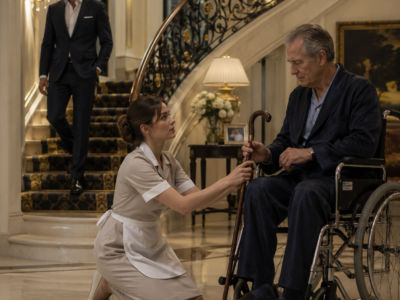
Lily didn’t move. Instead, she took two steps closer, dropping to her knees right in front of my wheelchair, ignoring the cold hardwood floor.
“If I wanted revenge, I would have walked out months ago,” she choked out, her voice breaking. “Yes, I came here with anger. But I stayed because I saw a man who was dying inside a cage of his own making. I stayed because underneath all the bitterness and the anger, I fell in love with you, Ryan. Every single moment we spent together… that was real.”
I stared down at her, my chest heaving, torn between the instinct to protect myself from further destruction and the agonizing pull of a love I couldn’t deny.
“How am I supposed to trust you?” I whispered, a single tear finally escaping down my cheek. “How do I know you won’t walk away tomorrow?”
Lily reached out, placing her warm hands gently on my knees, looking up at me with absolute, unyielding devotion.
“Because I’m not leaving,” she said softly. “Unless you physically push me out that door. I choose you, Ryan. Not your money, not your past, not your wheelchair. Just you.”
The silence in the penthouse was profound, broken only by the steady rhythm of the rain lashing against the glass balcony outside.
I looked down at her hands resting on my legs. For two years, I had believed my life was over—that my broken body meant a broken destiny, destined to be abandoned in an empty room. But as I reached out, placing my hands over hers, pulling her up closer to me, I realized that sometimes the people who change our lives are the ones who refuse to let us stay in the dark.
I didn’t push her away. Instead, I leaned down, wrapped my arms around her shoulders, and pulled her into my arms, letting the healing finally begin.