She Thought He Was Just a Librarian — Until He Revealed His Lawyer Past
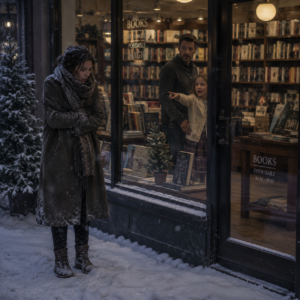
The radiator in the back corner of the Oak Creek Public Library made a rhythmic clanking sound that usually drove me to distraction. But this winter, it became the heartbeat of my afternoons.
I am Arthur, the head librarian. My life has always been a quiet arrangement of Dewey Decimal numbers and the smell of old paper. I preferred it that way. People are complicated; books are predictable. Or so I thought, until Lily appeared.
Lily was seven, had eyes the color of winter sky, and a backpack that seemed far too heavy for her small frame. She arrived every day at 3:30 PM, sat at the same desk near the radiator, and stayed until I flipped the “Closed” sign at 6:00 PM. She didn’t read much. She mostly just stared at the books, her chin resting on her palm, shivering every time the front door opened and a gust of snowy air drifted in.
For three weeks, I didn’t intervene. It wasn’t that I was heartless; I was just… careful. But on a Tuesday, when the temperature plummeted to ten degrees below zero, she didn’t just stay in her coat—she curled into a ball on the chair, her teeth audibly chattering.
I walked over, carrying a cup of hot cocoa and a spare cardigan I kept in my office.
“The library is closing in ten minutes, Lily,” I said softly.
She looked up, her face pale. “I know. I’m waiting for the bus.”
“It’s too cold to wait outside,” I said, sliding the cocoa toward her. She took it with trembling hands. That was when she whispered the words that would dismantle my perfectly ordered life: “Can my mom come get warm too? She’s waiting at the bus stop, and she’s very cold.”
My heart didn’t just break; it shattered. I walked to the door and looked out into the biting wind. A woman was standing by the bus stop post, dressed in a thin, worn-out coat, holding a bag of groceries. She looked like she was trying to disappear into the falling snow.
I opened the door and waved. “Ma’am! Please, come in. It’s far too cold out there.”
The woman was Elena. She moved with a strange, defensive grace, as if she were constantly preparing for a blow. She was hesitant, clutching her bag to her chest, but Lily’s face lit up. That night, I didn’t close the library on time. I kept the heater running, and we sat in the children’s section, sharing sandwiches I’d brought from home.
The drama didn’t come from a villain in a cape, but from the quiet, crushing weight of reality. As the weeks passed, I learned that Elena was a widow fleeing a nightmare. Her mother-in-law, a formidable woman named Mrs. Thorne who owned half the town’s real estate, was convinced Elena was an unfit mother because of her financial struggles. Mrs. Thorne was using her influence to block Elena’s job applications and had threatened to take legal custody of Lily.
Elena wasn’t just hiding from the cold; she was hiding from a woman who wanted to erase her existence.
The twist came in the form of a late-night incident. One evening, Mrs. Thorne walked into the library, flanked by an attorney. She was there to serve Elena with papers, claiming the library was an “unsuitable environment” for a child. She stood in the center of my sanctuary, looking at me with cold, aristocratic disdain.
“Mr. Penhaligon,” she said, her voice dripping with venom. “I assume you are unaware that you are harboring a woman who is currently under investigation for neglect.”
My hands shook, not with fear, but with an unfamiliar, hot rage. I looked at Elena, who was paralyzed with terror, and then at Lily, who was holding her mother’s hand as if it were a life raft.
I stepped out from behind my desk—the desk I had hidden behind for years. “Mrs. Thorne,” I began, my voice steady, “this library is a place of public record. I have spent the last month documenting the weather conditions and the safety of this child. I have also spent my evenings helping Elena prepare her portfolio for the local school board’s open position—a position you tried to block her from.”
I reached into my drawer and pulled out a stack of documents. “I’m not just a librarian. Before this, I was a civil rights attorney. I left that life because I lost my taste for fighting. But I’ve rediscovered it.”
Mrs. Thorne’s composure faltered. She hadn’t expected the quiet, bookish man to be a retired lawyer with a spine of steel. She wasn’t just attacking a mother; she was attacking a man who knew exactly how to make her life a legal nightmare.
“You’re making a mistake,” she hissed.
“No,” I replied, pointing to the door. “The mistake was assuming that because we are quiet, we have no voice. Please leave.”
The aftermath was a whirlwind of legal battles, but the truth, once brought into the light, is difficult to bury. Elena got the job, not just because I helped, but because she was brilliant. She moved into a small apartment just blocks from the library.
I stopped being the man who hid behind Dewey Decimals. My life became filled with the chaotic, beautiful sounds of a found family. There were weekend hikes, library story hours where Lily would help me organize the shelves, and dinners where the cocoa was always hot and the radiator finally stopped clanking.
One spring afternoon, as the snow melted and the first green buds appeared on the trees outside the library windows, Elena came in. She didn’t have a backpack or a bag of groceries. She just walked over to my desk, took my hand, and smiled—a real, genuine smile that had nothing to do with survival.
“You noticed us,” she said. “You didn’t look away.”
“I was waiting to be found,” I answered.
We hadn’t set out to build a home. We had just set out to find a little warmth. And in doing so, we found that the most important stories aren’t the ones kept on the shelves, but the ones we write together, day by day, in the quiet moments when someone finally decides to stay.