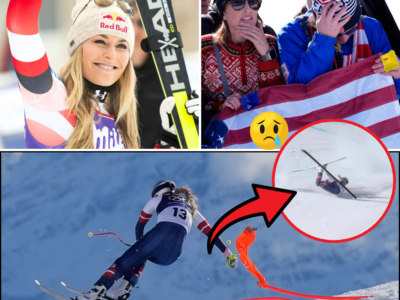
Under a brilliant blue sky in Cortina d’Ampezzo, where the jagged Dolomites pierce the horizon like frozen sentinels, Lindsey Vonn exploded out of the start gate on February 8, 2026. The 41-year-old American skiing legend, bib number 13 pinned to her suit, hurtled down the Olympia delle Tofane course in the women’s downhill at the Milan-Cortina Winter Olympics. This was her moment—a defiant stand against time, injury, and skepticism. Just nine days earlier, she had completely ruptured her left ACL in a training crash, yet here she was, braced knee and all, chasing one last shot at glory. The crowd’s cheers echoed through the valley, but 13 seconds later, everything changed. Vonn clipped a gate with her right arm, lost her edge, and catapulted into a terrifying tumble. Her body slammed into the snow, skis flailing, airbag deploying in a desperate bid for protection. Screams of pain cut through the air as she lay motionless, the race screeching to a halt. In that instant, a fairytale comeback dissolved into heartbreak, leaving the alpine world reeling and her family clinging to hope.
Vonn’s sister, Karin Kildow, captured the raw emotion in an interview with NBC moments after the crash. Watching from the stands alongside their father, Alan Kildow, and other family members who had traveled to Italy for support, Karin described the scene as “scary” and the last thing they wanted to witness. “It happened quick,” she said, her voice steady but laced with anguish. “So when that happens, you’re just immediately hoping she’s okay. It was scary because when you start to see the stretchers being put out, that is not a good sign.” Karin praised her sister’s unyielding spirit, noting how Vonn “dares greatly” and “always goes 110%.” Even in defeat, she emphasized, Lindsey had poured her heart into the race. “I know she put her whole heart into it and sometimes, just, like, things happen,” Karin added. “It’s a very dangerous sport. And there are a lot of variables at play.” The family, including Vonn’s four younger siblings, now faces an anxious wait for updates, with Karin expressing optimism: “We’re just hoping for the best.”
The crash unfolded on one of skiing’s most iconic and unforgiving tracks. The Olympia delle Tofane, a 2,572-meter descent with gradients up to 56% and speeds topping 80 mph, has hosted legends since the 1956 Olympics. On this day, conditions were pristine—clear visibility, firm snow, and light winds—priming the course for record-breaking runs. Vonn, starting mid-pack, attacked the early sections with her trademark aggression. But navigating a right-hand turn over a jump, her right arm (or shoulder, as some reports suggest) snagged the gate. The impact disrupted her balance, sending her airborne in a chaotic spin. She landed awkwardly, tumbling sideways before sliding to a stop on her back, skis crossed in a telltale sign of disaster. Her inflated airbag suit—mandatory safety gear—offered some protection, but the force was immense. Vonn’s immediate cries of pain pierced the broadcast, freezing viewers worldwide.

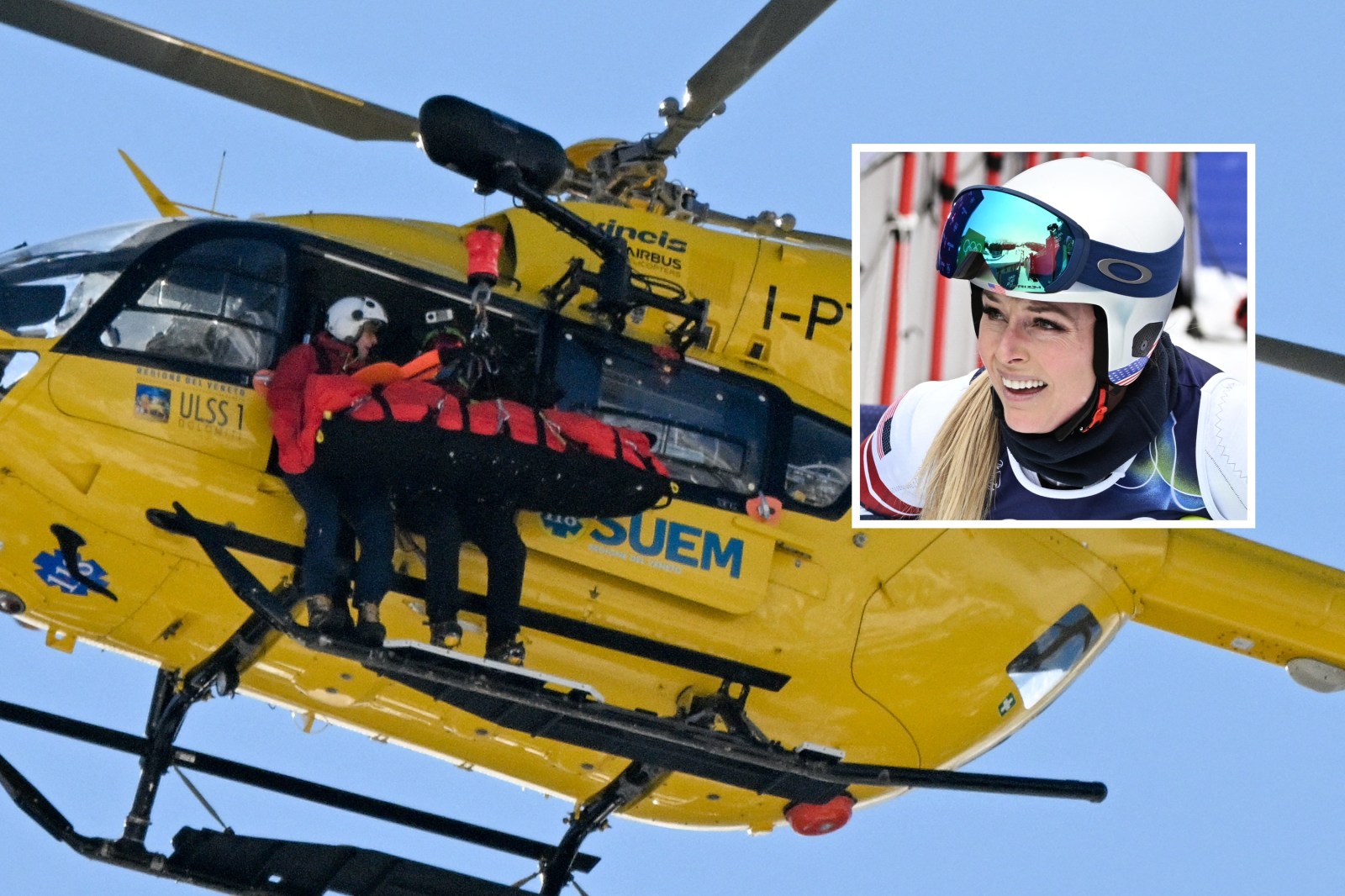
Medical teams swarmed the site within seconds, stabilizing her on the snow as the race paused for over 15 minutes—a tense eternity for spectators and broadcasters. A yellow rescue helicopter descended, its rotors whipping up flurries of snow, and lifted Vonn away in a dramatic evacuation. This marked her second airlift in just over a week; the first came after her ACL rupture during a training session in Switzerland, where she had been preparing intensely for these Games. U.S. Ski & Snowboard provided a brief update: “Lindsey Vonn sustained an injury but is in stable condition and in good hands with a team of American and Italian physicians.” She was transported to a hospital in Innsbruck, Austria, for further evaluation, with her dedicated medical staff on hand. While no life-threatening issues were reported, the potential for concussion, spinal strain, or aggravation of her existing knee damage loomed large.
Karin mentioned that the family expects more details soon, but the uncertainty weighs heavy. “I think she is being evaluated right now is the only thing we’ve heard, hopefully we’ll hear more soon,” she told NBC. The Kildows had turned the Olympics into a family affair, with Karin sharing an upbeat Instagram video earlier that day of her waking up in her hotel room, excited to cheer on Lindsey. “Perfect Day!” she captioned it, a post that now carries bittersweet irony. Alan Kildow, a former junior national champion skier who introduced Lindsey to the sport as a child, has been a constant presence, his pride in her achievements tempered by the sport’s inherent risks.
Teammates and rivals alike poured out support, highlighting the tight-knit alpine community. Mikaela Shiffrin, the 30-year-old phenom who surpassed Vonn’s World Cup win record in 2023, posted a simple yet poignant message on X: a broken heart emoji followed by three praying hands, tagging @lindseyvonn. Shiffrin, no stranger to injuries herself, understands the emotional rollercoaster. Anouk Patty, chief of sport for U.S. Ski & Snowboard, offered grounded reassurance: “She’ll be OK, but it’s going to be a bit of a process. This sport’s brutal and people need to remember when they’re watching these athletes are throwing themselves down a mountain and going really, really fast.” Breezy Johnson, Vonn’s teammate who went on to claim gold in the downhill with a time of 1:36.10—securing Team USA’s first medal of the Games—paused her jubilation to empathize. “I don’t claim to know what she’s going through, but I do know what it is to be here, to be fighting for the Olympics, and to have this course burn you and to watch those dreams die,” Johnson said. “I can’t imagine the pain that she’s going through and it’s not the physical pain—we can deal with physical pain—but the emotional pain is something else.”
The race itself became a footnote to the drama. Germany’s Emma Aicher snagged silver in 1:36.14, while Italy’s Sofia Goggia thrilled the home crowd with bronze in 1:36.69. American Jackie Wiles finished a heartbreaking fourth at 1:36.96, just off the podium. But the focus remained on Vonn, whose crash was the first of three in the event, underscoring the Tofane’s treacherous reputation. NBC commentators replayed the footage in slow motion, dissecting the mechanics: the gate clip, the loss of control, the hard impact. Snoop Dogg, serving as a colorful correspondent for the network, reacted with wide-eyed shock, his commentary blending awe and concern.
Vonn’s path to this moment was a saga of triumph and tribulation. Born Lindsey Caroline Kildow on October 18, 1984, in Saint Paul, Minnesota, she was destined for the slopes. Her father, Alan, spotted her talent early, enrolling her in ski programs where she quickly excelled. At 15, she became the first American female to win Italy’s Trofeo Topolino, a youth competition that launched many careers. Her World Cup debut came at 16, and by 2004, she was earning her first podiums. The 2010 Vancouver Olympics cemented her stardom: gold in downhill (America’s first since Picabo Street in 1994) and bronze in super-G. She dominated the circuit, amassing 82 World Cup victories—a women’s record until Shiffrin eclipsed it—along with four overall titles and eight downhill globes.
But glory came with grueling costs. Vonn’s body bore the scars: a torn ACL and MCL in 2013 that forced her to miss Sochi, another ACL tear in 2015, a fractured humerus in 2016 that required plates and screws, and chronic knee pain leading to partial replacements. She retired in 2019 after a final downhill win in Åre, Sweden, citing her body’s limits. “I’ve given everything I have,” she said then. Yet the fire lingered. In 2023, innovative knee surgery with an artificial joint restored her mobility. By 2024, she announced a comeback, stunning the sports world. She rejoined the circuit, leading the downhill standings pre-Olympics, proving age was no barrier.
The ACL rupture last week added epic drama. During a training run, she crashed and was airlifted, diagnosing a full tear plus bone bruise and meniscus damage. Doctors advised against racing, but Vonn refused. “This would be the best comeback I’ve done so far,” she told reporters. “Definitely the most dramatic.” Hours before the race, she posted an emotional Instagram message: “I will race tomorrow in my final Olympic Downhill and while I can’t guarantee a good result, I can guarantee I will give it everything I have. But no matter what happens, I have already won.” It was vintage Vonn—resilient, philosophical, unbreakable.
At 41, she aimed to be the oldest downhill medalist ever. Cortina held special meaning; dubbed the “queen of Cortina” for her multiple victories there, the venue suited her style. Yet the sport’s dangers—high speeds on icy terrain, no room for error—caught up. Historical crashes echo: her 2013 World Championships wipeout, or fatal incidents like Ulrike Maier in 1994. Modern safety—helmets, netting, airbags—helps, but adrenaline-fueled risks remain.
Fans worldwide reacted with an outpouring of love. Social media buzzed with tributes: “Lindsey, you’re a warrior—get well soon!” and “Heartbroken but inspired.” Debates raged: Was racing on a ruptured ACL heroic or reckless? Vonn’s advocacy—her foundation empowering girls in sports, mental health talks, pushing women’s equality in skiing—amplified the impact.
As Vonn recovers in Innsbruck, the alpine community reflects. Her legacy—redefining excellence, breaking barriers—endures. Johnson’s gold offers solace for Team USA, but Vonn’s story steals the show. Karin’s words ring true: she dared greatly. The Dolomites claimed a chapter, but legends like Vonn rise again. Whether this ends her career or sparks another miracle, her spirit soars eternal.